

shift work system
2조 격일제 교대 근무제
| 1. Concept and Application Method
1) Concept The two-team alternate-day shift work system is a working arrangement in which two teams take turns covering a full day (24 hours). It is generally operated in a repeating pattern of “1 day on duty (24 hours) → 1 day off (24 hours).” While one team is working, the other team is off duty, and it is mainly used in workplaces that require continuous 24-hour operation. This system is characterized by long on-site working hours combined with sufficient rest days provided alternately. However, when calculating working hours and wages, the basis is not the total on-site time but the actual working hours excluding break time. 2) Application Method and Structure (1) Necessity and Applicable Industries The alternate-day shift system is used in the following cases: ① Workplaces requiring continuous 24-hour operation ② Cases where workforce is limited and efficient allocation is needed ③ Cases where facility management and monitoring duties are continuously required 👉 Representative Application Fields Facility management, security, and guarding Hospitals and operation of public facilities Equipment maintenance and inspection work (2) Basic Operating Method Team A: Work → Off the next day Team B: Off → Work the next day 👉 In other words, a structure where working days and days off repeat in a 1:1 ratio 3) Operational Characteristics and Practical Considerations (1) Long Working Hour Structure ① A single shift often lasts 12 to 24 hours ② A structure in which overtime and night work occur simultaneously (2) Break Time and Working Hour Management ① It is essential to secure sufficient break time and rest facilities ② Substantive (not merely formal) break time must be guaranteed 👉 If break time is deemed actual working time: → Additional wage payment + risk of violation of working hour regulations (3) Legal Compliance with Working Hours ① Work schedules must be designed considering the 52-hour weekly limit ② Due to long working hours, flexible or selective working hour systems may be considered (4) Health and Safety Management ① Long working hours + repeated night work → Risk of sleep deprivation, accumulated fatigue, and health deterioration ② It is necessary to implement industrial safety and health management systems in parallel 2. Advantages and Disadvantages 1) Advantages ① Enables 24-hour facility operation Continuous operation improves efficiency in facility management and is suitable for tasks requiring constant oversight ② Ensures consecutive rest periods The alternate-day system provides a full day off after work, allowing sufficient rest ③ Simplicity in workforce management Operating with two teams makes scheduling and workforce management relatively simple ④ Reduced commuting burden Fewer commutes reduce transportation costs and allow better use of personal time 2) Disadvantages ① Accumulation of fatigue due to long working hours → risk of industrial accidents ② Disruption of circadian rhythm and potential health issues ③ Difficulty maintaining work-life balance (family and social life) ④ High likelihood of structurally exceeding the 52-hour weekly limit, creating legal risks without proper system design 3. Detailed Implementation Types 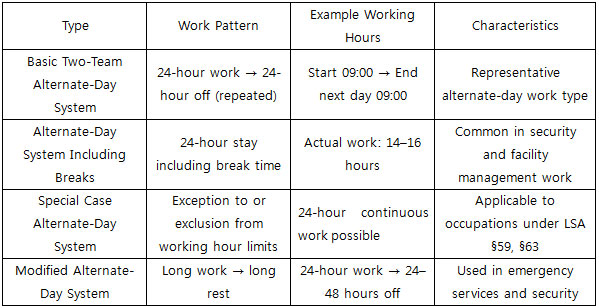 Basic 2-Team Alternate-Day Work Schedule 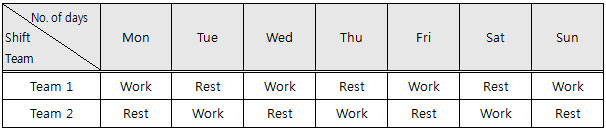 ※ Work: e.g., 07:00 to 07:00 the next day Operating companies: Homeswell, Camstic, Kukdo Safety Management, Shinsung TM, Human Housing, etc. Alternate-Day Work + Duty (On-Call) Hybrid 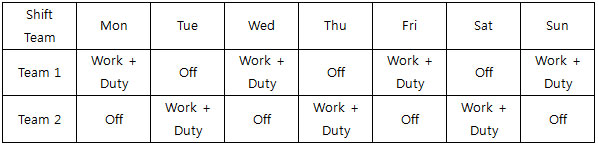 ※ Work: e.g., 07:00–22:00 (entire team) + 22:00–07:00 next day (duty/on-call) Operating companies: S-1, ADT Caps, KT Estate Facility Management, Hanwha Hotels & Resorts FM Division, large warehouse security firms, some positions in Coupang logistics centers, some CJ Logistics centers, etc. 4. Calculation of Prescribed Working Hours and Ordinary Wage 1) Calculation of Prescribed Working Hours (1) Total Annual Working Hours of the Workplace In a two-team alternate-day system: Only one team works per day, and the other team is off. Therefore: H hours × 1 team × 365 days = 365H hours Here, H refers to actual daily working hours. For example, if actual daily working hours are 16 hours: 16 × 365 = 5,840 hours → Total annual working hours of the workplace = 5,840 hours (2) Annual Working Hours per Team Since two teams alternate the total workload: 365H ÷ 2 = 182.5H hours For example: 5,840 ÷ 2 = 2,920 hours → Annual working hours per team = 2,920 hours (3) Monthly Average Prescribed Working Hours Converted into monthly basis: 182.5H ÷ 12 = 15.2083H hours For example: 2,920 ÷ 12 ≈ 243.33 hours → Monthly average prescribed working hours ≈ 243.33 hours 2) Monthly Paid Hours (Ordinary Wage Basis Time) When calculating ordinary wage, monthly paid hours include both prescribed working hours and weekly paid leave hours. Monthly paid hours = monthly prescribed working hours + monthly weekly paid leave hours (1) Monthly Prescribed Working Hours ≈ 243.33 hours (2) Monthly Weekly Paid Leave Hours Weekly paid leave ratio: 8 ÷ 40 = 0.2 Therefore: 243.33 × 0.2 = 48.67 hours → Monthly weekly paid leave hours ≈ 48.67 hours (3) Monthly Ordinary Wage Basis Time 243.33 + 48.67 ≈ 292 hours → Monthly ordinary wage calculation base time ≈ 292 hours 3) Example of Wage Calculation Assuming an hourly wage of KRW 10,000: 292 × 10,000 = 2,920,000 → Monthly base salary ≈ KRW 2,920,000 However, actual wages may additionally include: • Night work allowance • Overtime allowance • Holiday work allowance Thus, total wages are calculated by adding statutory allowances to the base salary. 4) Practical Considerations Since the two-team alternate-day system involves long daily working hours, the following must be reviewed in practice: • Compliance with the 52-hour weekly limit • Handling of overtime, night, and holiday work allowances • Proper provision of break time • Securing continuous rest periods • Consistency between actual operations and employment contracts / rules of employment In other words, the above calculation explains a general framework, and in actual wage design, shift schedules, break design, and allowance structures must be reviewed together. 5. Others Criteria for Using Annual Paid Leave for Alternate-Day Shift Workers [Ministry of Employment and Labor, Wage and Working Hours Division-2728, Nov. 30, 2020] [Inquiry] Criteria for using annual paid leave for alternate-day shift workers [Reply] Shift work refers to a working arrangement in which employees alternately work at certain time intervals in jobs requiring continuous long-hour operations. Types of shift systems vary depending on job characteristics, such as: • Two-team alternate-day system (2 teams, 1 shift), where each team works every other day • Three-team, three-shift system, where three teams work 8 hours each per day • Four-team, two-shift system, where two teams work 12 hours while the other two rest Under Article 60 of the Labor Standards Act, an employer must grant 15 days of paid leave to employees who have attended work for at least 80% of one year, and for employees with less than one year of service or less than 80% attendance, one day of paid leave per month of full attendance must be granted. In principle, shift workers also use annual leave on a daily basis. Although a definitive answer is difficult based solely on the inquiry, the mere fact that shift work is structured as an alternate-day system does not exclude the application of this principle. Even if both a working day and the following day (off-duty day) are taken together as leave, it should generally be regarded as the use of one day of leave. However, in cases where two teams alternate 24-hour continuous work over two calendar days, and the following day off is granted on the premise of the previous day’s work, such work may effectively be regarded as two consecutive days of work. Therefore, if both the working day and the following day are taken off using annual leave, it may be considered as the use of two days of leave (see references: Wage and Working Hours Division-2708, Nov. 23, 2020; Labor Standards Policy Division-561, Jan. 23, 2018; Geungi 68207-313, Feb. 5, 1999, etc.). Whether Re-approval Is Required When Shift Type Changes After Approval for Surveillance/Intermittent Work [Geungi 68207-2505, Aug. 6, 2001] [Inquiry] If a workplace changes from a three-team, two-shift system (12-hour day, 12-hour night, off) to a two-team, two-shift system (12-hour day, 12-hour night), does the prior approval for surveillance/intermittent work under Article 61 [now Article 63] of the Labor Standards Act remain valid, or must a new approval be obtained due to the change in work type? Also, can a two-team, two-shift system of 12 hours work followed by 12 hours rest be approved as surveillance/intermittent work? [Reply] Under Article 61 [now Article 63] of the Labor Standards Act, employees engaged in surveillance or intermittent work who have obtained approval from the Minister of Employment and Labor are exempt from provisions regarding working hours, breaks, and holidays. The Enforcement Rules define: • Surveillance work as work primarily involving monitoring duties with relatively low mental and physical fatigue • Intermittent work as work that is performed intermittently, with substantial break or standby time There is no provision in the Labor Standards Act that prohibits a specific type of shift system for such work. Therefore, even a two-team, two-shift system with 12-hour daily work may be approved if it meets the requirements for surveillance/intermittent work. Furthermore, if approval has already been granted by satisfying such requirements, a change in the shift system does not require re-approval, as long as the new system remains within the scope of those requirements. Method of Calculating Shutdown Allowance When a Public Holiday Overlaps with a Prescribed Working Day [Labor Standards Policy Division-2858, Sept. 14, 2022] [Inquiry] How should shutdown allowance be calculated when a public holiday overlaps with a prescribed working day of a shift worker? [Reply] If an employee is unable to work due to reasons attributable to the employer, the employer must pay at least 70% of the employee’s average wage during the shutdown period (or ordinary wage if it exceeds 70% of average wage), pursuant to Article 46(1) of the Labor Standards Act. Even if paid holidays are included within the shutdown period, or if all prescribed working days in a week are shut down such that no paid weekly holiday arises, it is appropriate to include paid holiday wages when calculating shutdown allowance (see similar administrative interpretations: Labor Improvement Policy Division-5243, Oct. 25, 2012; Wage and Working Hours Policy Team-429, Jan. 30, 2007). Therefore, when a public holiday overlaps with a prescribed working day, shutdown allowance should be calculated including paid holiday wages. Method of Calculating the Number of Regularly Employed Workers for Workers on Leave or Vacation [Labor Standards Policy Division-4370, Dec. 21, 2021] [Inquiry] When calculating the number of regular employees, should employees on leave, employees on long-service leave, employees on public holidays under a five-day workweek, and shift workers on off-duty days be included in the headcount? [Reply] Article 7-2 of the Enforcement Decree of the Labor Standards Act provides that the number of regularly employed workers is calculated by dividing the total number of employees used during one month prior to the occurrence of a legal issue by the number of operating days in that period. Here, “total number of employees used” includes all employees maintaining an employment relationship (regular, fixed-term, part-time, etc.), not only those obligated to attend work on a given day. Accordingly: • Employees on leave, vacation, long-service leave, or weekly paid leave • Shift workers who are on off-duty days but are considered regular employees should all be included in the total headcount for each operating day when calculating the number of regular employees. However, since the method of calculating employee numbers may differ depending on the purpose of each law, calculations for laws other than the Labor Standards Act should follow the respective provisions of those laws. |

