

Discrimination Remedy (Corrective Relief) Labor Consulting & Legal Representation
Consultation Request
Preliminary diagnosis of discrimination against non-regular employees and workplace gender discrimination, support for Labor Relations Commission remedy applications, and implementation of corrective orders
The Discrimination Correction and Remedy Service is not a simple complaint-filing service. It is a professional HR and labor-management service in which a certified labor attorney diagnoses whether discrimination has occurred under legal standards, selects comparator employees, calculates unfavorable treatment, reviews whether reasonable grounds exist, supports Labor Relations Commission remedy procedures, and assists with the implementation of corrective orders.
I. What Services We Provide | What Service
Discrimination correction and remedy work involves determining whether discrimination has occurred against non-regular employees or employees who have received unfavorable treatment due to gender, pregnancy, childbirth, childcare leave, or related reasons. Where necessary, it also includes support for Labor Relations Commission remedy applications, employer defense, mediation and settlement, and implementation of corrective orders. KangNam Labor Law Firm builds each case not on a simple “claim of discrimination,” but on evidence and comparative data that satisfy the legal requirements.
1. Main Service Areas
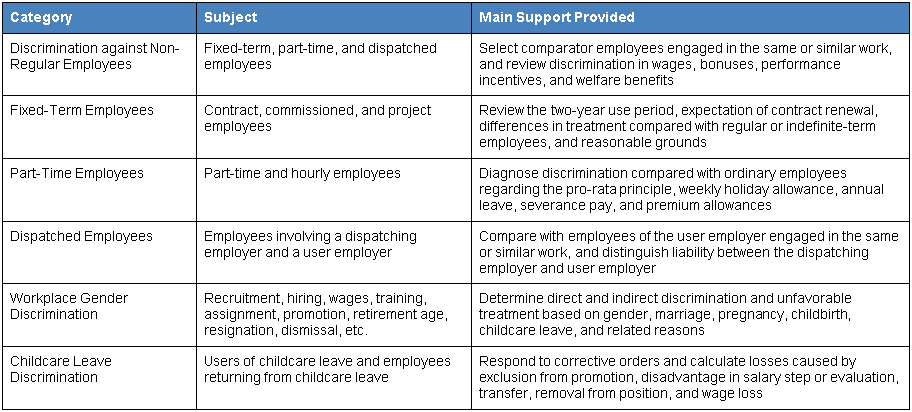
2. Key Requirements for Determining Discrimination
ㆍDiscrimination correction begins by confirming whether the applicant is a protected employee and whether the law applied at the time the discrimination occurred.
ㆍFor discrimination against non-regular employees, it is necessary to select a comparator employee who is engaged in the same or similar work in the relevant business or workplace.
ㆍUnfavorable treatment may occur across a broad range of working conditions, including wages, regular bonuses, holiday bonuses, management performance incentives, leave, and welfare benefits.
ㆍThe employer must explain that there are reasonable grounds for differential treatment. Key factors include the scope of work, responsibility, authority, skill level, length of service, and the pro-rata principle.
ㆍGender discrimination and childcare leave discrimination may arise broadly from recruitment and hiring to promotion, assignment, resignation, and dismissal. Excluding a period of childcare leave from the period of service may also constitute unfavorable treatment.
II. How We Deliver the Service | How to Deliver
Discrimination correction and remedy work requires a precise comparison of facts and wage data. From the beginning of the case, KangNam Labor Law Firm organizes materials according to the structure of “comparator employee - unfavorable treatment - reasonable grounds - amount of loss - remedy method” so that they can be used in Labor Relations Commission procedures or in pre-dispute settlement
1. Common Process
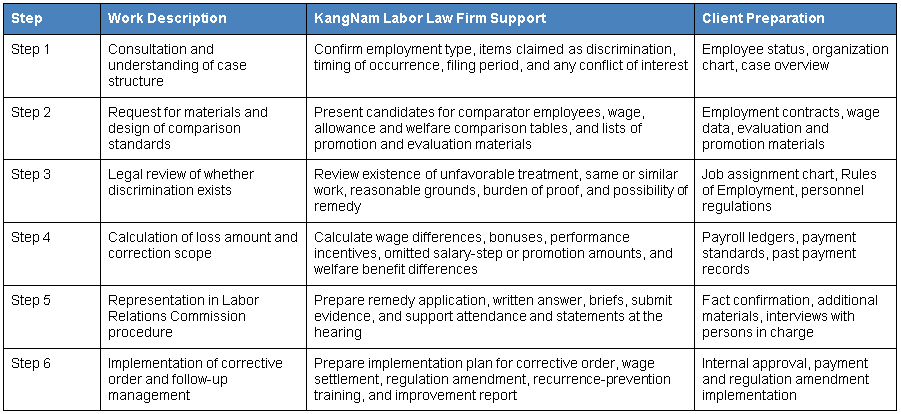
2. Preliminary Materials to Prepare
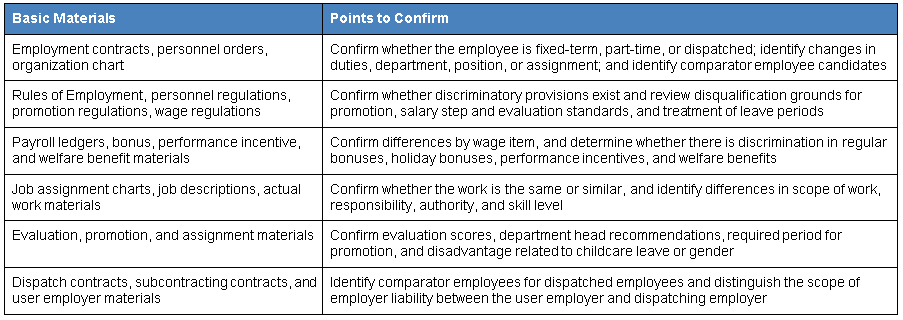
3. Detailed Support by Major Type | Detailed Support
(1) Correction of Discrimination against Non-Regular Employees
ㆍWe compare, item by item, wages, regular bonuses, holiday bonuses, management performance incentives, leave, and welfare benefits applicable to fixed-term, part-time, and dispatched employees.
ㆍWe confirm whether the comparator employee actually performs the same or similar work, and judge similarity based on the work actually performed rather than the job title.
ㆍWe review whether the grounds for differential treatment asserted by the employer are reasonable in light of employment type, scope of work, responsibility and authority, skill level, length of service, and the pro-rata principle.
ㆍIf discriminatory treatment is confirmed, we calculate wage differences and the correction scope, and establish either a Labor Relations Commission remedy application strategy or an employer-side written answer strategy.
(2) Remedy for Workplace Gender Discrimination and Childcare Leave Discrimination
ㆍWe review discrimination in recruitment, hiring, wages, training, assignment, promotion, retirement age, resignation, and dismissal based on gender, marriage, pregnancy, childbirth, childcare leave, and related reasons.
ㆍWe intensively review unfavorable treatment against childcare leave users, including exclusion from promotion, removal from position, unfavorable evaluation, suspension of wage increases, omitted salary steps, and exclusion of the leave period from length of service.
ㆍWhere comparator employees must be selected, we organize objective comparison data based on employees who did not use childcare leave, employees of the same rank or job, and the required period for promotion.
ㆍIf discrimination is recognized, we design practical corrective measures such as retroactive grant of promotion opportunities, payment of wage differences, improvement of regulations, and recurrence-prevention measures.
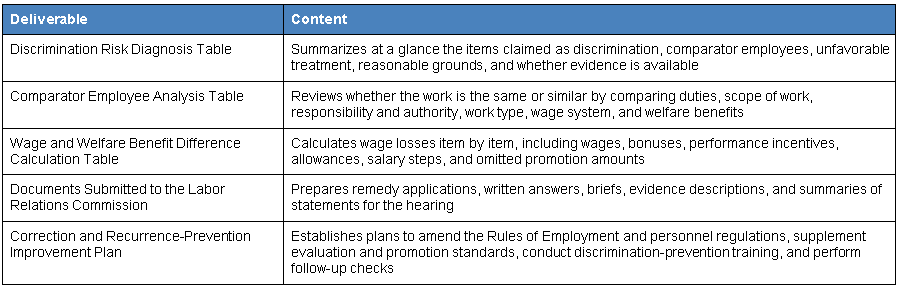
(3) Deliverables by Case Stage
III. Client Benefits | Client Benefits
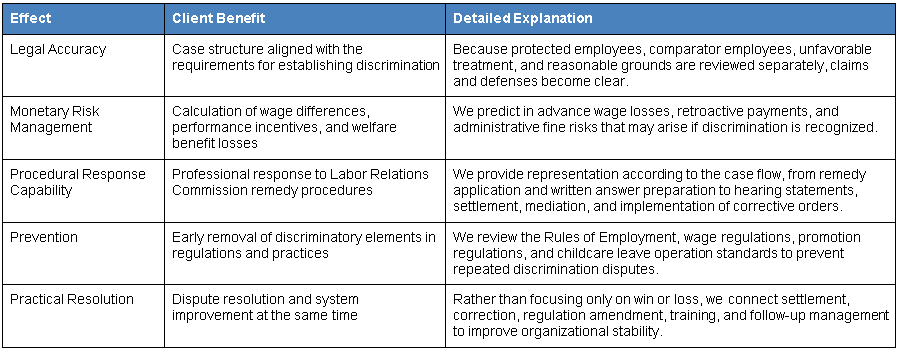
Even when a discrimination case begins as an emotional dispute, it ultimately comes down to comparator employees, wage differences, reasonable grounds, and evidentiary materials. By retaining KangNam Labor Law Firm, the client can organize whether discrimination exists according to legal standards and systematically prepare the arguments and evidence required in Labor Relations Commission procedures.
Why Choose KangNam Labor Law Firm
ㆍWe can accurately understand complex case structures by reviewing non-regular employment, dispatch and subcontracting, employee status, gender discrimination, and childcare leave discrimination together.
ㆍBased on experience in Labor Relations Commission cases, wage-difference calculations, amendments to the Rules of Employment and personnel regulations, and advisory work for foreign-invested companies, we provide materials that can be used in practice.
ㆍWhether the case is for the employer or the employee, we first check for any conflict of interest and then explain realistic prospects of success and resolution strategies based on facts and supporting evidence.
ㆍBecause Korean- and English-based consultation and document preparation are available, we can effectively respond to discrimination cases involving foreign companies, multinational companies, and foreign executives or employees.
ㆍWe do not falsely conclude that there is “no problem.” Instead, we specifically explain risks such as the possibility of discrimination, reasonable grounds, lack of evidence, statute of limitations, and filing periods.
Notes for Consultation
The possibility of discrimination correction or remedy may vary depending on the type of employment, number of regular employees, existence of comparator employees, wage and welfare benefit systems, evaluation and promotion materials, date of discrimination, and filing period. For an accurate diagnosis, the relevant materials and case history must first be reviewed through a preliminary consultation.
This material has been prepared for general information and promotional purposes. Requirements for individual cases must be confirmed through a separate consultation..
FAQ
Q10
What are the employer’s burden of proof and liability in non-regular worker discrimination cases?
A key feature of discrimination correction cases is that the burden of proof lies with the employer. In other words, once the worker specifically alleges discriminatory treatment, the employer must prove that there is a reasonable justification for the difference in treatment. Differences based on objective factors such as job duties, level of responsibility, length of service, qualifications, performance, or working hours may constitute reasonable justification, but it is difficult to justify differences based solely on non-regular employment status.
If discrimination is recognized, the Labor Relations Commission may order cessation of discriminatory treatment, improvement of working conditions such as wages, and appropriate monetary compensation. In addition, an employer must not subject the worker to adverse treatment?such as dismissal, non-renewal of contract, transfer, or disciplinary action?because they filed a discrimination correction claim. Such retaliatory actions may result in separate legal liability.
Where discrimination is recognized, compensation may be ordered based on the damages suffered by the worker due to discriminatory treatment. However, if intentional discrimination or repeated discriminatory conduct is established, compensation may be ordered up to three times the amount of damages. This is provided under Article 13(2) of the Act on Fixed-Term and Part-Time Workers. Similar provisions apply under the Act on the Protection of Dispatched Workers, where punitive damages up to three times may also be imposed under Article 21. In particular, where intentional or repeated discrimination against dispatched workers is recognized, the user company may also bear responsibility.
If discrimination is recognized, the Labor Relations Commission may order cessation of discriminatory treatment, improvement of working conditions such as wages, and appropriate monetary compensation. In addition, an employer must not subject the worker to adverse treatment?such as dismissal, non-renewal of contract, transfer, or disciplinary action?because they filed a discrimination correction claim. Such retaliatory actions may result in separate legal liability.
Where discrimination is recognized, compensation may be ordered based on the damages suffered by the worker due to discriminatory treatment. However, if intentional discrimination or repeated discriminatory conduct is established, compensation may be ordered up to three times the amount of damages. This is provided under Article 13(2) of the Act on Fixed-Term and Part-Time Workers. Similar provisions apply under the Act on the Protection of Dispatched Workers, where punitive damages up to three times may also be imposed under Article 21. In particular, where intentional or repeated discrimination against dispatched workers is recognized, the user company may also bear responsibility.
Q9
How should a company respond to a discrimination correction case?
A company should first examine whether the worker actually received unfavorable treatment, whether the comparator worker is appropriately selected, and whether there is a reasonable justification for any difference in treatment.
The practical response steps are as follows:
Step Matters to be Reviewed by the Company
Step 1 Confirm the applicant’s employment type
Step 2 Review whether a valid comparable worker exists
Step 3 Assess whether duties are the same or similar in substance
Step 4 Identify differences in wages, allowances, and welfare benefits
Step 5 Organize reasonable justification for any differences
Step 6 Submit supporting evidence such as wage rules, job descriptions, and evaluation records
Step 7 Consider settlement or system improvements if necessary
In particular, companies must not rely on abstract explanations such as “regular and non-regular workers are inherently different,” but must prove differences in job content, responsibility, authority, tenure, qualifications, performance, working hours, and wage structure with concrete evidence.
The practical response steps are as follows:
Step Matters to be Reviewed by the Company
Step 1 Confirm the applicant’s employment type
Step 2 Review whether a valid comparable worker exists
Step 3 Assess whether duties are the same or similar in substance
Step 4 Identify differences in wages, allowances, and welfare benefits
Step 5 Organize reasonable justification for any differences
Step 6 Submit supporting evidence such as wage rules, job descriptions, and evaluation records
Step 7 Consider settlement or system improvements if necessary
In particular, companies must not rely on abstract explanations such as “regular and non-regular workers are inherently different,” but must prove differences in job content, responsibility, authority, tenure, qualifications, performance, working hours, and wage structure with concrete evidence.
Q8
What should companies check to prevent discrimination correction claims?
Companies should regularly review whether there are differences in working conditions between non-regular workers and regular workers in areas such as wages, allowances, bonuses, performance pay, welfare benefits, education opportunities, and leave systems. Since unfavorable treatment based solely on employment status may be subject to discrimination correction claims, any differences in treatment should be verified to ensure they are based on objective factors such as job content, level of responsibility, length of service, qualifications, performance, or working hours.
Key review items include the following.First, companies should check whether there are differences in wage components such as base salary, allowances, bonuses, and performance pay between fixed-term/part-time workers and regular employees. They should also review whether allowances and welfare benefits?such as meal allowances, transportation allowances, holiday bonuses, and eligibility criteria?are applied differently based on employment type. Welfare benefits such as welfare points, health checkups, condolence payments, training opportunities, and leave systems should also be reviewed for unjustified disparities.Job content and duties are also important. Companies must verify whether actual work performed is the same or similar between regular and non-regular workers, whether there are real differences in responsibility and authority, and whether such differences are properly documented. Internal rules such as employment regulations, wage rules, and welfare benefit policies should also be examined to ensure they do not contain provisions that unfairly disadvantage non-regular workers.For dispatched workers, it is necessary to check comparability with workers of the user company, especially whether the user company exercises direct supervision and command, and whether there are unjustified differences in wages or welfare benefits compared to workers performing similar duties.To reduce discrimination risks, companies should avoid differentiating treatment solely based on employment status and instead design wage and welfare systems based on objective criteria such as job type, responsibility, skill level, experience, performance, and working hours. Accordingly, employment contracts, job descriptions, performance evaluation records, wage calculation standards, contract renewal criteria, and working time records should be systematically documented and managed.
Key review items include the following.First, companies should check whether there are differences in wage components such as base salary, allowances, bonuses, and performance pay between fixed-term/part-time workers and regular employees. They should also review whether allowances and welfare benefits?such as meal allowances, transportation allowances, holiday bonuses, and eligibility criteria?are applied differently based on employment type. Welfare benefits such as welfare points, health checkups, condolence payments, training opportunities, and leave systems should also be reviewed for unjustified disparities.Job content and duties are also important. Companies must verify whether actual work performed is the same or similar between regular and non-regular workers, whether there are real differences in responsibility and authority, and whether such differences are properly documented. Internal rules such as employment regulations, wage rules, and welfare benefit policies should also be examined to ensure they do not contain provisions that unfairly disadvantage non-regular workers.For dispatched workers, it is necessary to check comparability with workers of the user company, especially whether the user company exercises direct supervision and command, and whether there are unjustified differences in wages or welfare benefits compared to workers performing similar duties.To reduce discrimination risks, companies should avoid differentiating treatment solely based on employment status and instead design wage and welfare systems based on objective criteria such as job type, responsibility, skill level, experience, performance, and working hours. Accordingly, employment contracts, job descriptions, performance evaluation records, wage calculation standards, contract renewal criteria, and working time records should be systematically documented and managed.
Q7
Where and when should a discrimination correction application be filed?
A discrimination correction application must be filed with the competent Regional Labor Relations Commission, and in principle within six months from the date the discriminatory treatment occurred. However, in cases of continuing discrimination?such as wages, allowances, or welfare benefits that are repeatedly underpaid?the application must be filed within six months from the date the discriminatory treatment ends. This is based on Article 9(1) of the Act on Fixed-Term and Part-Time Workers.For example, if a company continuously fails to provide meal allowances or benefits to fixed-term workers, this is considered continuing discriminatory treatment rather than a one-time act. In such cases, the six-month period is counted from the date the discrimination ends, such as the retirement date or the date the payment system is changed, and the application may be filed with the competent Regional Labor Relations Commission within that period.The Regional Labor Relations Commission will examine whether a comparable worker exists, whether there is unfavorable treatment, and whether there is a reasonable justification. If discrimination is recognized, it may order remedies such as cessation of discriminatory treatment, improvement of working conditions such as wages, or monetary compensation. If the company disagrees with the order, it may file a reconsideration request with the National Labor Relations Commission and subsequently bring an administrative lawsuit.
Q6
Is it always discrimination if wages or welfare benefits are different?
No, it is not always discrimination. Even if there are differences in wages or welfare benefits, it is not considered discriminatory treatment if there is a reasonable justification for such differences.For example, wages and welfare benefits may differ depending on job difficulty, level of responsibility, length of service, experience, qualifications, performance, working hours, hiring conditions, or the special nature of the assigned department. However, if an employee is treated unfavorably simply because they are a fixed-term worker, part-time worker, or dispatched worker, without any other justification, it may be considered discrimination.The Supreme Court has held that “no reasonable justification” means either that there is no recognized necessity for different treatment, or that even if such necessity exists, the method or degree of differentiation is not appropriate. Whether there is reasonable justification must be determined by comprehensively considering factors such as the nature of the disadvantage, job duties and scope, authority and responsibility, and wage and working-condition determinants.
Q5
How are working conditions for non-regular workers calculated compared to full-time workers?
In principle, working conditions for part-time workers are determined in proportion to the working hours of full-time workers performing the same type of work at the same workplace. In other words, wages, paid holidays, and annual paid leave for part-time workers are calculated in proportion to working hours compared to full-time workers.For example, if a full-time worker works 40 hours per week and a part-time worker works 25 hours per week, the ratio is 25 ÷ 40 = 62.5%. Accordingly, wages, weekly holiday pay, and annual leave entitlements are generally calculated based on 62.5% of the full-time worker’s conditions. If the full-time worker’s monthly salary is KRW 2,400,000, the part-time worker’s salary would be KRW 2,400,000 × 62.5% = KRW 1,500,000, assuming the same hourly wage standard. Annual paid leave days for part-time workers are also calculated as full-time annual leave days × 62.5%.The legal basis is Article 18(1) of the Labor Standards Act, which provides that working conditions for part-time workers must be determined in proportion to the working hours of full-time workers engaged in the same type of work. Detailed calculation standards are set out in Article 9 of the Enforcement Decree of the Labor Standards Act and [Table 2].
Q4
How is a comparable worker determined?
A comparable worker is a worker who performs the same or similar duties at the same workplace or business as the worker alleging discrimination.In determining a comparable worker, the assessment is not based solely on job titles or written job descriptions in the employment contract, but on the actual work performed. The Supreme Court has held that whether duties are the same or similar must be determined based on actual job performance, and even if duties are not completely identical, workers may still be considered comparable if there is no essential difference in the main nature of their work.Therefore, in discrimination correction cases, companies should prepare the following materials:
Review item Required materials
Actual duties Job assignment sheets, job descriptions, daily work records
Responsibility and authority Approval authority records, scope of management, reporting structure
Working arrangements Working hours, shift system, workplace location
Wage structure Salary rules, allowance criteria
Experience and qualifications Job postings, resumes, qualification requirements
Review item Required materials
Actual duties Job assignment sheets, job descriptions, daily work records
Responsibility and authority Approval authority records, scope of management, reporting structure
Working arrangements Working hours, shift system, workplace location
Wage structure Salary rules, allowance criteria
Experience and qualifications Job postings, resumes, qualification requirements
Q3
What constitutes discriminatory treatment?
Discriminatory treatment refers to unfavorable treatment without reasonable justification in relation to wages, regular bonuses, performance bonuses, and other working conditions or welfare benefits. Under the Act, discriminatory treatment includes not only wages and working conditions but also welfare benefits.For example, the following items may be subject to discrimination claims:
Category Possible items subject to discrimination correction
Wages Base salary, job allowance, long-service allowance, meal allowance
Bonuses Regular bonuses, holiday bonuses
Performance pay Performance-based bonuses, incentives
Welfare benefits Welfare points, transportation allowance, meal vouchers, health checkups
Working conditions Leave, training opportunities, work-related conveniences
However, differences based on job type, responsibility, length of service, performance, qualifications, working hours, recruitment channel, or wage structure may be considered reasonable justification and therefore not constitute discrimination.
Category Possible items subject to discrimination correction
Wages Base salary, job allowance, long-service allowance, meal allowance
Bonuses Regular bonuses, holiday bonuses
Performance pay Performance-based bonuses, incentives
Welfare benefits Welfare points, transportation allowance, meal vouchers, health checkups
Working conditions Leave, training opportunities, work-related conveniences
However, differences based on job type, responsibility, length of service, performance, qualifications, working hours, recruitment channel, or wage structure may be considered reasonable justification and therefore not constitute discrimination.
Q2
Which workers can apply for discrimination correction?
The main applicants for discrimination correction are fixed-term workers, part-time workers, and dispatched workers.A fixed-term worker is a worker employed under a contract with a fixed duration. A part-time worker is a worker whose prescribed weekly working hours are shorter than those of full-time workers in the same workplace. A dispatched worker is a worker employed by a dispatching employer but working under the direction and supervision of a user company. However, not all differences constitute discrimination. For discrimination to be recognized, there must be a comparable worker, unfavorable treatment compared to that worker, and no reasonable justification for such unfavorable treatment.
Q1
What is the discrimination correction system?
The discrimination correction system is a procedure that allows fixed-term workers, part-time workers, and dispatched workers to apply to the Labor Relations Commission for correction when they receive unfavorable treatment without reasonable justification compared to workers performing the same or similar work in the same workplace.In other words, it is a procedure designed to correct situations where a company treats non-regular workers unfavorably in terms of wages, bonuses, performance pay, welfare benefits, or other working conditions solely because of their non-regular employment status. The Act on Fixed-Term and Part-Time Workers prohibits employers from engaging in discriminatory treatment against fixed-term or part-time workers compared to comparable workers.