

Calculation of Unpaid WagesㆍLabor Office Complaint and Criminal Complaintㆍ
Investigation ResponseㆍSettlement and Recovery Support
Unpaid Wages Labor Consulting & Legal Representation
Consultation Request
The Wage Arrears Representation Service is a labor case representation service that helps employees recover unpaid wages, severance pay, and allowances promptly, while helping employers accurately calculate wage arrears and respond to Labor Office investigations. KangNam Labor Law Firm reviews employment contracts, wage ledgers, pay slips, payroll transfer records, attendance records, and annual leave records to determine whether wage arrears exist and to calculate the amount. We support the entire process, including filing a Labor Office complaint or criminal complaint, responding to investigations, preparing settlement agreements, and closing the case.
I. What Service
Wage arrears refer to cases where an employer fails to pay wages, severance pay, overtime/night/holiday work allowances, unused annual paid leave allowance, weekly holiday allowance, shutdown allowance, or other money and valuables owed to an employee within the statutory deadline. During employment, wages must be paid in full at least once a month on a fixed wage payment date. After resignation or termination, unless there is a special agreement, all money and valuables, including wages and severance pay, must be settled within 14 days from the date of resignation or termination.
1. Main Service Areas
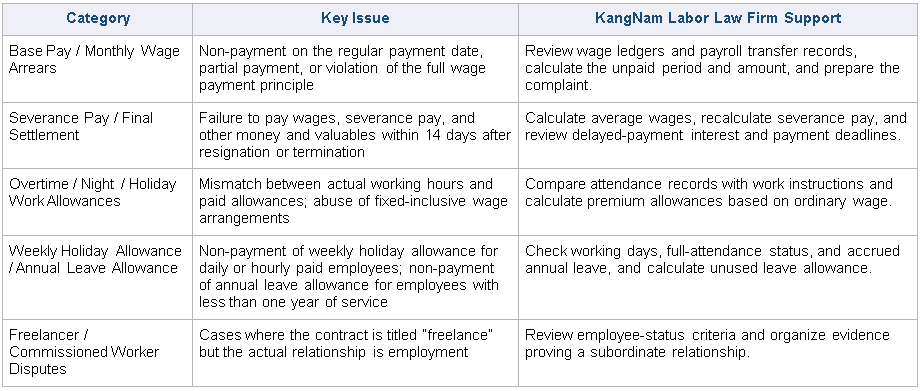
2. Scope of Service
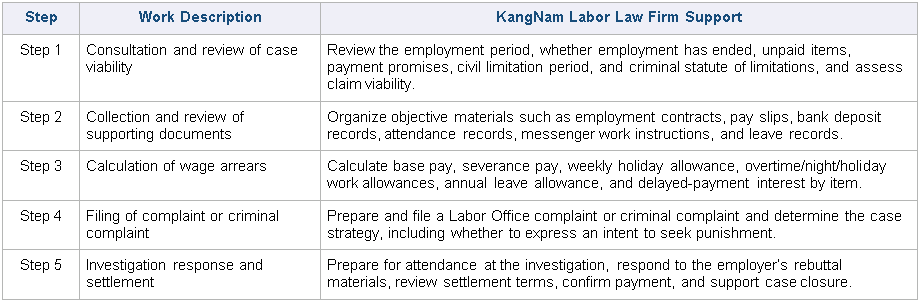
ㆍInitial consultation on how wage arrears arose, the employment period, whether employment has ended, unpaid items, and whether any payment promise was made.
ㆍReview of supporting documents, including employment contracts, wage ledgers, pay slips, payroll transfer records, attendance records, and leave records.
ㆍItem-by-item calculation of unpaid amounts, including base pay, severance pay, overtime/night/holiday work allowances, weekly holiday allowance, and annual leave allowance.
ㆍPreparation and filing of a Labor Office complaint or criminal complaint, response to labor inspector investigations, and submission of rebuttal materials against the employer’s claims.
ㆍSupport for settlement of unpaid wages, preparation of payment confirmation letters and settlement agreements, issuance of the Certificate of Unpaid Wages, etc. and Employer, and guidance on follow-up procedures.
Key Point: Even when a wage arrears case begins with a single employee’s complaint, it may expand to other employees who are under the same wage system or work arrangement. Therefore, it is necessary to review not only the claimed amount but also the company-wide wage management risks related to working-time management, pay slips, annual leave, and severance pay calculation methods.
II. How to Deliver
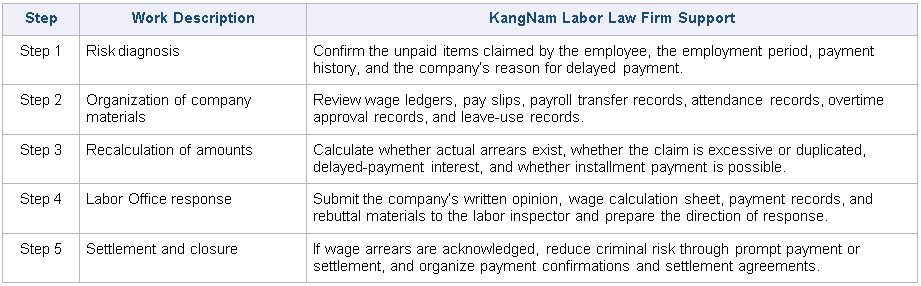
Wage arrears representation proceeds in the sequence of “fact-finding → evidence organization → amount calculation → Labor Office proceedings → payment or settlement and closure.” For employee-side cases, the focus is on securing the maximum recoverable unpaid wages. For employer-side cases, the focus is on accurately confirming whether wage arrears exist and the amount due, thereby reducing risks of criminal liability, delayed-payment interest, and collective disputes.
1. Employee-Side Representation Procedure
2. Employer-Side Representation Procedure
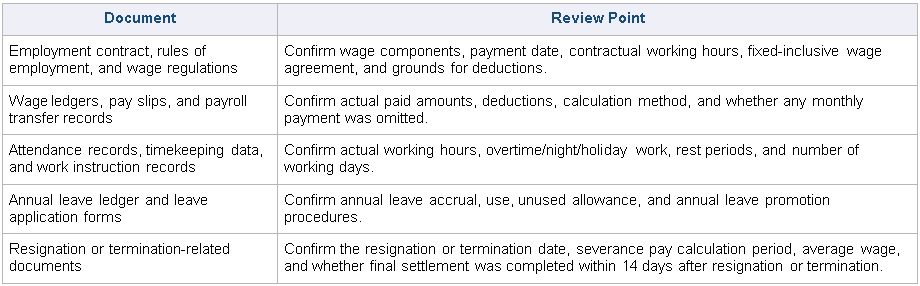
3. Documents to Prepare in Advance
4. Detailed Support by Key Issue
Wage arrears cases involve not only whether payment was omitted, but also issues such as employee status, wage character, ordinary wage and average wage, actual working hours, civil limitation period and criminal statute of limitations, delayed-payment interest, and the possibility of criminal liability. KangNam Labor Law Firm separates each issue, organizes calculation materials and legal arguments, and builds case records that can be persuasively explained during a Labor Office investigation.
(1) Wage Arrears Determination Checklist
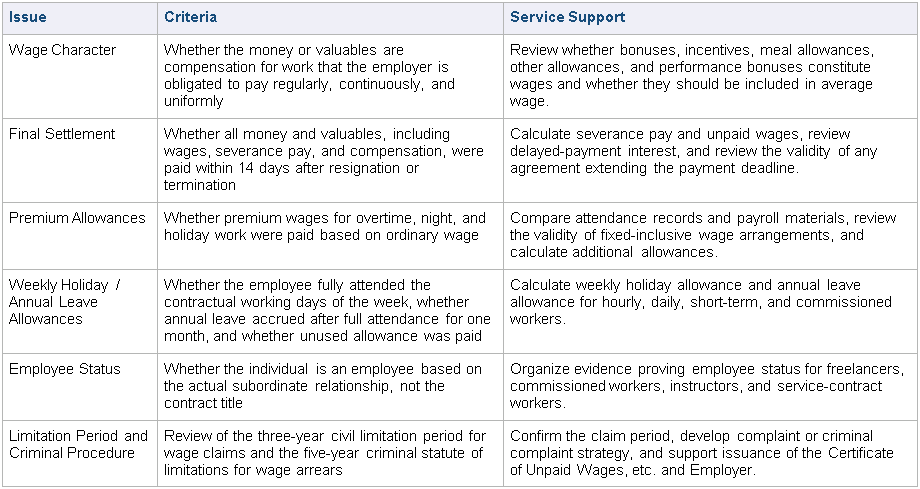
(2) Response Method for Labor Office Complaint and Criminal Complaint
ㆍBefore filing the complaint, first confirm the claimed items and amounts to prevent unnecessary omissions or excessive claims.
ㆍFor the labor inspector investigation, organize the materials in the order of “employment period - wage agreement - actual working hours - payment history - unpaid amount.”
ㆍFor employer-side cases, distinguish issues such as intent, dispute over payment obligation, calculation errors, items already paid, and settlement possibility.
ㆍIf wage arrears are likely to be acknowledged, review early payment, installment payment agreement, non-punishment intention, or possible case closure together.
ㆍIf non-payment continues after Labor Office proceedings, provide guidance on follow-up procedures such as the Certificate of Unpaid Wages, etc. and Employer, small-amount substitute payment, and civil proceedings.
Practical Note: As a rule, the civil limitation period for wage claims is three years, but the criminal statute of limitations for wage arrears may be five years. In addition, if all money and valuables are not settled within 14 days after resignation or termination, delayed-payment interest at 20% per annum may become an issue. Therefore, the claim period and payment deadline must be specified accurately from the beginning of the case..
III. Client Benefits
Wage arrears cases involve complicated amount calculations. Submission of materials and statements during Labor Office investigations is important, and if a case expands, it may lead to criminal liability, delayed-payment interest, collective complaints, and civil litigation. By entrusting the case to KangNam Labor Law Firm, clients can accurately identify the amount of wage arrears from the beginning and seek a prompt and reasonable resolution by systematically submitting the necessary written statements and supporting documents during Labor Office proceedings.
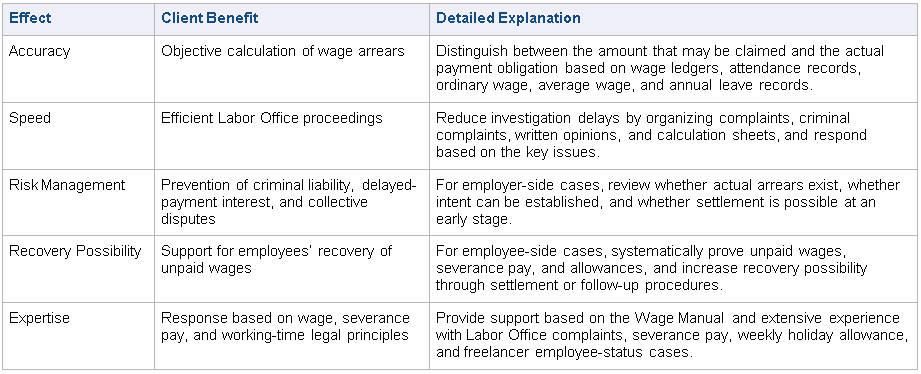
Why Choose KangNam Labor Law Firm
ㆍWe have extensive experience calculating each wage-related item, including wages, severance pay, overtime allowances, annual leave allowance, and weekly holiday allowance.
ㆍWe can represent employees and defend employers in Labor Office complaint and criminal complaint cases, allowing us to establish a balanced strategy.
ㆍWe can handle wage arrears cases involving employee-status issues for freelancers, commissioned workers, foreign instructors, part-time employees, and fixed-term employees.
ㆍWe support not only payment demands but also practical documents such as wage arrears calculation sheets, evidence lists, settlement agreements, and payment confirmation letters.
ㆍFor foreign-invested companies and multinational corporations, we can provide Korean- and English-based consultations and organize materials related to payroll and severance pay issues.
Consultation Guidance
Whether wage arrears exist and the amount due may vary depending on the industry, wage system, work arrangement, fixed-inclusive wage agreement, availability of attendance records, resignation or termination date, annual leave use records, and existing payment records. For an accurate diagnosis, it is advisable to prepare the employment contract, pay slips, payroll transfer records, attendance records, and resignation or termination-related documents in advance for the consultation.
※ This material has been prepared for general informational and promotional purposes. For each individual case, the facts and supporting documents must be reviewed through a separate consultation.
FAQ
Q11
What are the eligibility requirements, payment amounts, and application deadlines for wage subrogation payments?
Wage subrogation payments are a system in which the state pays unpaid wages, suspension allowances, and severance pay within a certain scope when the employer is unable to pay, and then seeks reimbursement from the employer. They are broadly divided into insolvency-based subrogation payments and simplified subrogation payments. Simplified subrogation payments can be received relatively quickly upon confirmation of wage arrears without requiring insolvency, whereas insolvency-based subrogation payments require the employer’s insolvency but provide higher payment limits.
Insolvency-based subrogation payments are provided when the company is in an insolvency situation such as bankruptcy, commencement of rehabilitation proceedings, or official recognition of insolvency. The employer must be subject to the Wage Claim Guarantee Act, have operated the business for a certain period, and the employee must have retired with unpaid wages remaining. A claim must be filed with the Korea Workers’ Compensation & Welfare Service within two years from the date of bankruptcy declaration, rehabilitation commencement, or insolvency recognition. Eligible employees are those who retired within three years before one year prior to the application date.
Simplified subrogation payments may be provided even if the company is not insolvent, as long as unpaid wages are confirmed. For retired employees, eligibility requires that the employer operated the business for at least six months up to the employee’s retirement date, and the employee must have obtained an enforceable title such as a court judgment or payment order, or a certificate of unpaid wages issued by the labor office. Where an enforceable title exists, the application must be made within one year from the date it became final; where based on a certificate of unpaid wages, within six months from the first issuance of the certificate. In practice, it is important for retired employees to file a labor complaint within one year from the day after retirement to secure the certificate of unpaid wages.
The scope of payment generally covers up to three months of final wages and suspension allowances, and up to three years of severance pay. Simplified subrogation payments have a maximum limit of 10 million KRW, with separate caps of 7 million KRW each for wages/suspension allowances and severance pay. Insolvency-based subrogation payments apply age-based monthly ceilings, with a maximum payment amount typically up to 21 million KRW.
Insolvency-based subrogation payments are provided when the company is in an insolvency situation such as bankruptcy, commencement of rehabilitation proceedings, or official recognition of insolvency. The employer must be subject to the Wage Claim Guarantee Act, have operated the business for a certain period, and the employee must have retired with unpaid wages remaining. A claim must be filed with the Korea Workers’ Compensation & Welfare Service within two years from the date of bankruptcy declaration, rehabilitation commencement, or insolvency recognition. Eligible employees are those who retired within three years before one year prior to the application date.
Simplified subrogation payments may be provided even if the company is not insolvent, as long as unpaid wages are confirmed. For retired employees, eligibility requires that the employer operated the business for at least six months up to the employee’s retirement date, and the employee must have obtained an enforceable title such as a court judgment or payment order, or a certificate of unpaid wages issued by the labor office. Where an enforceable title exists, the application must be made within one year from the date it became final; where based on a certificate of unpaid wages, within six months from the first issuance of the certificate. In practice, it is important for retired employees to file a labor complaint within one year from the day after retirement to secure the certificate of unpaid wages.
The scope of payment generally covers up to three months of final wages and suspension allowances, and up to three years of severance pay. Simplified subrogation payments have a maximum limit of 10 million KRW, with separate caps of 7 million KRW each for wages/suspension allowances and severance pay. Insolvency-based subrogation payments apply age-based monthly ceilings, with a maximum payment amount typically up to 21 million KRW.
Q10
Does sending a content-certified letter or filing a labor complaint interrupt the statute of limitations for wage claims?
A content-certified letter may function as a demand under civil law, and thus its effect on interrupting the statute of limitations may be an issue. However, sending a content-certified letter alone does not conclusively interrupt the statute of limitations. To recognize interruption, a civil legal action such as a lawsuit, payment order, seizure, provisional attachment, or injunction must be initiated within six months after the demand. A labor complaint, while meaningful as an administrative and criminal remedy for wage arrears, is generally not regarded as a procedure that definitively interrupts the civil statute of limitations for wage claims. Therefore, if the limitation period is approaching, it is safer to consider civil procedures such as filing a lawsuit, applying for a payment order, small claims proceedings, or provisional seizure in addition to filing a labor complaint.However, if the employer acknowledges the debt by issuing a written confirmation or payment agreement, or if part of the arrears is paid, it may be considered an acknowledgment of debt and thus interrupt the statute of limitations.
Q9
After a labor complaint is closed, is re-filing possible, and when is a case sent to the prosecution?
Even if a labor complaint has been closed, re-filing may be considered if new evidence is discovered or if certain wage arrears were not sufficiently addressed in the previous investigation. However, repeated complaints on the same facts may have limited practical benefit, so it is necessary to first review prior investigation results, wage calculations, and the existence of additional evidence. If wage arrears are confirmed but the employer fails to pay, or if punishment is deemed necessary, the labor inspector may refer the case to the prosecution. The prosecutor then decides whether to conduct supplementary investigation, issue a summary indictment, proceed to formal indictment, or dismiss the case.
Q8
What kind of assistance is available during a labor office investigation stage?
Before appearing at the labor office, one can organize facts and key issues and prepare calculation materials and evidence related to unpaid wages. During the investigation, assistance may include structuring responses to questions from the labor inspector and preparing rebuttal materials against the other party’s claims. If necessary, support may also extend to settlement negotiations, confirmation of payment of arrears, case closure, or consideration of subsequent civil procedures.
Q7
What is the difference between a labor complaint (petition) and a criminal accusation?
A complaint is primarily a procedure requesting payment of unpaid wages and an investigation by the labor office. A criminal accusation is a procedure in which the employee clearly expresses intent to seek criminal punishment for the employer’s wage arrears. Depending on the case, an employee may proceed only with a complaint, or may also file a criminal accusation together with the complaint depending on the circumstances of the case or the employer’s response.
Q6
What documents should be prepared before filing a labor complaint or criminal accusation regarding wage arrears, etc.?
Employees should prepare documents such as the employment contract, wage statements, salary transfer records, attendance records (clock-in/out data), overtime work records, and documents related to termination. Employers should prepare documents such as the employment contract, wage ledger, wage statements, salary transfer records, attendance records, overtime approval records, and records of leave usage. Even if documents are insufficient, additional required materials can be identified through consultation.
Q5
Can I also claim late payment interest on unpaid wages?
Article 37(1) of the Labor Standards Act provides that if an employer fails to pay wages, severance pay, or other money or valuables within 14 days after the employee’s death or resignation under Article 36, interest must be paid from the day after the due date until the date of actual payment. The statutory interest rate is 20% per annum under Article 17 of the Enforcement Decree of the Labor Standards Act.
In addition, from October 23, 2025, the system will be expanded so that delayed payment of wages to currently employed workers may also incur interest at 20% per annum from the day after the regular payday until the date of actual payment under Article 37(1) Item 2 of the Labor Standards Act and Article 17 of the Enforcement Decree.
However, late payment interest is generally considered a civil monetary claim ancillary to unpaid wages. Therefore, if the employer does not voluntarily pay it, the employee may need to pursue civil litigation, a payment order, or small claims proceedings, rather than relying solely on a labor office complaint.
In addition, from October 23, 2025, the system will be expanded so that delayed payment of wages to currently employed workers may also incur interest at 20% per annum from the day after the regular payday until the date of actual payment under Article 37(1) Item 2 of the Labor Standards Act and Article 17 of the Enforcement Decree.
However, late payment interest is generally considered a civil monetary claim ancillary to unpaid wages. Therefore, if the employer does not voluntarily pay it, the employee may need to pursue civil litigation, a payment order, or small claims proceedings, rather than relying solely on a labor office complaint.
Q4
Will I receive unpaid wages immediately if I file a labor complaint with the Labor Office?
A complaint to the Labor Office is a procedure to investigate wage arrears and either instruct the employer to pay or proceed with criminal action. In many cases, employers pay or reach a settlement during the investigation process, but filing a complaint does not itself result in immediate compulsory enforcement. If the employer still refuses to pay, further steps such as obtaining a certificate of unpaid wages, filing a civil lawsuit, applying for a payment order, or pursuing compulsory enforcement may be necessary.
Q3
Can I still claim unpaid wages or severance pay three years after leaving the company?
In principle, wage and severance pay claims are subject to a three-year statute of limitations, so after three years it may be difficult to pursue civil claims. However, the statute of limitations for criminal prosecution of wage arrears is five years, so even after three years, if five years have not yet passed, it may still be possible to pursue the matter by filing a petition or a criminal complaint with the labor office. The five-year limitation is derived from Article 109(1) of the Labor Standards Act combined with Article 249(1) item 5 of the Criminal Procedure Act.
Q2
If I resigned and was rehired at the company’s request before completing one year of service, am I still entitled to severance pay?
Even if a formal resignation and rehire process was carried out, if the employment relationship was not actually interrupted, continuous service may be recognized. In particular, if an employee submits a resignation only formally at the employer’s request and immediately returns to the same duties, the pre- and post-employment periods may need to be aggregated when calculating severance pay.
Q1
If a company says it will pay severance pay later, do I have to wait?
In principle, when employment ends, the employer must pay wages, severance pay, compensation, and all other monies within 14 days from the date the payment obligation arises. However, in special circumstances, the payment deadline may be extended by agreement between the parties. A unilateral statement by the company such as “we will pay it later” is generally not sufficient to constitute a lawful extension of the payment deadline.
Key Representative Cases