

Representation for Unfair Dismissal Claims Labor Consulting & Legal Representation
Consultation Request
Representation for Labor Relations Commission unfair dismissal remedy applications, employer responses, hearings, settlements, and monetary compensation negotiations
The Unfair Dismissal Representation Service is a Labor Relations Commission case representation service that provides effective remedies for employees and lawful, reasonable dispute resolution for employers. KangNam Labor Law Firm comprehensively reviews the reasons for dismissal, procedure, proportionality of disciplinary action, written notice, statutory filing period, and evidence, and represents clients throughout the full process, including preparation of remedy applications, responses, briefs, rebuttals, attendance at hearings, and settlement negotiations.
I. What Service
Unfair dismissal refers to dismissal, suspension, suspension with pay, transfer of job, wage reduction, or any other disciplinary action imposed by an employer on an employee without justifiable reason. For a dismissal to be lawful, substantive justification, procedural justification, and the appropriateness of the disciplinary level must all be satisfied. In particular, if there is no written notice specifying the reason for dismissal and the effective date of dismissal, the dismissal may be deemed invalid.
1. Major Service Areas
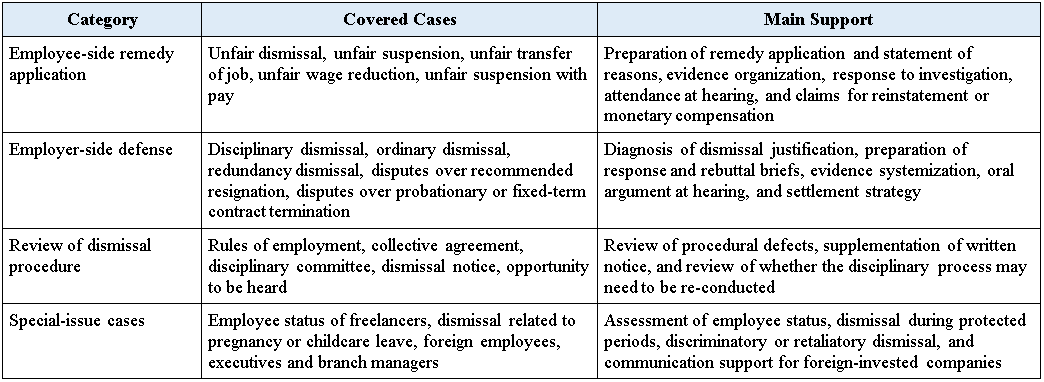
2. Scope of Representation
ㆍReview of the dismissal notification method, dismissal date, reasons for dismissal, and legality of procedures under the rules of employment and collective agreement.
ㆍConfirmation of whether the three-month statutory filing period for an unfair dismissal remedy application has been met, and urgent filing support if necessary.
ㆍOrganization of evidence, including employment contracts, dismissal notices, personnel committee materials, performance evaluations, emails, messenger records, and audio recordings.
ㆍResponse to requests for materials from the Labor Relations Commission investigator, and preparation and submission of statements of reasons, responses, and rebuttals.
ㆍPre-hearing rehearsal, preparation for expected questions, representative attendance, and oral argument at the hearing.
ㆍNegotiation support for case-specific solutions, including reinstatement, wages equivalent to the dismissal period, monetary compensation, and agreed resignation.
II. How to Deliver
In unfair dismissal cases, the key factors are deadlines, evidence, and procedure. At the initial consultation stage, KangNam Labor Law Firm first confirms the statutory filing period and key issues. Employee-side cases are handled to increase the likelihood of effective remedy, while employer-side cases are handled to defend the legitimacy of the dismissal and minimize dispute costs.
1. Common Procedure
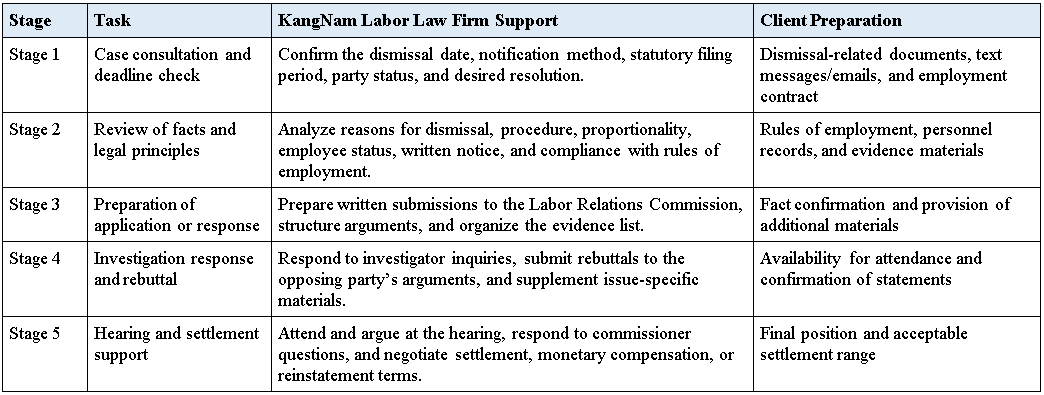
2. Employee-side Representation Procedure
ㆍFile a remedy application with the competent Regional Labor Relations Commission within three months from the date of dismissal.
ㆍStructure legal arguments around the absence of written dismissal notice, absence of justifiable reason, excessive disciplinary level, violation of disciplinary procedure, and whether resignation was forced.
ㆍDifferentiate the claim and negotiation strategy depending on whether the employee seeks reinstatement, monetary compensation, or agreed resignation.
ㆍFor freelancer or delegation-contract cases, focus on evidence proving the actual employment relationship and subordinate relationship rather than the title of the contract.
3. Employer-side Representation Procedure
ㆍFirst diagnose the existence of reasons for dismissal, compliance with disciplinary procedure, written notice of dismissal, advance notice of dismissal, and balance in the disciplinary level.
ㆍFor disciplinary dismissal cases, systemize objective evidence of misconduct, the degree of disruption to company order, and consistency with past disciplinary precedents.
ㆍWhere procedural defects are significant, review settlement before the Labor Relations Commission hearing to reduce legal and financial risk.
ㆍTo prevent recurrence, review the rules of employment, disciplinary rules, dismissal notice, and personnel committee operation process together.
4. Detailed Support by Major Issue
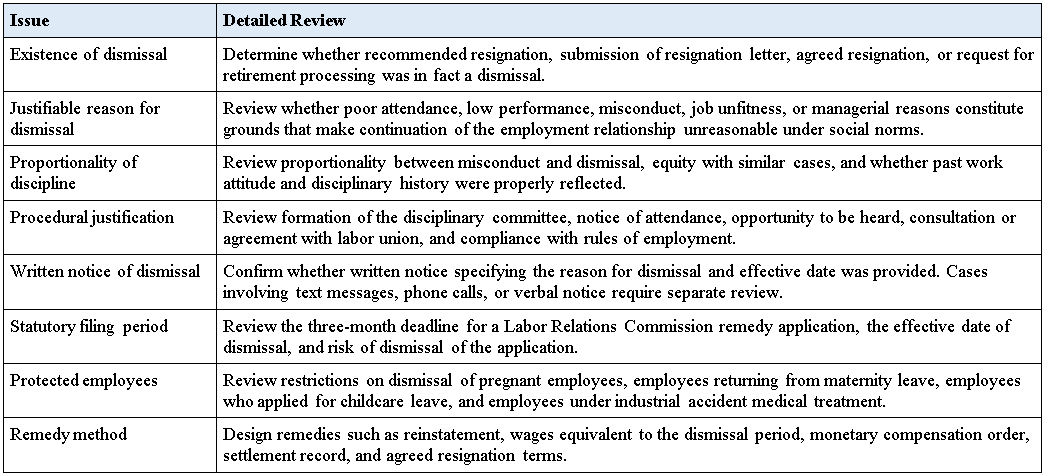
Key management point: Even if some reasons for dismissal are recognized, the dismissal may still be found unfair if there is a procedural violation or if the disciplinary level is excessive. Conversely, in employer-side cases, sufficient objective evidence and records of procedural compliance can support the legitimacy of dismissal before the Labor Relations Commission.
III. Client Benefits
After an unfair dismissal case is filed with the Labor Relations Commission, written submissions, evidence, investigation, and hearings proceed within a short period. Early response is therefore very important. Based on experience representing both employees and employers, KangNam Labor Law Firm quickly organizes the key issues and proposes practical solutions available in each case.
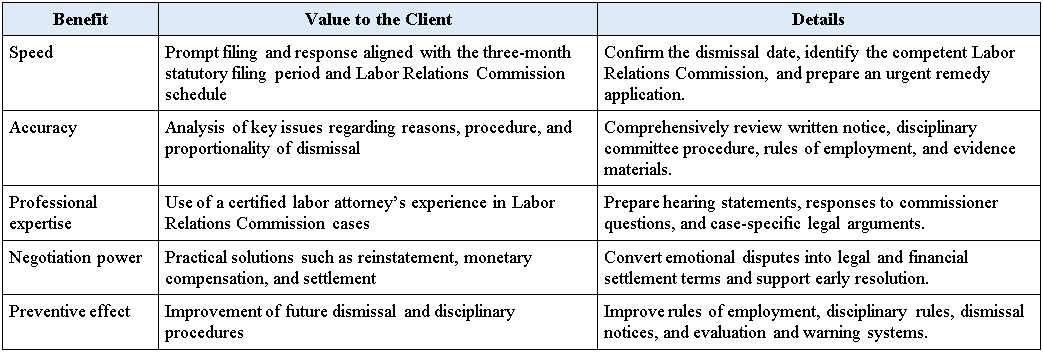
Why Choose KangNam Labor Law Firm
ㆍBased on its dismissal manual and actual unfair dismissal case experience, the firm reviews the reasons, procedure, and proportionality of dismissal in a balanced manner.
ㆍFor employee-side cases, the firm presents remedy possibilities and compensation strategies; for employer-side cases, it presents defense logic and settlement risks at the same time.
ㆍThe firm supports Korean and English communication and document organization for dismissal cases involving foreign-invested companies and multinational companies.
ㆍThe firm can handle complex cases, including dismissal of pregnant employees, employee status of freelancers, foreign employees, and dismissal of executives and branch managers.
ㆍRather than simply explaining the “chance of winning,” the firm provides practical guidance on reinstatement, monetary compensation, and settlement possibilities based on facts and evidence.
Consultation Notes
An unfair dismissal remedy application must be filed within three months from the date of dismissal. At the consultation stage, the dismissal date, dismissal notification method, whether a written dismissal notice was received, the rules of employment, personnel committee materials, and whether a resignation letter was submitted must first be confirmed. The outcome of each case may vary depending on the facts, evidence, company rules, and the Labor Relations Commission’s judgment.
※ This material has been prepared for general informational and promotional purposes. For each individual case, the factual background and legal requirements must be confirmed through a separate consultation.
FAQ
Q6
How long does it take for an unfair dismissal relief application at the first and second instance levels?
1) Regional Labor Relations Commission (first instance)
In the first-instance procedure before the Regional Labor Relations Commission, an unfair dismissal relief application is, in principle, scheduled for a hearing within 60 days from the date of filing the application. The hearing date is typically notified to the parties at least 7 days in advance, and after the hearing and deliberation meeting, the written decision is served on the parties within 30 days from the date of the decision meeting. Therefore, in practice, it usually takes about 2?3 months from the filing of the application to the service of the first-instance decision. However, in complex cases, cases involving multiple submissions of briefs and responses, cases where investigation hearings are conducted, cases where parties request postponement of hearings, or cases involving multiple employees, the process may take longer. Meanwhile, if measured from the submission of written arguments rather than from filing, the hearing is typically scheduled about 3?6 weeks after the exchange of initial briefs, although the statutory standard is based on 60 days from the filing date, not from the submission of written arguments.
2) National Labor Relations Commission (second instance / retrial)
A party who is dissatisfied with the decision of the Regional Labor Relations Commission may file an appeal (reconsideration) with the National Labor Relations Commission within 10 days from the date of receipt of the written decision. If no appeal is filed within this period, the first-instance decision becomes final. The second-instance procedure generally follows a similar structure to the first instance. Accordingly, from the filing of the appeal to the service of the final decision, it usually takes about 2?3 months, although it may take longer in complex cases or where additional evidence submissions or postponements occur.
In summary, the first instance generally takes about 2?3 months from filing to service of the decision, and the second instance also takes about 2?3 months from appeal to decision. Overall, if both stages are pursued, the entire process typically takes around 4?6 months or more in practice.
In the first-instance procedure before the Regional Labor Relations Commission, an unfair dismissal relief application is, in principle, scheduled for a hearing within 60 days from the date of filing the application. The hearing date is typically notified to the parties at least 7 days in advance, and after the hearing and deliberation meeting, the written decision is served on the parties within 30 days from the date of the decision meeting. Therefore, in practice, it usually takes about 2?3 months from the filing of the application to the service of the first-instance decision. However, in complex cases, cases involving multiple submissions of briefs and responses, cases where investigation hearings are conducted, cases where parties request postponement of hearings, or cases involving multiple employees, the process may take longer. Meanwhile, if measured from the submission of written arguments rather than from filing, the hearing is typically scheduled about 3?6 weeks after the exchange of initial briefs, although the statutory standard is based on 60 days from the filing date, not from the submission of written arguments.
2) National Labor Relations Commission (second instance / retrial)
A party who is dissatisfied with the decision of the Regional Labor Relations Commission may file an appeal (reconsideration) with the National Labor Relations Commission within 10 days from the date of receipt of the written decision. If no appeal is filed within this period, the first-instance decision becomes final. The second-instance procedure generally follows a similar structure to the first instance. Accordingly, from the filing of the appeal to the service of the final decision, it usually takes about 2?3 months, although it may take longer in complex cases or where additional evidence submissions or postponements occur.
In summary, the first instance generally takes about 2?3 months from filing to service of the decision, and the second instance also takes about 2?3 months from appeal to decision. Overall, if both stages are pursued, the entire process typically takes around 4?6 months or more in practice.
Q5
What sanctions are imposed if a company fails to comply with a Labor Relations Commission remedial order regarding unfair dismissal, etc.?
If an employer fails to comply with a remedial order for unfair dismissal or similar orders within the specified compliance period, the Labor Relations Commission may impose an enforcement fine on the employer. An enforcement fine is an administrative sanction intended to compel compliance with the remedial order, and it may be imposed if the employer fails to comply within the deadline even before the order becomes final.Enforcement fines are imposed under Article 33 of the Labor Standards Act (in dismissal cases, between 5 million KRW and 30 million KRW under the Enforcement Decree), and the Labor Relations Commission may repeatedly impose and collect such fines up to twice per year based on the initial date of the remedial order, for a period not exceeding two years until the order is complied with. Once the employer complies with the remedial order, no new enforcement fines are imposed, but any already imposed fines must still be paid.In addition, criminal penalties may apply in cases where a finalized remedial order or a reexamination decision containing a remedial order is not complied with. In such cases, under Article 111 of the Labor Standards Act, imprisonment of up to one year or a fine of up to 10 million KRW may be imposed, and prosecution for this offense requires a complaint from the Labor Relations Commission.Therefore, when a company receives a remedial order for unfair dismissal, it must accurately review the content of the order?such as reinstatement, payment of wage equivalent amounts, or monetary compensation?and clearly determine whether to comply within the deadline. Even if the company files a reexamination or administrative lawsuit against the order, unless a separate suspension of execution is granted, the risk of enforcement fines for non-compliance with the remedial order may continue.
Q4
Can the head of a branch office of a foreign company be recognized as an employee and file a claim for unfair dismissal relief?
Even if a person holds the title of branch manager, if they are actually under the direction and supervision of the headquarters, have limited independent managerial authority, and provide labor for the purpose of earning wages, they may be recognized as an employee. Conversely, if they have independent authority over business operations and function as an employer, employee status may be denied.If employee status is recognized for a branch manager of a foreign company, the restrictions under the Labor Standards Act regarding dismissal apply. Therefore, even if the company terminates the contract with the branch manager or removes them from their position, it cannot be treated simply as termination of an executive contract or mandate agreement, and just cause and proper procedures for dismissal are required. If the contract is terminated or dismissal procedures are violated without just cause, it may be deemed unfair dismissal, and the branch manager may file a petition for relief with the Labor Relations Commission.On the other hand, if the branch manager is not an employee but is considered an independent business operator or a mandatary under a contract of mandate, they are generally not eligible to file an unfair dismissal relief claim under the Labor Standards Act. In such cases, the validity of contract termination is mainly examined under civil law mandate relationships, commercial executive relationships, or contract law issues.Therefore, in cases involving termination of a foreign company branch manager’s contract, it is first necessary to determine whether the branch manager is substantively an employee, and depending on that determination, the availability of unfair dismissal relief and the legal nature of contract termination will differ.
Q3
If a reinstatement order is issued by the Labor Relations Commission, how much unpaid wages must the company pay?
If an order for reinstatement is issued due to unfair dismissal, the company must pay wage equivalent amounts that the employee would have received had they worked normally from the date of dismissal to the date of actual reinstatement. This includes base salary as well as various allowances and bonuses that are regularly and uniformly paid as wages. However, items such as performance-based pay, incentives, overtime pay, and whether interim earnings should be deducted may vary depending on the case, so they must be calculated individually based on specific wage items and the dismissal period.
Q2
How should a company respond when unfair dismissal or unfair disciplinary action occurs?
If an employee considers a dismissal or disciplinary action to be unfair, they may file a petition for relief with the competent Regional Labor Relations Commission within three months from the date of dismissal or disciplinary action. When a company receives such a petition, it must submit a written response and prepare materials that can prove the legitimacy of the dismissal or disciplinary action. For example, it is necessary to systematically organize materials such as work rules, disciplinary regulations, documents related to disciplinary grounds, warning letters, evaluation records, attendance notices, minutes of disciplinary committee meetings, materials showing that an opportunity to be heard was given, and dismissal notices or disciplinary action documents.The Labor Relations Commission does not simply compare the claims of the employer and the employee, but comprehensively determines whether the grounds for dismissal or disciplinary action actually exist, whether the company complied with procedures set out in work rules or collective agreements, and whether the severity of the disciplinary action is proportionate to the misconduct. In particular, in the case of dismissal, the key issue is whether there is just cause sufficient to terminate the employment relationship, and in the case of disciplinary action, both the existence of disciplinary grounds and the appropriateness of the level of discipline are at issue.Therefore, companies should not begin to search for materials only after a relief petition is filed; rather, from the stage of deciding on dismissal or disciplinary action, it is important to document and retain materials so that the legitimacy of grounds, procedures, and severity can be proven.
Q1
What can an employee do if they are unfairly dismissed or subjected to unfair disciplinary action?
If an employee believes they have been dismissed or disciplined without just cause, they may file a petition for relief with the Labor Relations Commission for unfair dismissal or unfair disciplinary action. In principle, such a petition must be filed within three months from the date of dismissal or disciplinary action, and if this period passes, it may be difficult to obtain relief.The Labor Relations Commission comprehensively determines whether the reasons for dismissal or discipline are justified, whether the company complied with procedures set out in work rules or collective agreements, and whether the severity of the disciplinary action is proportionate to the misconduct. In the case of dismissal, the key issue is whether there is just cause sufficient to terminate the employment relationship, and in the case of disciplinary action, both the existence of grounds for discipline and the appropriateness of the level of discipline are important standards of judgment.If unfair dismissal or unfair disciplinary action is recognized, the Labor Relations Commission may issue necessary remedial orders such as reinstatement to the original position, payment of wages equivalent to the period of dismissal, cancellation or reduction of disciplinary measures, etc. Therefore, employees need to secure relevant materials such as dismissal notices, disciplinary action documents, personnel committee materials, warning letters, emails, messenger conversations, and work records, and specifically argue the unfairness of the dismissal or disciplinary action.
Key Representative Cases