

Dismissal & Disciplinary Action Labor Consulting & Legal Representation
Consultation Request
Preventing unfair dismissal risks and supporting lawful disciplinary and dismissal procedures
The Dismissal and Disciplinary Action Service is not a service in which a labor attorney makes disciplinary decisions on behalf of the company. Rather, it is a preventive and dispute-response HR and labor-management service in which a certified labor attorney reviews the facts, the Rules of Employment, the Labor Standards Act, and court precedents so that disciplinary action or dismissal can be implemented with justifiable grounds, appropriate severity, and lawful procedures.
I. What Services We Provide | What Service
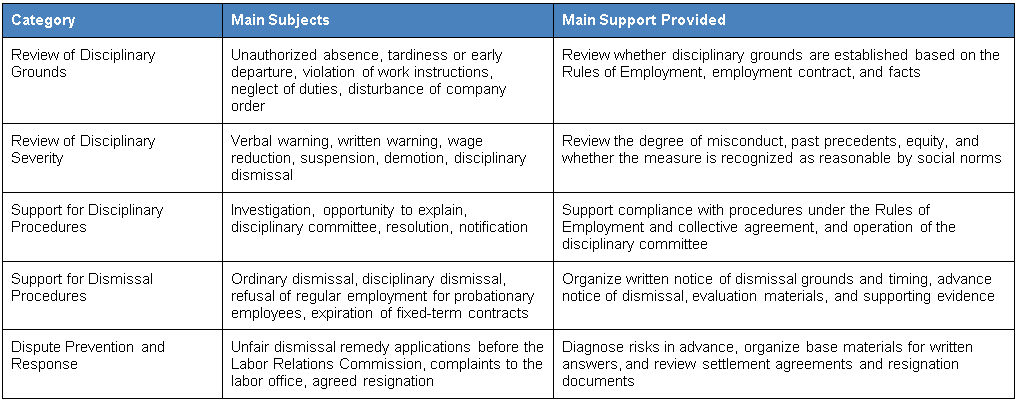
Disciplinary work is the process by which a company imposes appropriate sanctions on conduct that harms corporate order, such as violation of workplace rules, neglect of duties, unauthorized absence, disturbance of workplace order, violation of work instructions, workplace harassment or sexual harassment, embezzlement, breach of trust, and other misconduct. Dismissal is the most serious personnel measure because it terminates the employment relationship. If justifiable grounds and lawful procedures are not satisfied, the dismissal may be found to be unfair.
Based on its Dismissal Manual and experience in actual Labor Relations Commission cases, KangNam Labor Law Firm reviews in advance whether disciplinary grounds exist, whether the level of discipline is appropriate, and whether disciplinary procedures are being followed. We support the company in preparing the necessary documents and procedures so that it can make decisions safely and lawfully.
1. Main Service Areas
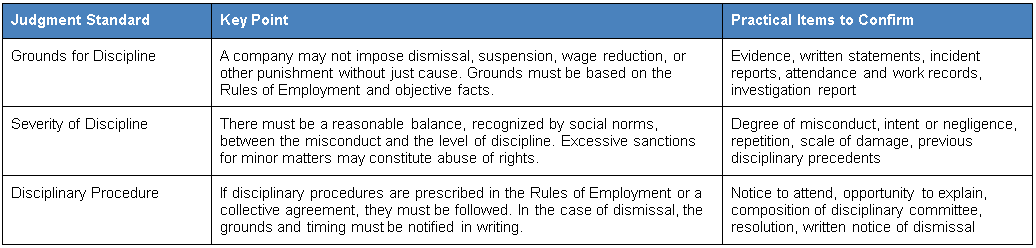
2. Basic Principles for Judging Dismissal and Disciplinary Action
3. Scope of Service
ㆍInitial legal risk diagnosis regarding the possibility of disciplinary action or dismissal
ㆍReview of the Rules of Employment, personnel regulations, disciplinary regulations, collective agreement, and employment contract
ㆍSetting the direction for fact-finding, and providing interview questionnaires and incident report templates
ㆍReview opinions and recommendations on disciplinary grounds, severity, and procedures
ㆍSupport for preparing notices to convene a disciplinary committee, notices to attend, resolutions, notices of disciplinary action, and written notices of dismissal
ㆍReview of recommended resignation, agreed resignation, resignation settlement agreements, and monetary compensation methods
ㆍOrganization of supporting evidence and response strategy in preparation for a possible unfair dismissal remedy application
II. How We Deliver the Service | How to Deliver
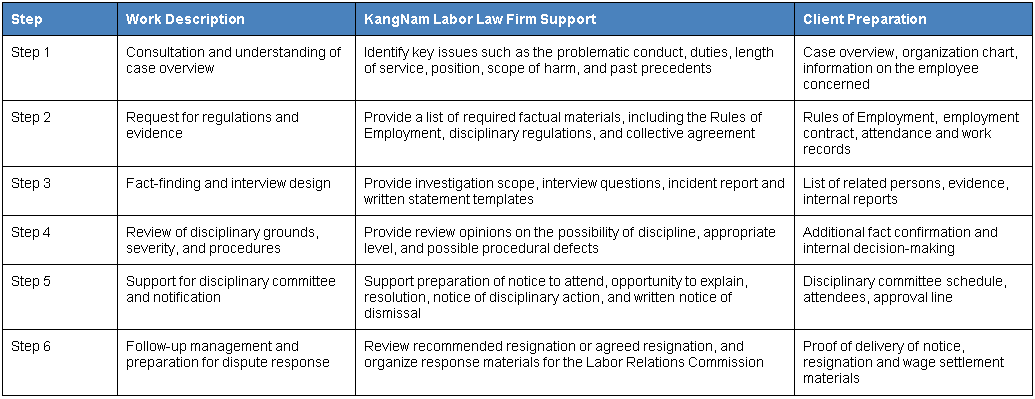
Dismissal and disciplinary work proceeds in the order of fact-finding, legal evaluation, procedural implementation, notification, and follow-up management. KangNam Labor Law Firm does not merely adjust the formality of a conclusion already decided by the company. Instead, we review disciplinary grounds, disciplinary level, and possible procedural defects step by step according to the standards applied by the Labor Relations Commission and the courts.
1. Common Process
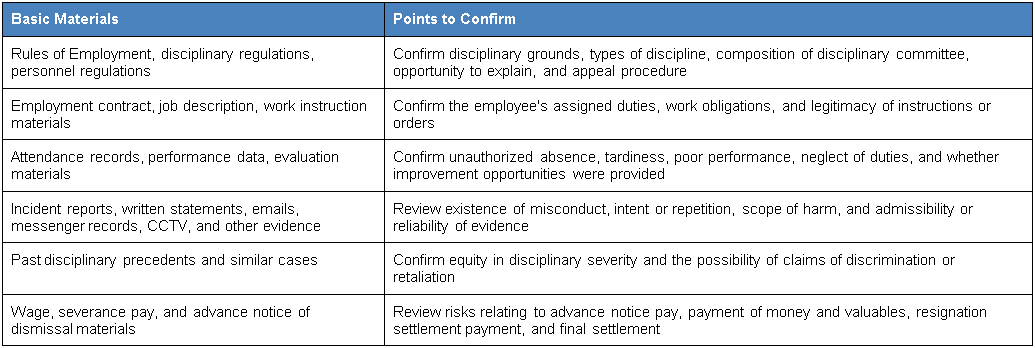
2. Preliminary Materials to Prepare
3. Detailed Support by Major Type | Detailed Support
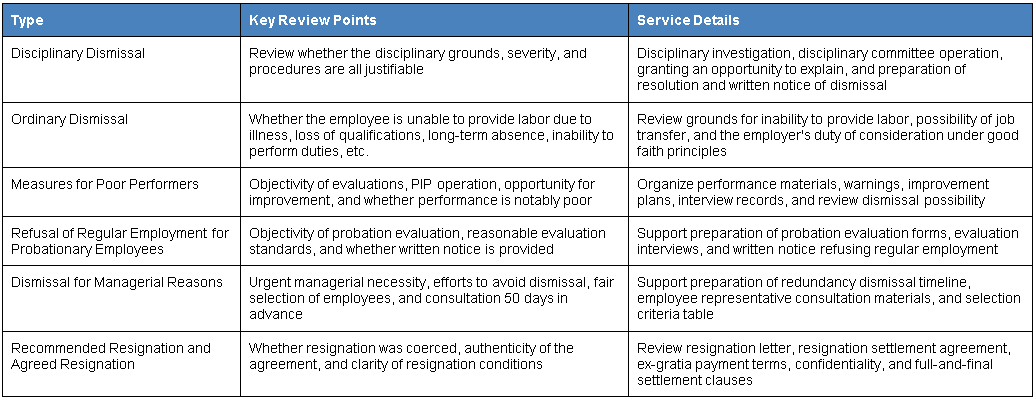
4. Practical Method of Implementation
ㆍA certified labor attorney compares company regulations with factual materials to review whether disciplinary grounds are actually established.
ㆍWe confirm whether the disciplinary level is excessive or inconsistent with past precedents, and, where necessary, suggest lower-level alternatives.
ㆍWe manage the document flow so that there are no procedural defects in the notice to attend the disciplinary committee, granting an opportunity to explain, preparing the resolution, and notifying the result.
ㆍFor dismissal, we prepare a written notice clearly stating the grounds and timing of dismissal, and review whether advance notice of dismissal or advance notice pay is required.
ㆍFor cases with a high possibility of dispute, we organize in advance the issues that may be contested at a Labor Relations Commission hearing and prepare defense materials.
Key Management Point: Disciplinary action and dismissal are not safe merely because the company believes that “the grounds are sufficient.” If the disciplinary level is excessive or if there are procedural defects in the composition of the disciplinary committee, the opportunity to explain, or the written notice of dismissal, the disciplinary grounds may be recognized but the measure may still be found to be an unfair disciplinary action or unfair dismissal.
III. Client Benefits
Dismissal and disciplinary action are among the areas with the highest dispute risk within a company's exercise of personnel authority. By entrusting these matters to KangNam Labor Law Firm, clients can reduce emotional responses and procedural omissions, and systematically manage unfair dismissal and unfair disciplinary action risks through personnel measures based on objective evidence and legal standards.
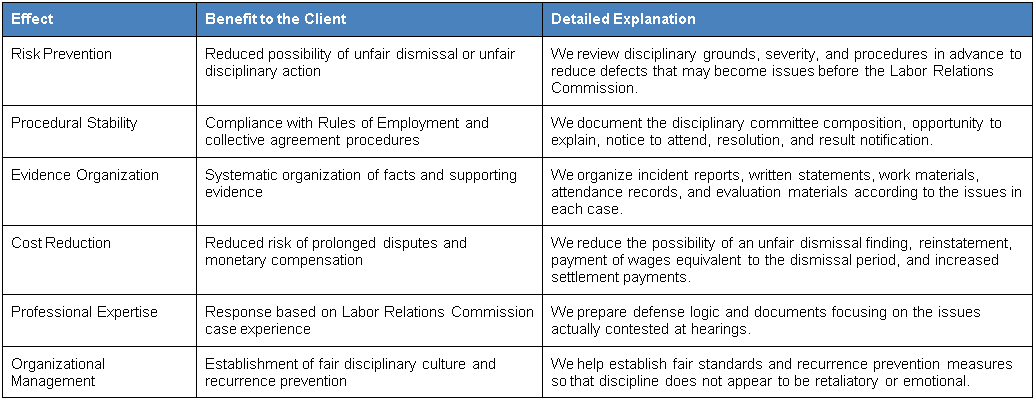
Why Entrust This Service to KangNam Labor Law Firm
ㆍWe comprehensively review grounds, severity, and procedures based on our Dismissal Manual and extensive experience in Labor Relations Commission cases.
ㆍFor dismissal and disciplinary matters involving foreign-invested companies and multinational companies, we can explain Korean labor law standards in both English and Korean.
ㆍWe do not merely answer whether dismissal is possible. We also present practical alternatives such as recommended resignation, agreed resignation, transfer, warning, and PIP.
ㆍWe prepare and supplement practical documents for each case, including disciplinary committee documents, written notices of dismissal, resignation settlement agreements, and resignation letters.
ㆍWe help the company make safe decisions based on objective evidence and procedural records rather than relying on a vague conclusion that “there is no problem.”
Guidance for Consultation
Dismissal and disciplinary risks may vary depending on the employee's position, length of service, details of the misconduct, the company's disciplinary precedents, provisions in the Rules of Employment and collective agreement, and whether evidence has been secured. For an accurate diagnosis, the case overview and relevant supporting materials must first be reviewed through a preliminary consultation.
※ This material has been prepared for general guidance and promotional purposes. For each individual case, the facts and legal requirements must be confirmed through a separate consultation.
FAQ
Q13
Does the employment relationship automatically end when a fixed-term contract expires?
In principle, a fixed-term employment contract ends upon expiration of the agreed contract period. Therefore, unless there are special circumstances, the employer may terminate the employment relationship upon contract expiration.However, if the employment rules or contract provide for renewal, if the company has created a reasonable expectation of continued employment, or if there is an established practice of renewal, a renewal expectation right may be recognized for the employee. For example, if most fixed-term employees have been repeatedly renewed without special reasons, or if renewal occurs as long as there are no performance issues, termination solely based on contract expiration may be difficult.If a renewal expectation right is recognized, the company must have a reasonable justification to refuse renewal. Even if there are reasons such as poor performance, misconduct, or business reduction, objective evidence and fair evaluation procedures are required. Therefore, if renewal is refused without reasonable grounds, it may be treated similarly to unfair dismissal even if it formally takes the form of contract expiration.
Q12
Can a submitted resignation letter be withdrawn?
Whether a resignation letter can be withdrawn depends on whether the company has already accepted it. If the employer has not yet accepted the resignation, the employee may withdraw the resignation. However, once the resignation has been accepted and the termination of employment is finalized, unilateral withdrawal is generally not allowed.
Q11
What should be considered when transferring an employee to another city or overseas?
If there is business necessity and a basis in the employment contract, employment rules, or company practice, an employee may be transferred to another region or overseas. However, if the transfer causes excessive disadvantages to the employee’s living conditions, lacks proper justification, or is made without necessary consultation procedures, it may be considered an abuse of managerial authority.In such cases, the employee may request the company to explain the grounds and necessity of the transfer and may seek reconsideration by presenting personal circumstances or hardship. Internal grievance procedures, HR committees, or appeal processes may also be used.If the transfer is still considered unfair, the employee may file an unfair transfer or reassignment claim with the Labor Relations Commission. The Commission will comprehensively consider business necessity, disadvantages to the employee, consultation procedures, and purpose and intent of the personnel order in determining whether there is an abuse of authority.Therefore, before issuing a transfer order, the company should clearly establish business necessity and selection criteria, consult sufficiently with the employee, and consider measures to mitigate disadvantages such as housing, transportation, and family-related issues.
Q10
What should a company prepare before taking disciplinary action or dismissal?
The company must conduct a factual investigation, secure objective evidence, confirm disciplinary procedures under employment rules, determine whether a disciplinary committee is required, provide the employee with an opportunity to explain, and review the appropriateness of the disciplinary level. Even if there are substantive grounds, procedural defects may result in the dismissal or disciplinary action being ruled unfair
Q9
Can a company freely determine the level of disciplinary action?
No. Even if misconduct is established, the company cannot freely determine the level of disciplinary action. Discipline must be proportionate to the severity of the misconduct. Therefore, factors such as intent, repetition, extent of damage, impact on work duties, remorse, prior disciplinary history, length of service, and disciplinary standards in the company’s employment rules must all be considered.In particular, imposing severe disciplinary action such as dismissal for minor misconduct may be considered excessive and therefore unfair discipline. Accordingly, the company must consider not only whether misconduct exists but also whether the disciplinary level is socially reasonable and consistent with similar past cases.
Q8
Can an employee be dismissed for falsifying information on a resume?
False statements on a resume do not automatically justify dismissal. For resume falsification to be a valid reason for dismissal, it must be determined whether the false information was a material factor in the hiring decision, whether the employer would not have hired the employee if the truth had been known, whether it affected actual job performance or qualification requirements, and whether it seriously undermined the trust relationship between the employee and employer.For example, if an employee falsified key hiring-related information such as education, work experience, certifications, or criminal history, and the employer hired the employee based on that misinformation regarding their ability or qualifications, dismissal may be justified. However, if the falsification is minor, has little relevance to job performance, or is not materially linked to the hiring decision, dismissal may be considered excessive.Therefore, even if resume falsification is discovered, the company must comprehensively assess the nature and severity of the falsehood, its relevance to hiring decisions, its impact on actual job performance, the employee’s intent, post-employment conduct, and the disciplinary standards in the company’s employment rules. In minor cases, disciplinary measures such as warnings, salary reduction, or suspension may be more appropriate than dismissal.
Q7
Is it possible to dismiss an underperforming employee?
Poor performance may, depending on the case, constitute grounds for dismissal. However, dismissal is not generally justified merely because an employee has low performance or fails to meet the company’s expectations. Courts and the Labor Relations Commission apply a very strict standard to dismissals of underperforming employees, so the company must prove that the employee’s job ability or performance is objectively and significantly insufficient. For this, clear performance evaluation standards must be established in advance, and an objective and fair evaluation must be conducted based on those standards. In addition, the issue must reflect repeated and continuous underperformance rather than a temporary decline, and subjective dissatisfaction from supervisors or abstract attitude issues alone are insufficient to justify dismissal.Furthermore, before dismissal, the company must provide meaningful opportunities for improvement, such as training, guidance, warnings, and a Performance Improvement Plan (PIP), and must also consider possible reassignment or job adjustment. Even after such measures, if the employee’s performance or ability does not improve and the employment relationship becomes objectively difficult to continue, dismissal may be recognized as justified.Therefore, dismissal of underperforming employees cannot be determined solely based on performance appraisal results, but must be assessed comprehensively based on objective evaluation data, repeated underperformance records, whether improvement opportunities were provided, whether reassignment or job adjustment was considered, and procedural fairness in the company’s process.
Q6
Can an employee be dismissed for lateness, unauthorized absence, or poor work attitude?
Lateness, unauthorized absence, and poor work attitude may, depending on the case, constitute grounds for disciplinary action or dismissal. However, the legitimacy of dismissal is determined by considering whether such conduct was repeated and intentional, whether it caused business damage or disruption of workplace order, and whether the company provided prior warnings or opportunities for improvement.In particular, dismissal may be considered excessive if it is based solely on one or two instances of lateness or a temporary decline in work attitude. Therefore, the company must determine the level of discipline in proportion to the number, duration, and reasons for attendance issues, impact on work performance, prior warnings or disciplinary history, and disciplinary standards under employment rules.On the other hand, dismissal may be justified if unauthorized absences or repeated lateness continue, poor work attitude persists, and the employee fails to improve despite company warnings and requests for correction, to the extent that continued employment becomes difficult.
Q5
Is it necessary to give the employee an opportunity to explain before disciplinary action?
If internal rules such as employment rules, collective agreements, or HR regulations stipulate procedures such as disciplinary committee hearings or opportunities to be heard, the company must follow those procedures. Even if part of the disciplinary grounds are recognized, failure to follow the prescribed procedures may result in the disciplinary action or dismissal being deemed unfair due to procedural defects.Legally, not all workplaces are required to hold a disciplinary committee, but in cases of serious disciplinary actions such as suspension or dismissal, it is very important to notify the employee of the specific grounds in advance and provide an opportunity to explain in order to protect the employee’s right to defense. If the employee is not informed of the reasons for disciplinary action, procedural validity may be questioned.Therefore, it is advisable for the company to properly notify the employee of the disciplinary reasons, date of disciplinary committee, attendance notice, opportunity to present explanations, and opportunity to submit materials. The employee should be able to submit relevant documents or attend the disciplinary committee to state their position after reviewing the notified reasons.Ultimately, the legitimacy of disciplinary action is determined not only by the existence of disciplinary grounds but also by whether the company complied with procedures set in employment rules or collective agreements and whether it ensured the employee’s substantive right to defense and explanation.
Q4
What is the difference between recommended resignation and dismissal?
Recommended resignation refers to a situation where the company recommends resignation to the employee and the employee freely accepts it and submits a resignation letter, thereby terminating the employment relationship. In principle, this is regarded not as a unilateral termination by the company, but as a termination by mutual agreement between the employee and the company.In contrast, dismissal is a unilateral termination of the employment relationship by the company regardless of the employee’s intention. Therefore, for dismissal to be valid, just cause and legally required procedures must be satisfied.However, even if a resignation letter is formally submitted, if the employee submitted it in a situation where they could not realistically refuse, or if the company exerted coercion, threats, repeated pressure, or implied disadvantages to induce resignation, it may not be considered a truly recommended resignation. In such cases, it may be judged as dismissal rather than voluntary resignation. Therefore, the key issue in recommended resignation is whether the employee had a real choice to refuse resignation and whether the intent to resign was free and genuine.
Q3
Does paying dismissal advance notice allowance make the dismissal legitimate?
No. Dismissal advance notice allowance does not substitute for the legitimacy of dismissal. Article 26 of the Labor Standards Act provides that an employer must, in principle, give at least 30 days’ advance notice before dismissing an employee, and if not, must pay at least 30 days’ ordinary wages. However, this concerns only the procedural requirement of advance notice. Even if the advance notice allowance is paid, the dismissal may still be considered unfair if there is no justifiable reason or if required procedures such as written notice, disciplinary committee procedures, or opportunity to be heard are violated. In other words, payment of advance notice allowance ≠ lawful dismissal.
Q2
Is written notice mandatory when dismissing an employee?
Yes. If a company dismisses an employee, it must give written notice specifying the reasons for dismissal and the timing of dismissal. Article 27 of the Labor Standards Act requires that the reasons and timing of dismissal be notified in writing, and such written notice is required for the dismissal to take effect. Therefore, verbal notice, simple text messages, KakaoTalk announcements, or email notices alone may raise issues regarding the validity of the dismissal. In practice, a dismissal notice should clearly state the dismissal date, specific reasons for dismissal, relevant provisions of the employment rules, date of notice, and company name.
Q1
What requirements are needed for a company to dismiss or discipline an employee?
Dismissal·disciplinary action must be based on justifiable grounds. Simple abstract reasons such as “the work is not satisfactory,” “attitude is bad,” or “performance is low” are not sufficient. The company must be able to prove specific facts such as poor work attitude, failure to follow work instructions, unauthorized absence, low performance, misconduct, or damage to the company with objective evidence. In particular, dismissal is the most severe measure that terminates the employment relationship, so not only the existence of disciplinary grounds but also whether the grounds are serious enough to justify dismissal must be considered. The Labor Standards Act prohibits employers from imposing disciplinary actions such as dismissal, suspension, demotion, or pay reduction without just cause.
Key Representative Cases