

Redundancy / Layoff Labor Consulting & Legal Representation
Consultation Request
Review of dismissal requirements for managerial reasons, voluntary retirement, consultation with employee representatives, dismissal notices, and dispute prevention support
The Redundancy Dismissal Service is a professional HR and labor-management service for cases where workforce restructuring is unavoidable due to the company’s managerial difficulties. A certified labor attorney reviews the legal requirements for dismissal for managerial reasons and systematically supports the entire process, including efforts to avoid dismissal, selection of employees subject to dismissal, consultation with employee representatives, and written dismissal notices, in order to prevent unfair dismissal disputes and labor-management conflict..
I. What Service
Redundancy dismissal, or dismissal for managerial reasons, is a measure to terminate the employment relationship based on the company’s managerial needs even though the employee is not at fault. Therefore, it is subject to stricter legal requirements than ordinary dismissal. It requires not merely a reduction in headcount but also the need for restructuring, efforts to avoid dismissal, fair selection of employees subject to dismissal, and sincere consultation with employee representatives. KangNam Labor Law Firm supports the entire process from preliminary diagnosis to execution and post-dismissal dispute response so that redundancy dismissal can be recognized as a measure of last resort.
1. Major Service Areas
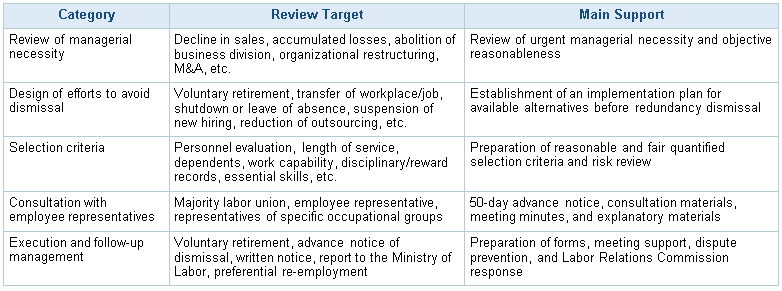
2. Scope of Service
ㆍPreliminary legal review of the possibility of dismissal for managerial reasons and diagnosis of restructuring risks
ㆍDesign of dismissal-avoidance measures, including voluntary retirement, transfer of workplace/job, adjustment of working hours, and cost reduction
ㆍPreparation of key documents such as the selection criteria table, evaluation materials, meeting minutes, and notices
ㆍSupport for 50-day advance notice and sincere consultation with the labor union or employee representative
ㆍReview of redundancy dismissal plan reporting, advance notice of dismissal, written notice of dismissal reasons and date, and retirement settlement materials
ㆍPost-management support in preparation for unfair dismissal remedy applications, collective disputes, and collective bargaining conflict
II. How to Deliver
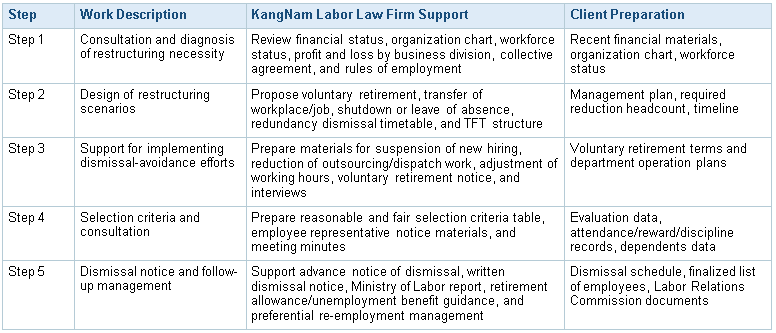
The Redundancy Dismissal Service is not simply the preparation of a dismissal notice. It is a process of organizing the company’s managerial situation with objective materials, first implementing alternatives to avoid dismissal, and recording the consultation with employee representatives and the selection procedure so that the legitimacy of the dismissal can later be explained before the Labor Relations Commission or a court.
1. Common Process
2. Preliminary Materials
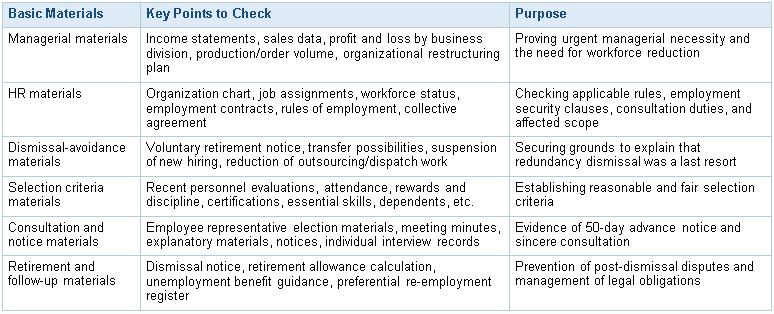
3. Detailed Support by Major Procedure
(1) Review of the Four Requirements for Dismissal for Managerial Reasons
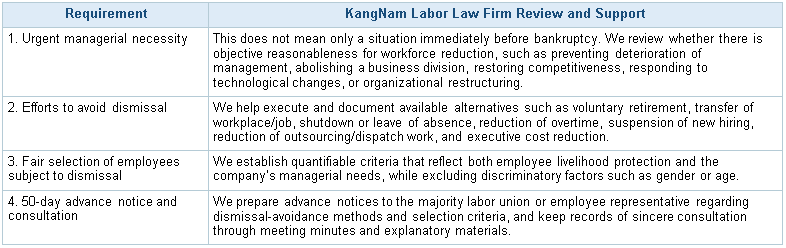
(2) Execution Process for Redundancy Dismissal
ㆍOrganize the need for restructuring and the scale of workforce reduction with objective materials, and form a TFT consisting of management, HR, and field managers.
ㆍFirst design a voluntary retirement program and prepare severance compensation, application period, eligible employees, the company’s right to reject applications, resignation forms, and settlement agreement forms.
ㆍExplain the managerial situation, dismissal-avoidance efforts, and selection criteria to the labor union or employee representative, and keep meeting minutes.
ㆍIf the target reduction is not achieved through voluntary retirement, prepare the redundancy dismissal criteria table and the notice procedure for employees scheduled for dismissal.
ㆍIf redundancy dismissal above the statutory scale is expected, prepare reporting materials for the Ministry of Labor and proceed with advance notice and written notice of dismissal.
ㆍBecause an obligation of preferential re-employment may arise when hiring for the same work within three years after dismissal, maintain a re-employment management register.
(3) Example of Designing Selection Criteria for Employees Subject to Dismissal
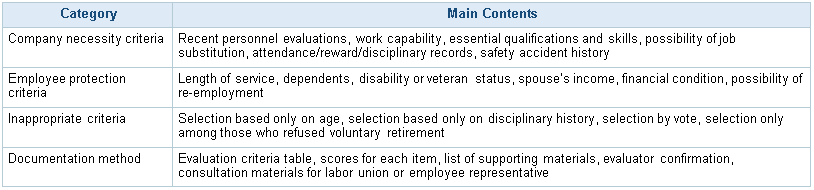
Key Management Point: Redundancy dismissal must not be used as a tool to remove specific employees. The key is to establish objective criteria that reflect both the company’s needs and employee protection factors, make sufficient efforts to avoid dismissal, and conduct sincere consultation with employee representatives..
III. Client Benefits
If redundancy dismissal has procedural defects, it may lead to unfair dismissal remedy applications, wage-equivalent liabilities, labor-management conflict, and collective disputes. By entrusting the matter to KangNam Labor Law Firm, clients can explain the necessity of restructuring in accordance with legal requirements and operate voluntary retirement and redundancy dismissal procedures in a balanced manner to reduce the likelihood of disputes.
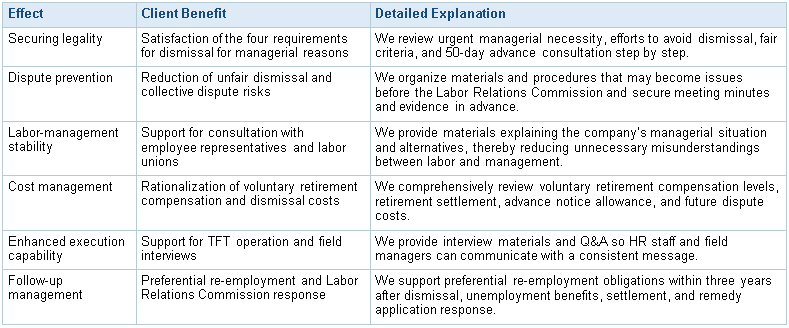
Reasons to Entrust This Service to KangNam Labor Law Firm
ㆍWe design practical procedures based on restructuring manuals and actual cases involving redundancy dismissal and voluntary retirement.
ㆍWe document the four requirements for dismissal for managerial reasons in a way that can be explained before the Labor Relations Commission and courts.
ㆍWe organize interview processes and forms so that voluntary retirement, recommended resignation, and redundancy dismissal are not confused and later judged as unfair dismissal.
ㆍWe provide practical experience for workplaces with labor unions, workplaces with employment security clauses in collective agreements, and restructuring by foreign-invested companies.
ㆍRather than rushing dismissal, we advise in a way that minimizes labor-management conflict through dismissal-avoidance efforts, reasonable selection of employees, and sincere consultation.
ㆍWe can prepare Korean- and English-language reports, official letters, and explanatory materials to support communication between foreign headquarters and Korean subsidiaries.
Notes for Consultation
The legality of redundancy dismissal may vary depending on the company’s financial status, the scale of workforce reduction, profit and loss by business division, existence of a labor union, collective agreement provisions, dismissal-avoidance efforts, selection criteria, and the sufficiency of consultation with employee representatives. For an accurate diagnosis, managerial and HR materials should first be reviewed through preliminary consultation.
※ This material has been prepared for general information and promotional purposes. For each individual workplace, the requirements must be reviewed through separate consultation..
FAQ
Q7
What must be proven if a labor dispute is filed after a layoff?
If a dismissed employee files an unfair dismissal claim with the Labor Relations Commission, the employer must prove that the dismissal for managerial reasons was justified.
Specifically, the employer must demonstrate:
urgent managerial necessity, sufficient efforts to avoid dismissal, fair and reasonable selection of employees, compliance with the 50-day prior notice and consultation process with employee representatives or the labor union.
Conversely, the employee may argue that the company lacked managerial necessity, failed to make sufficient avoidance efforts, used unfair selection criteria, or conducted only a formal consultation process.
Specifically, the employer must demonstrate:
urgent managerial necessity, sufficient efforts to avoid dismissal, fair and reasonable selection of employees, compliance with the 50-day prior notice and consultation process with employee representatives or the labor union.
Conversely, the employee may argue that the company lacked managerial necessity, failed to make sufficient avoidance efforts, used unfair selection criteria, or conducted only a formal consultation process.
Q6
What happens if the 50-day prior notice and consultation requirement is not met?
Article 24(3) of the Labor Standards Act requires employers conducting layoffs for managerial reasons to notify and sincerely consult with employee representatives or labor unions at least 50 days prior to the dismissal date regarding the methods of avoiding dismissal and selection criteria.
However, case law does not treat the 50-day period as an absolute requirement for validity. Therefore, even if the full 50-day period is not observed, the dismissal may still be considered valid if:
sincere consultation was actually conducted, the consultation period was not unreasonably short, other requirements for managerial dismissal were satisfied.
However, failure to comply with the 50-day requirement may still be considered a serious procedural defect. In particular, if consultation was merely formal, if insufficient information was provided, or if employees had already been effectively selected before consultation, the dismissal is likely to be deemed invalid.
Ultimately, validity is determined by a comprehensive assessment of all circumstances, including the sincerity of consultation, adequacy of the consultation period, efforts to avoid dismissal, and fairness of selection criteria.
However, case law does not treat the 50-day period as an absolute requirement for validity. Therefore, even if the full 50-day period is not observed, the dismissal may still be considered valid if:
sincere consultation was actually conducted, the consultation period was not unreasonably short, other requirements for managerial dismissal were satisfied.
However, failure to comply with the 50-day requirement may still be considered a serious procedural defect. In particular, if consultation was merely formal, if insufficient information was provided, or if employees had already been effectively selected before consultation, the dismissal is likely to be deemed invalid.
Ultimately, validity is determined by a comprehensive assessment of all circumstances, including the sincerity of consultation, adequacy of the consultation period, efforts to avoid dismissal, and fairness of selection criteria.
Q5
Is consultation with employee representatives or the labor union mandatory?
Yes. When a company intends to conduct layoffs for managerial reasons, it must notify and sincerely consult with the employee representative or labor union at least 50 days before the intended dismissal date regarding the reasons for dismissal, efforts to avoid dismissal, and selection criteria.
Failure to properly follow this process may result in the dismissal being invalidated. Therefore, it is important to retain records of consultation, meeting minutes, and related documents.
Simple notification alone is not sufficient; the consultation process must involve explanation by the employer, collection of employee opinions, and consideration of alternatives.
Failure to properly follow this process may result in the dismissal being invalidated. Therefore, it is important to retain records of consultation, meeting minutes, and related documents.
Simple notification alone is not sufficient; the consultation process must involve explanation by the employer, collection of employee opinions, and consideration of alternatives.
Q4
What measures are included in “efforts to avoid layoffs”?
Efforts to avoid layoffs may include stopping new hiring, implementing voluntary retirement programs, reassignment, reduction of working hours, wage adjustments, temporary suspension of work, and cost-cutting measures.
If a company does not sufficiently review such alternatives and proceeds directly with layoffs, the legitimacy of the dismissal for managerial reasons may be denied.
Therefore, it is important to document whether such alternatives were actually implemented or reviewed.
If a company does not sufficiently review such alternatives and proceeds directly with layoffs, the legitimacy of the dismissal for managerial reasons may be denied.
Therefore, it is important to document whether such alternatives were actually implemented or reviewed.
Q3
Can a company freely choose employees to be laid off?
No. A company cannot arbitrarily select employees for layoffs.
The selection of employees must be based on objective and reasonable criteria. Factors such as job necessity, work performance, job capability, length of service, disciplinary history, and livelihood protection factors (e.g., dependents) should be comprehensively considered.
Criteria that are merely formal, discriminatory, or intended to exclude specific employees may be deemed unlawful. Therefore, fairness in selection criteria and consistency in application are essential.
The selection of employees must be based on objective and reasonable criteria. Factors such as job necessity, work performance, job capability, length of service, disciplinary history, and livelihood protection factors (e.g., dependents) should be comprehensively considered.
Criteria that are merely formal, discriminatory, or intended to exclude specific employees may be deemed unlawful. Therefore, fairness in selection criteria and consistency in application are essential.
Q2
What efforts must a company make before implementing layoffs?
Before conducting layoffs, the company must make efforts to avoid dismissal.
For example, the company may consider measures such as stopping new hiring, implementing voluntary retirement programs, reassignment of employees, reduction of working hours, wage adjustments, temporary suspension of work, and cost reduction.
If a company proceeds directly with layoffs without considering such measures, the validity of the dismissal for managerial reasons may be denied.
For example, the company may consider measures such as stopping new hiring, implementing voluntary retirement programs, reassignment of employees, reduction of working hours, wage adjustments, temporary suspension of work, and cost reduction.
If a company proceeds directly with layoffs without considering such measures, the validity of the dismissal for managerial reasons may be denied.
Q1
Can a company immediately conduct layoffs just because it is experiencing financial difficulties?
No. The mere fact that a company is facing financial difficulty does not automatically justify layoffs for managerial reasons.
For a dismissal for managerial reasons to be valid, there must be a recognized “urgent managerial necessity.” In addition, the company must have made sufficient efforts to avoid dismissal, the selection of employees for dismissal must be fair, and the company must have engaged in sincere consultation with employee representatives or the labor union. These factors must be assessed comprehensively.
For a dismissal for managerial reasons to be valid, there must be a recognized “urgent managerial necessity.” In addition, the company must have made sufficient efforts to avoid dismissal, the selection of employees for dismissal must be fair, and the company must have engaged in sincere consultation with employee representatives or the labor union. These factors must be assessed comprehensively.
Key Representative Cases