

Payroll Management Labor Consulting & Legal Representation
Consultation Request
Payroll Service: Payroll CalculationㆍWage LedgerㆍPay SlipsㆍFour Major Social InsurancesㆍWithholding TaxㆍYear-end Tax Settlement Support
The Payroll Management Service is not limited to handling a company’s monthly payroll as a simple administrative task. It is a professional labor-management service that manages wages, working hours, allowances, the obligation to issue pay slips under the Labor Standards Act, the four major social insurances, withholding tax, retirement benefits, and year-end tax settlement materials together, thereby preventing risks such as wage arrears, administrative fines, and labor-management disputes
I. What Services Are Provided | What Service
Payroll management is the process of calculating monthly payment amounts and deductions by reflecting actual attendance data based on the wage items stipulated in employment contracts and the rules of employment, and preparing and issuing wage ledgers and pay slips in accordance with statutory requirements. KangNam Labor Law Firm operates the company’s payroll process in a stable manner by reviewing the legality of wage items, calculation of ordinary wage and average wage, overtime, night and holiday work allowances, and handling of the four major social insurances and withholding tax.
1. Main Service Areas
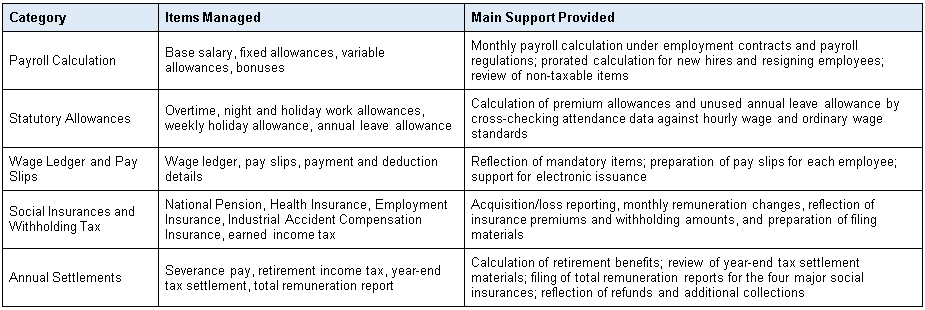
2. Scope of Service
ㆍSupport for monthly payroll calculation, preparation of wage ledgers, and issuance and delivery of pay slips for each employee
ㆍProrated payroll calculation and preparation of social insurance acquisition/loss materials when new hires, resignations, leaves of absence, and reinstatements occur
ㆍCalculation of variable pay, including overtime, night and holiday work allowances, unused annual leave allowance, bonuses, and incentives
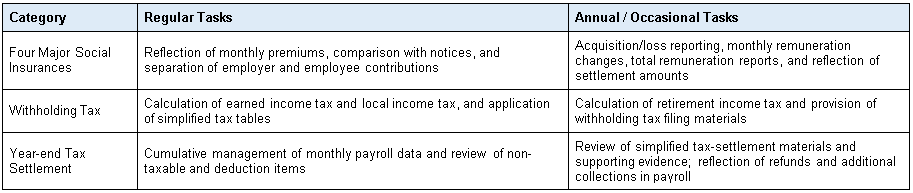
ㆍReflection of statutory deductions, including earned income tax, local income tax, and social insurance premiums, and provision of withholding tax filing materials
ㆍSupport for calculation of severance pay, average wage, retirement income tax, year-end tax settlement, and total remuneration reports for the four major social insurances
ㆍProvision of improvement opinions on payroll errors, potential wage arrears, and deficiencies in payroll regulations
II. How the Service Is Delivered | How to Deliver
The Payroll Management Service proceeds through the following structure: “initial setup -> monthly data collection -> payroll calculation -> verification and approval -> issuance of pay slips and provision of filing materials -> follow-up management.” Because an error in payroll amount can immediately lead to wage arrears, tax errors, and loss of employee trust, KangNam Labor Law Firm cross-checks attendance data and wage items and finalizes payroll after the client company’s final approval process.
1. Introduction Stage: Initial Setup and Risk Diagnosis
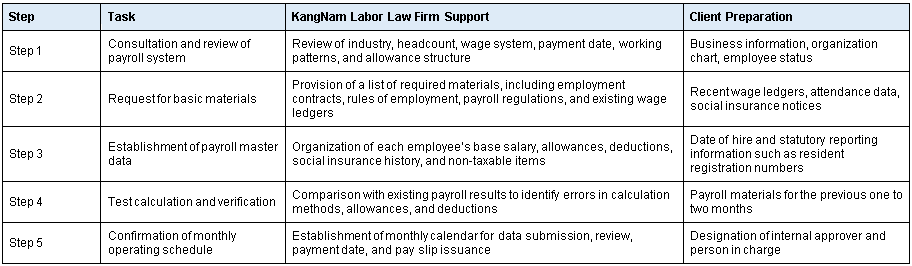
2. Regular Monthly Payroll Process
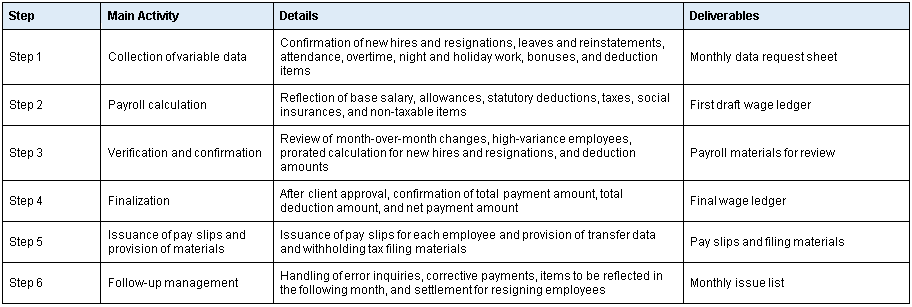
3. Key Materials to Be Provided by the Client Company Each Month
ㆍLists of new hires, resigning employees, employees on leave, and reinstated employees; changes to employment contracts; and changes in departments and positions
ㆍClock-in/out records; approved overtime, night and holiday work; and records of absences, tardiness, early departures, and unpaid leave
ㆍBonuses, incentives, meal allowances, vehicle maintenance allowances, other non-taxable allowances, and special deduction items
ㆍNotices for the four major social insurances, materials related to withholding tax payment, settlement materials for resigning employees, and evidence for year-end tax settlement
Key Management Point: Payroll calculation is not merely a matter of matching the “amounts in the payroll ledger.” Employment contracts, attendance records, rules of employment, wage regulations, and social insurance filing materials must be consistent with one another so that the company can provide stable explanations during labor inspections, wage-arrears complaints, and severance-pay disputes.
4. Detailed Support by Main Task | Detailed Support
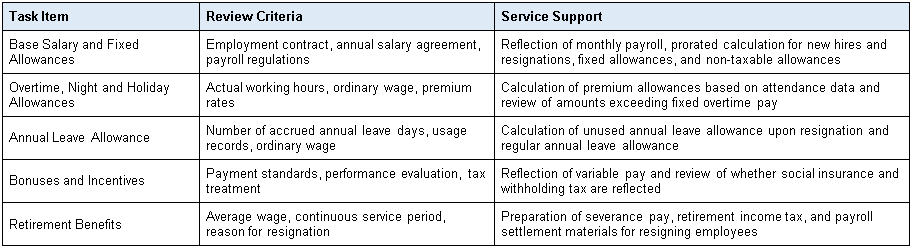
In the payroll management process, KangNam Labor Law Firm also reviews the wage payment principles under the Labor Standards Act, rules on working hours, recesses and holidays, annual leave allowance, severance pay calculation standards, and the obligation to issue pay slips. In particular, because the calculation method differs depending on each workplace’s wage system - such as monthly salary, hourly wage, daily wage, annual salary, fixed overtime pay, inclusive wage arrangements, and shift work - we document payroll calculation standards and establish a repeatable operating system.
(1) Payroll Calculation and Statutory Allowance Calculation
(2) Preparation of Wage Ledgers and Pay Slips
ㆍThe wage ledger systematically organizes monthly payment data, including names, payment periods, amounts by wage component, deduction items, and net payment amounts.
ㆍThe pay slip reflects items that employees can understand, including base salary, various allowances, bonuses, deduction items, and calculation methods.
ㆍWhen electronic issuance is required, the materials are converted into individual files for email delivery or data files for system upload.
ㆍMatters that may be pointed out in a labor inspection - such as failure to issue pay slips, omission of calculation methods, or unclear deduction details - are supplemented in advance.
(3) Support for the Four Major Social Insurances, Withholding Tax, and Year-end Tax Settlement
(4) Support for Prevention of Payroll Errors and Disputes
ㆍA month-over-month payroll variance report explains the main reasons for changes in total payroll, total deductions, and net payment amounts.
ㆍLabor-management issues are reviewed, including errors in calculating ordinary wage and average wage, problems in operating fixed overtime pay, and risks related to inclusive wage arrangements.
ㆍCalculation grounds and supporting evidence are accumulated so that the company can explain its position if wage-arrears complaints, labor inspections, or severance-pay disputes arise.
III. What Benefits Does the Client Receive? | Client Benefits
Payroll work is repeated every month, but a single error can expand into wage arrears, amended tax filings, correction filings for the four major social insurances, and employee distrust. By entrusting payroll management to KangNam Labor Law Firm, clients can secure payroll accuracy and legal stability, reduce the workload of internal staff, and focus on core HR strategy work.
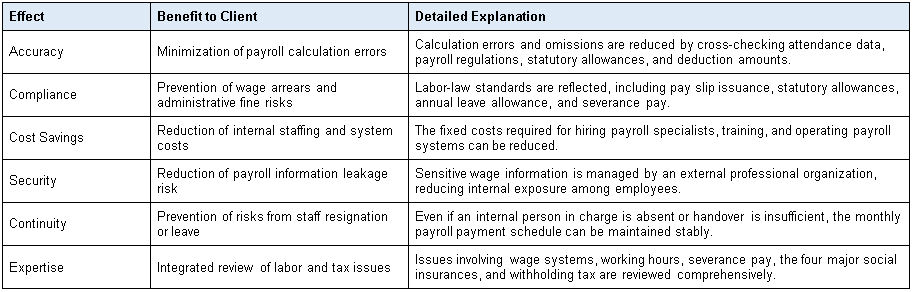
Why Entrust This Work to KangNam Labor Law Firm
ㆍWe review payroll calculation not as simple number processing, but as labor-management work connected to employment contracts, rules of employment, wage regulations, and attendance management.
ㆍBased on experience with labor inspections, wage arrears, severance pay, overtime allowance, and annual leave allowance cases, we diagnose payroll risks for each workplace.
ㆍWe manage practical materials, including wage ledgers, pay slips, withholding tax materials, social insurance materials, and severance pay calculation materials, in a consistent manner.
ㆍFor foreign-invested companies and multinational companies, we can prepare Korean- and English-based explanatory materials and organize payroll processes for head-office reporting.
ㆍWe do not falsely conclude that there is “no problem.” Instead, we clearly identify matters requiring supplementation based on actual attendance data and wage regulations.
Consultation Guidance
The scope and fee for payroll management may vary depending on the number of regular employees, payroll payment date, number of wage items, whether shift work and overtime occur, scope of social insurance filing, whether year-end tax settlement is included, and whether English reports are required. For an accurate quotation and operating schedule, a preliminary consultation should be conducted based on recent wage ledgers, employment contracts, rules of employment, wage regulations, and attendance data.
※ This material has been prepared for general information and promotional purposes. The requirements and scope of work for each individual workplace must be confirmed through separate consultation.
FAQ
Q14
Could you explain the contribution bases for Korea’s four major social insurance programs, using examples?
The contribution bases for Korea’s four major social insurance programs are as follows.
1) National Pension
National Pension contributions are calculated based on the standard monthly income, which is determined by reference to taxable employment income under Article 20 of the Income Tax Act.
The term “standard monthly income,” which serves as the basis for calculating pension contributions, is defined in Article 3(1)5 of the National Pension Act as follows:
“Standard monthly income” means the amount determined on the basis of an insured person’s monthly income for the purpose of calculating pension contributions and benefits.
2) National Health Insurance
National Health Insurance contributions are calculated based on the employee’s monthly remuneration, which is determined from the remuneration received by the employee.
Although the scope of remuneration for National Health Insurance purposes is generally similar to the scope of employment income under Article 20 of the Income Tax Act, the direct statutory basis is found in Articles 69 and 70 of the National Health Insurance Act and Article 33 of its Enforcement Decree.
The contribution base for National Health Insurance is independently determined under the following provisions:
Article 69(4)1 of the National Health Insurance Act: calculation of monthly remuneration-based insurance contributions
Article 70 of the National Health Insurance Act: definitions of monthly remuneration and remuneration
Article 33 of the Enforcement Decree of the National Health Insurance Act: items included in and excluded from remuneration
3) Employment Insurance and 4) Industrial Accident Compensation Insurance
For Employment Insurance and Industrial Accident Compensation Insurance, “remuneration” generally means employment income under Article 20 of the Income Tax Act, less any payments expressly excluded by law.
Accordingly, even a payment that does not constitute ordinary wage may be included in the social insurance contribution base if it constitutes taxable employment income or remuneration under the applicable social insurance laws.
The following examples illustrate this principle.
1) Company Performance Bonuses
A performance bonus paid by a company to an employee on the basis of the employment relationship generally constitutes employment income in the form of a bonus or similar compensation, even where the amount is determined according to the company’s business performance.
Accordingly, even where a performance bonus does not satisfy the requirements for ordinary wage, such as regularity or uniformity, it is generally included in the social insurance contribution base if it is paid on the basis of the employment relationship and constitutes taxable employment income under the Income Tax Act.
2) Birthday Bonuses
Where a birthday bonus is provided solely for congratulatory or employee-welfare purposes, it will generally not constitute ordinary wage because it is not paid in consideration for prescribed work.
However, its treatment for social insurance purposes must be determined separately. Even where a cash birthday bonus is not paid as compensation for work, it may generally be included in the social insurance contribution base if it is paid on the basis of the employment relationship and constitutes taxable employment income or remuneration under the applicable social insurance laws.
3) Overtime Pay
Overtime pay itself does not constitute ordinary wage. Ordinary wage is the statutory basis used to calculate additional pay for overtime, night work, and holiday work.
However, overtime pay actually paid to an employee constitutes remuneration or employment income paid in consideration for work and is therefore generally included in the social insurance contribution base.
The key point is that the contribution bases for Korea’s four major social insurance programs are not determined by reference to “ordinary wage” under the Labor Standards Act. Instead, they are determined by the concepts of “income” or “remuneration” separately defined under the respective social insurance laws.
Therefore, even where a payment does not constitute ordinary wage because it lacks a sufficient connection to the work performed, regularity, or uniformity, it will generally be included in the social insurance contribution base if it is paid on the basis of the employment relationship and constitutes taxable employment income under the Income Tax Act.
4) Business travel expenses
Overseas business travel expenses are incurred when an employee travels abroad to perform duties on behalf of the company. To the extent that such expenses are paid in accordance with the company’s overseas business travel expense policy and are reasonably sufficient to cover the actual expenses incurred, they are regarded as reimbursements of actual expenses and therefore constitute non-taxable income.
(National Tax Service Interpretation: Income Tax, Corporate Tax Division 46013-1932, September 18, 2000)
The assessment bases for earned income tax and the four major social insurance contributions?namely, income or remuneration?are generally determined by deducting non-taxable income from the income prescribed under the Income Tax Act.
Accordingly, overseas business travel expenses should be excluded not only when calculating earned income tax but also when calculating the four major social insurance contributions.
1) National Pension
National Pension contributions are calculated based on the standard monthly income, which is determined by reference to taxable employment income under Article 20 of the Income Tax Act.
The term “standard monthly income,” which serves as the basis for calculating pension contributions, is defined in Article 3(1)5 of the National Pension Act as follows:
“Standard monthly income” means the amount determined on the basis of an insured person’s monthly income for the purpose of calculating pension contributions and benefits.
2) National Health Insurance
National Health Insurance contributions are calculated based on the employee’s monthly remuneration, which is determined from the remuneration received by the employee.
Although the scope of remuneration for National Health Insurance purposes is generally similar to the scope of employment income under Article 20 of the Income Tax Act, the direct statutory basis is found in Articles 69 and 70 of the National Health Insurance Act and Article 33 of its Enforcement Decree.
The contribution base for National Health Insurance is independently determined under the following provisions:
Article 69(4)1 of the National Health Insurance Act: calculation of monthly remuneration-based insurance contributions
Article 70 of the National Health Insurance Act: definitions of monthly remuneration and remuneration
Article 33 of the Enforcement Decree of the National Health Insurance Act: items included in and excluded from remuneration
3) Employment Insurance and 4) Industrial Accident Compensation Insurance
For Employment Insurance and Industrial Accident Compensation Insurance, “remuneration” generally means employment income under Article 20 of the Income Tax Act, less any payments expressly excluded by law.
Accordingly, even a payment that does not constitute ordinary wage may be included in the social insurance contribution base if it constitutes taxable employment income or remuneration under the applicable social insurance laws.
The following examples illustrate this principle.
1) Company Performance Bonuses
A performance bonus paid by a company to an employee on the basis of the employment relationship generally constitutes employment income in the form of a bonus or similar compensation, even where the amount is determined according to the company’s business performance.
Accordingly, even where a performance bonus does not satisfy the requirements for ordinary wage, such as regularity or uniformity, it is generally included in the social insurance contribution base if it is paid on the basis of the employment relationship and constitutes taxable employment income under the Income Tax Act.
2) Birthday Bonuses
Where a birthday bonus is provided solely for congratulatory or employee-welfare purposes, it will generally not constitute ordinary wage because it is not paid in consideration for prescribed work.
However, its treatment for social insurance purposes must be determined separately. Even where a cash birthday bonus is not paid as compensation for work, it may generally be included in the social insurance contribution base if it is paid on the basis of the employment relationship and constitutes taxable employment income or remuneration under the applicable social insurance laws.
3) Overtime Pay
Overtime pay itself does not constitute ordinary wage. Ordinary wage is the statutory basis used to calculate additional pay for overtime, night work, and holiday work.
However, overtime pay actually paid to an employee constitutes remuneration or employment income paid in consideration for work and is therefore generally included in the social insurance contribution base.
The key point is that the contribution bases for Korea’s four major social insurance programs are not determined by reference to “ordinary wage” under the Labor Standards Act. Instead, they are determined by the concepts of “income” or “remuneration” separately defined under the respective social insurance laws.
Therefore, even where a payment does not constitute ordinary wage because it lacks a sufficient connection to the work performed, regularity, or uniformity, it will generally be included in the social insurance contribution base if it is paid on the basis of the employment relationship and constitutes taxable employment income under the Income Tax Act.
4) Business travel expenses
Overseas business travel expenses are incurred when an employee travels abroad to perform duties on behalf of the company. To the extent that such expenses are paid in accordance with the company’s overseas business travel expense policy and are reasonably sufficient to cover the actual expenses incurred, they are regarded as reimbursements of actual expenses and therefore constitute non-taxable income.
(National Tax Service Interpretation: Income Tax, Corporate Tax Division 46013-1932, September 18, 2000)
The assessment bases for earned income tax and the four major social insurance contributions?namely, income or remuneration?are generally determined by deducting non-taxable income from the income prescribed under the Income Tax Act.
Accordingly, overseas business travel expenses should be excluded not only when calculating earned income tax but also when calculating the four major social insurance contributions.
Q13
What should companies be careful about in managing the four major social insurance systems?
When hiring employees, companies must first determine whether the employee is subject to the four major social insurance systems and must complete acquisition and loss notifications within the statutory deadlines.
Eligibility is not determined by the job title or employment type, but by actual working conditions, working hours, employment duration, and income level. Therefore, companies must separately assess eligibility for regular employees, fixed-term employees, part-time workers, daily workers, and foreign workers.
The burden of insurance contributions varies by type of insurance. National pension, health insurance, and long-term care insurance are shared between employer and employee. Employment insurance is also partially shared, although a portion (employment stabilization and vocational skills development contribution) is borne by the employer. Industrial accident compensation insurance is fully borne by the employer and cannot be deducted from employee wages.
Accordingly, when paying wages, companies must deduct the employee’s share of national pension, health insurance, long-term care insurance, and employment insurance in accordance with statutory requirements.
At the same time, companies must not only calculate net pay but also manage acquisition and loss reports, contribution responsibilities, correctness of deductions, and settlement adjustments.
Changes in wages, working hours, leave status, retirement, hiring and resignation dates, or changes in foreign workers’ visa status may all affect insurance eligibility and contributions. Failure to properly reflect such changes may result in underpayment or overpayment and subsequent disputes or adjustments.
Therefore, management of the four major social insurance systems is not merely administrative work, but a core component of payroll and labor management. Failure to properly handle enrollment, delayed reporting, incorrect deductions, or improper burden of industrial accident insurance contributions may lead to penalties, additional assessments, and disputes with employees.
Eligibility is not determined by the job title or employment type, but by actual working conditions, working hours, employment duration, and income level. Therefore, companies must separately assess eligibility for regular employees, fixed-term employees, part-time workers, daily workers, and foreign workers.
The burden of insurance contributions varies by type of insurance. National pension, health insurance, and long-term care insurance are shared between employer and employee. Employment insurance is also partially shared, although a portion (employment stabilization and vocational skills development contribution) is borne by the employer. Industrial accident compensation insurance is fully borne by the employer and cannot be deducted from employee wages.
Accordingly, when paying wages, companies must deduct the employee’s share of national pension, health insurance, long-term care insurance, and employment insurance in accordance with statutory requirements.
At the same time, companies must not only calculate net pay but also manage acquisition and loss reports, contribution responsibilities, correctness of deductions, and settlement adjustments.
Changes in wages, working hours, leave status, retirement, hiring and resignation dates, or changes in foreign workers’ visa status may all affect insurance eligibility and contributions. Failure to properly reflect such changes may result in underpayment or overpayment and subsequent disputes or adjustments.
Therefore, management of the four major social insurance systems is not merely administrative work, but a core component of payroll and labor management. Failure to properly handle enrollment, delayed reporting, incorrect deductions, or improper burden of industrial accident insurance contributions may lead to penalties, additional assessments, and disputes with employees.
Q12
Are part-time workers entitled to weekly holiday allowance and severance pay?
Yes. Part-time workers or hourly workers may be entitled to weekly holiday allowance and severance pay if they meet certain requirements.
Weekly holiday allowance arises when the worker has completed all scheduled working days in a week and has a scheduled working time of at least 15 hours per week. In such cases, the weekly holiday is treated as a paid day off, and the worker receives wages even for the day not actually worked.
Severance pay also applies if the worker has a scheduled working time of at least 15 hours per week and has continuously worked for at least one year.
Therefore, being a part-time worker does not automatically exclude entitlement to weekly holiday allowance or severance pay. Determination must be made based on actual working conditions, scheduled working hours, and continuous service period.
Conversely, workers with less than 15 scheduled working hours per week are generally excluded from weekly holiday allowance and severance pay provisions.
Weekly holiday allowance arises when the worker has completed all scheduled working days in a week and has a scheduled working time of at least 15 hours per week. In such cases, the weekly holiday is treated as a paid day off, and the worker receives wages even for the day not actually worked.
Severance pay also applies if the worker has a scheduled working time of at least 15 hours per week and has continuously worked for at least one year.
Therefore, being a part-time worker does not automatically exclude entitlement to weekly holiday allowance or severance pay. Determination must be made based on actual working conditions, scheduled working hours, and continuous service period.
Conversely, workers with less than 15 scheduled working hours per week are generally excluded from weekly holiday allowance and severance pay provisions.
Q11
How is average wage calculated when certain periods are excluded?
In principle, average wage is calculated by dividing the total wages paid during the three months immediately preceding the date on which the calculation cause occurred by the total number of days in that period.
However, if that period includes time during which the employee could not normally provide labor, the calculated average wage may become unfairly lower than the actual wage level. To prevent this, the law excludes certain periods from the calculation base.
Typical excluded periods include: periods of medical leave for occupational injury, maternity leave, miscarriage/stillbirth leave, parental leave, suspension of work due to reasons attributable to the employer, and lawful periods of industrial action.
In such cases, both the excluded period and any wages paid during that period are excluded from the calculation, and the average wage is computed based only on the remaining period and wages.
For example, if part of the three-month calculation period includes parental leave or occupational injury treatment, that period and any wages paid during it are excluded, and the calculation is made based on the remaining working period and wages.
This system is intended to prevent unfair reduction of wages used as the basis for retirement allowances, leave allowance, and industrial accident compensation.
Therefore, when calculating average wage, companies must not mechanically sum the wages of the three-month period before the calculation date. They must first check whether any statutory excluded periods exist.
In addition, if the calculated average wage is lower than the employee’s ordinary wage, the ordinary wage must be used instead. This is provided under Article 2(2) of the Labor Standards Act and is intended to prevent average wage from being unfairly reduced due to temporary leave, suspension, or absence.
However, if that period includes time during which the employee could not normally provide labor, the calculated average wage may become unfairly lower than the actual wage level. To prevent this, the law excludes certain periods from the calculation base.
Typical excluded periods include: periods of medical leave for occupational injury, maternity leave, miscarriage/stillbirth leave, parental leave, suspension of work due to reasons attributable to the employer, and lawful periods of industrial action.
In such cases, both the excluded period and any wages paid during that period are excluded from the calculation, and the average wage is computed based only on the remaining period and wages.
For example, if part of the three-month calculation period includes parental leave or occupational injury treatment, that period and any wages paid during it are excluded, and the calculation is made based on the remaining working period and wages.
This system is intended to prevent unfair reduction of wages used as the basis for retirement allowances, leave allowance, and industrial accident compensation.
Therefore, when calculating average wage, companies must not mechanically sum the wages of the three-month period before the calculation date. They must first check whether any statutory excluded periods exist.
In addition, if the calculated average wage is lower than the employee’s ordinary wage, the ordinary wage must be used instead. This is provided under Article 2(2) of the Labor Standards Act and is intended to prevent average wage from being unfairly reduced due to temporary leave, suspension, or absence.
Q10
How is the minimum wage calculated, and does it apply equally to all employees?
Minimum wage compliance is not determined by total wages paid, but only by the portion of wages that fall within the statutory minimum wage inclusion scope.
Therefore, not only base salary but also certain regular bonuses or welfare allowances may be included in the minimum wage calculation, while items such as overtime pay, night work pay, holiday work pay, and annual leave allowances are generally excluded.
Accordingly, companies must not assess minimum wage compliance based solely on base salary. They must carefully examine whether each wage component?such as meal allowances, bonuses, and welfare benefits?is included in the minimum wage calculation base.
Minimum wage generally applies to all employees regardless of job type, nationality, or employment status. Therefore, foreign workers, fixed-term workers, and part-time workers cannot be paid below the minimum wage.
However, in limited cases such as trainee or probationary employees, reduced minimum wage application may be allowed only if statutory requirements are strictly satisfied, and such conditions must be carefully verified.
Therefore, not only base salary but also certain regular bonuses or welfare allowances may be included in the minimum wage calculation, while items such as overtime pay, night work pay, holiday work pay, and annual leave allowances are generally excluded.
Accordingly, companies must not assess minimum wage compliance based solely on base salary. They must carefully examine whether each wage component?such as meal allowances, bonuses, and welfare benefits?is included in the minimum wage calculation base.
Minimum wage generally applies to all employees regardless of job type, nationality, or employment status. Therefore, foreign workers, fixed-term workers, and part-time workers cannot be paid below the minimum wage.
However, in limited cases such as trainee or probationary employees, reduced minimum wage application may be allowed only if statutory requirements are strictly satisfied, and such conditions must be carefully verified.
Q9
When must “leave allowance (paid suspension allowance)” be paid?
Leave allowance must be paid when an employee cannot provide labor due to reasons attributable to the employer.
Here, “reasons attributable to the employer” do not only refer to intentional or negligent acts by the employer, but also include management-related causes such as business conditions, lack of raw materials, reduced orders, declining sales, production adjustments, or unilateral suspension of work decisions.
Therefore, if employees are not allowed to work due to company circumstances, or are not given work even after reporting to work, or if working days or hours are reduced, such cases generally fall under leave allowance obligations.
In such cases, the employer must pay at least 70% of the employee’s average wage as leave allowance. If 70% of the average wage exceeds the ordinary wage, the ordinary wage may be paid instead.
However, in cases of force majeure?such as natural disasters, war, or direct government orders due to infectious diseases?where the employer cannot reasonably be held responsible, the obligation to pay leave allowance may not apply.
Ultimately, whether leave allowance is required depends on whether the cause lies within the employer’s management sphere or is due to unavoidable external force majeure.
Here, “reasons attributable to the employer” do not only refer to intentional or negligent acts by the employer, but also include management-related causes such as business conditions, lack of raw materials, reduced orders, declining sales, production adjustments, or unilateral suspension of work decisions.
Therefore, if employees are not allowed to work due to company circumstances, or are not given work even after reporting to work, or if working days or hours are reduced, such cases generally fall under leave allowance obligations.
In such cases, the employer must pay at least 70% of the employee’s average wage as leave allowance. If 70% of the average wage exceeds the ordinary wage, the ordinary wage may be paid instead.
However, in cases of force majeure?such as natural disasters, war, or direct government orders due to infectious diseases?where the employer cannot reasonably be held responsible, the obligation to pay leave allowance may not apply.
Ultimately, whether leave allowance is required depends on whether the cause lies within the employer’s management sphere or is due to unavoidable external force majeure.
Q8
How long should payroll-related records be retained?
Documents such as wage ledgers, employment contracts, wage statements, attendance records, annual leave management data, and retirement allowance calculation records must be retained for at least the legally required retention period.
In practice, it is safer to retain them for a sufficient period considering wage claims, retirement allowances, annual leave compensation, four major insurances, and tax audits.
Key records the company should maintain include:
Record Purpose
Employment contract Proof of wage conditions
Wage ledger Proof of payment details
Wage statement Proof of wage calculation breakdown
Attendance records Basis for overtime calculation
Payroll transfer records Proof of actual payment
Annual leave register Prevention of leave disputes
Retirement allowance calculation sheet Basis for retirement payment
If such records are missing, even if wages were actually paid, the company may have difficulty proving it.
In practice, it is safer to retain them for a sufficient period considering wage claims, retirement allowances, annual leave compensation, four major insurances, and tax audits.
Key records the company should maintain include:
Record Purpose
Employment contract Proof of wage conditions
Wage ledger Proof of payment details
Wage statement Proof of wage calculation breakdown
Attendance records Basis for overtime calculation
Payroll transfer records Proof of actual payment
Annual leave register Prevention of leave disputes
Retirement allowance calculation sheet Basis for retirement payment
If such records are missing, even if wages were actually paid, the company may have difficulty proving it.
Q7
What should be considered in payroll management for retirement allowance calculations?
Retirement allowance is generally calculated based on the average wage for the three months immediately prior to retirement. Therefore, payroll records, bonuses, annual leave allowances, various allowances, deductions for absences, and leave periods must be accurately managed.
The following items are commonly disputed in retirement allowance cases:
Item Key Consideration
Bonus May be included in average wage depending on whether it is regular and continuous
Annual leave allowance Must confirm calculation period and payment timing
Meal/allowances Must assess whether they constitute wages
Leave periods Must determine whether excluded from average wage calculation
Performance bonuses Must be evaluated based on payment conditions and continuity
Errors in payroll management can directly lead to errors in retirement allowance calculations.
The following items are commonly disputed in retirement allowance cases:
Item Key Consideration
Bonus May be included in average wage depending on whether it is regular and continuous
Annual leave allowance Must confirm calculation period and payment timing
Meal/allowances Must assess whether they constitute wages
Leave periods Must determine whether excluded from average wage calculation
Performance bonuses Must be evaluated based on payment conditions and continuity
Errors in payroll management can directly lead to errors in retirement allowance calculations.
Q6
Are meal allowances, vehicle allowances, and communication allowances considered wages?
They are not determined by their name alone; their actual nature must be examined.
If such payments are made regularly and uniformly and are considered compensation for work, they may be recognized as wages.
Item Determination Critera
Meal allowance May be considered wages if paid fixed monthly
Vehicle allowance Depends on whether it is reimbursement or fixed allowance
Communication allowance May be non-wage if reimbursed based on receipts
Welfare benefits Depends on regularity, uniformity, and payment conditions
These items may affect calculations of minimum wage, ordinary wages, average wages, and retirement allowances, so their classification must be clearly defined and managed.
If such payments are made regularly and uniformly and are considered compensation for work, they may be recognized as wages.
Item Determination Critera
Meal allowance May be considered wages if paid fixed monthly
Vehicle allowance Depends on whether it is reimbursement or fixed allowance
Communication allowance May be non-wage if reimbursed based on receipts
Welfare benefits Depends on regularity, uniformity, and payment conditions
These items may affect calculations of minimum wage, ordinary wages, average wages, and retirement allowances, so their classification must be clearly defined and managed.
Q5
Can a company deduct wages for lateness, absence, or damages?
If an employee does not work due to unauthorized absence, lateness, or early leave, wages for the corresponding non-worked time may be withheld under the “no work, no pay” principle.
However, employers are generally restricted from unilaterally deducting penalties, damages, training costs, or equipment costs from wages.
Under the Labor Standards Act, wages must be paid in full, and deductions are only permitted in limited cases based on legal grounds or specific provisions in a collective agreement.
Statutory deductions such as national pension, health insurance, employment insurance, and income tax are allowed.
However, deducting employer damages or penalty-type amounts from wages unilaterally is risky and may be illegal.
However, employers are generally restricted from unilaterally deducting penalties, damages, training costs, or equipment costs from wages.
Under the Labor Standards Act, wages must be paid in full, and deductions are only permitted in limited cases based on legal grounds or specific provisions in a collective agreement.
Statutory deductions such as national pension, health insurance, employment insurance, and income tax are allowed.
However, deducting employer damages or penalty-type amounts from wages unilaterally is risky and may be illegal.
Q4
If a fixed (inclusive) wage system is used, do we still need to pay overtime separately?
Yes, it may still be required. Even under a fixed or inclusive wage system, additional overtime, night work, or holiday work allowances must be paid if actual working hours exceed the agreed scope.
For an inclusive wage system to be considered valid and safe, the following must be clear:
Item Content
Legal basis Clearly stated in the employment contract or wage agreement
Wage breakdown Base salary and fixed overtime allowance must be distinguishable
Included hours Must specify how many hours of overtime are included
Additional payment Extra payment required if hours are exceeded
Time tracking Actual working hours must be recorded and retained
A simple statement such as “all allowances are included in the annual salary” is not sufficient.
For an inclusive wage system to be considered valid and safe, the following must be clear:
Item Content
Legal basis Clearly stated in the employment contract or wage agreement
Wage breakdown Base salary and fixed overtime allowance must be distinguishable
Included hours Must specify how many hours of overtime are included
Additional payment Extra payment required if hours are exceeded
Time tracking Actual working hours must be recorded and retained
A simple statement such as “all allowances are included in the annual salary” is not sufficient.
Q3
Is a wage ledger mandatory?
Yes. Employers must prepare and retain a wage ledger for each employee.
The wage ledger must include items such as name, date of birth, date of hire, job duties, wage calculation basis (including family allowances if applicable), number of working days, working hours, overtime/night/holiday hours, base salary, allowances, and deductions.
The wage ledger is one of the most important documents in labor inspections, wage arrears disputes, and retirement allowance disputes.
If the wage ledger, actual bank transfer records, employment contract, and attendance records do not match, the employer may be at a disadvantage.
The wage ledger must include items such as name, date of birth, date of hire, job duties, wage calculation basis (including family allowances if applicable), number of working days, working hours, overtime/night/holiday hours, base salary, allowances, and deductions.
The wage ledger is one of the most important documents in labor inspections, wage arrears disputes, and retirement allowance disputes.
If the wage ledger, actual bank transfer records, employment contract, and attendance records do not match, the employer may be at a disadvantage.
Q2
Is it mandatory to issue wage statements?
Yes. Employers must issue a wage statement when paying wages.
The wage statement must include total wages, breakdown of wage components, deduction items, and calculation methods.
In particular, items such as overtime pay, night work pay, and holiday work pay?which require calculations?should clearly show the basis of calculation.
Failure to issue a wage statement or omission of required information may result in an administrative fine.
The Ministry of Employment and Labor also provides wage statement templates and guidance on how to prepare them.
The wage statement must include total wages, breakdown of wage components, deduction items, and calculation methods.
In particular, items such as overtime pay, night work pay, and holiday work pay?which require calculations?should clearly show the basis of calculation.
Failure to issue a wage statement or omission of required information may result in an administrative fine.
The Ministry of Employment and Labor also provides wage statement templates and guidance on how to prepare them.
Q1
What are the most basic requirements in payroll management?
Employers must pay wages on a fixed payday, in cash, directly to the employee, and in full. This is referred to as the “four principles of wage payment.”
Accordingly, delaying the payday at the employer’s discretion, deducting part of wages without the employee’s consent, or paying wages in kind is generally not permitted.
The fundamentals of payroll management are as follows:
Item Key Content
Employment contract Specifies wage structure, calculation method, and payment date
Wage ledger Records wage payment details for each employee
Wage statement Issued to employees every month
Payroll transfer records Evidence of actual payment (bank transfer proof)
Accordingly, delaying the payday at the employer’s discretion, deducting part of wages without the employee’s consent, or paying wages in kind is generally not permitted.
The fundamentals of payroll management are as follows:
Item Key Content
Employment contract Specifies wage structure, calculation method, and payment date
Wage ledger Records wage payment details for each employee
Wage statement Issued to employees every month
Payroll transfer records Evidence of actual payment (bank transfer proof)
Key Representative Cases