

Mandatory Training Labor Consulting & Legal Representation
Consultation Request
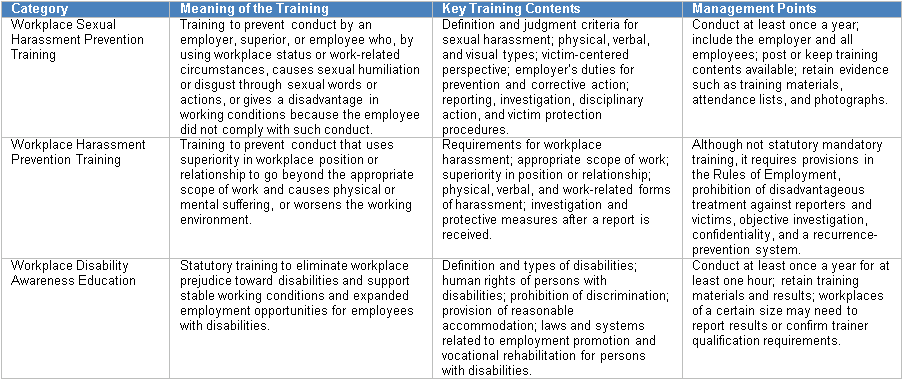
Workplace Sexual Harassment Prevention TrainingㆍWorkplace Harassment Prevention TrainingㆍDisability Awareness Education
The Mandatory Training Service is not merely a service for providing training materials. It is a preventive labor-management service in which a certified labor attorney reviews the company’s statutory obligations and organizational culture risks together, and supports training design, delivery, and evidence management tailored to the characteristics of the workplace.
I. What Service
KangNam Labor Law Firm provides training customized to each company’s circumstances on workplace sexual harassment, workplace harassment, and disability awareness, which employers and employees must understand. In particular, for foreign-invested companies, foreign schools, and multinational companies, we explain the differences between Korean labor law standards and internal global policies, and conduct practical case-based training designed to produce real preventive effects.
1. Scope of Representation
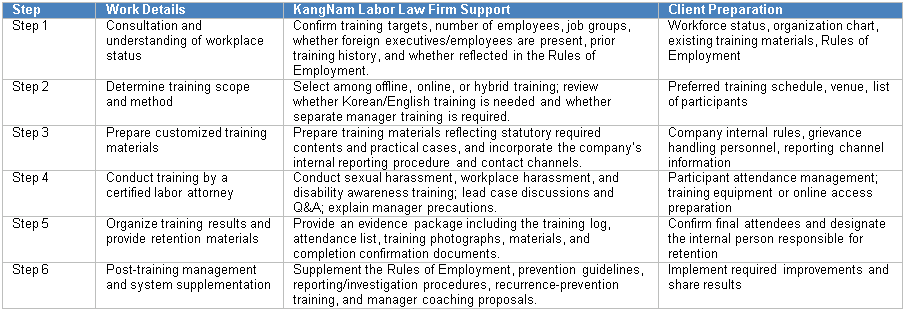
ㆍWe first review the workplace size, industry, workforce composition, whether foreign executives and employees are present, existing training materials, and Rules of Employment.
ㆍWe check the legally required contents for each of the three training areas and prepare customized training materials reflecting company policies, cases, and Q&A.
ㆍA certified labor attorney conducts the training on-site or online, and after training organizes the attendance list, training photographs, materials, and training log.
ㆍWhere necessary, we also review the Rules of Employment, sexual harassment and workplace harassment handling procedures, and internal rules related to disability discrimination prohibition and reasonable accommodation.
II. How to Deliver
The Mandatory Training Service is designed not to end with “training delivery and evidence retention,” but to enable the company to explain its training compliance and preventive measures in the event of an actual dispute or labor inspection. KangNam Labor Law Firm provides comprehensive support from preliminary diagnosis, preparation of training materials, lectures, Q&A, organization of training results, and post-training supplementation.
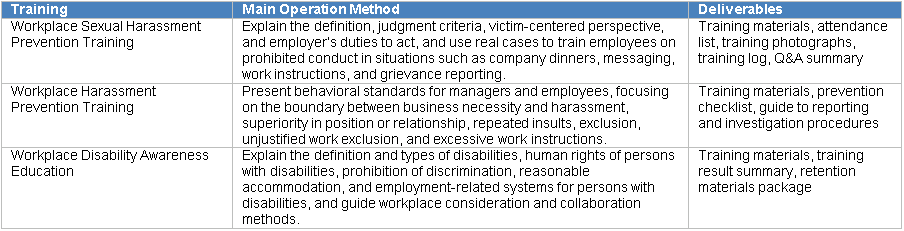
1. Detailed Operation Method by Training Type
2. Preliminary Materials and Evidence Management
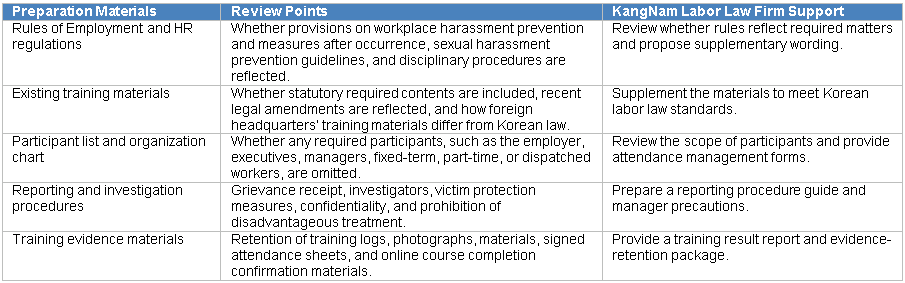
To improve training effectiveness, the company’s actual reporting procedures, Rules of Employment, grievance handling personnel, and participant management must be organized together with the training materials. In particular, workplace sexual harassment prevention training may not be recognized if only materials are distributed, so it is important to conduct the training in a way that confirms whether the training contents were actually delivered.
3. Key Management Points for Training Operation
ㆍEnsure that the CEO, executives, managers, contract employees, part-time employees, and other actual workers are not omitted from the training targets.
ㆍFor sexual harassment and workplace harassment training, preventive effects are stronger when the training explains, through cases, which words and actions are problematic rather than merely explaining the law.
ㆍRegardless of whether workplace harassment prevention training is statutory mandatory training, it is directly connected to the Rules of Employment provisions on prevention, investigation, and protective measures.
ㆍDisability awareness education should cover prohibition of discrimination and reasonable accommodation, as well as practical collaboration methods in the workplace.
ㆍAfter training, it is safest to organize training materials, participants, photographs, Q&A, and training logs so that they can be retained for at least three years.
Key management point: Once a sexual harassment or workplace harassment incident occurs, it can expand into issues involving investigation, disciplinary action, victim protection, prohibition of disadvantageous treatment, and restoration of organizational culture. Therefore, mandatory training should not be operated as a mere annual event, but as a process to organize the company’s prevention system and manager behavior standards.
III. Client Benefits
Mandatory training is not a formality to avoid administrative fines. It is a practical preventive mechanism that prevents workplace disputes and helps managers and employees share common standards for a safe working environment. By entrusting training to KangNam Labor Law Firm, the company can fulfill its statutory obligations while also strengthening its ability to respond to actual incidents.
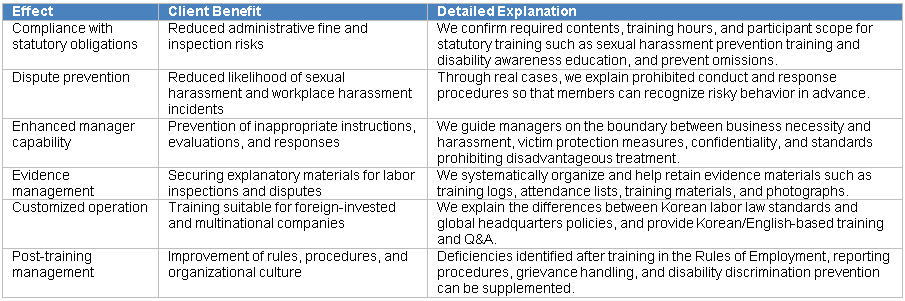
Why Entrust This Service to KangNam Labor Law Firm
ㆍBecause a certified labor attorney directly conducts the training, we can explain not only lecture content but also Korean labor law and practical incident-response standards.
ㆍWorkplace sexual harassment prevention training, workplace harassment prevention training, and disability awareness education can be operated as one integrated prevention system.
ㆍOur experience in labor inspections, workplace harassment and sexual harassment investigations, Rules of Employment revision, disciplinary action, and dismissal cases can be connected to practical training examples.
ㆍWe can provide Korean/English training materials and consultations for foreign-invested companies, foreign schools, and multinational companies.
ㆍAfter training, we provide a result report and evidence materials that clients can retain immediately, helping them prepare for future disputes and inspections.
Information Required for Consultation
The training structure and required time may vary depending on the number of training participants, training language, online or offline format, whether existing training materials are available, and the status of the Rules of Employment and internal reporting procedures. Accurate quotations and schedules will be provided after a preliminary consultation confirming the workplace status and preferred training method.
Note: This material has been prepared for general guidance and promotional purposes; individual workplaces require separate consultation to confirm applicable requirements.
FAQ
Q8
What is the most important practical consideration regarding mandatory workplace training?
It is not sufficient to treat mandatory workplace training merely as a formality by saying, “We conducted the legally required training once a year.”
Companies should separately manage the participants, training hours, training content, training methods, and supporting documentation for each type of training.
In particular, the following five matters are the most important in practice.
Key Management Item Description
1) Verification of Training Participants Determine whether the training applies to all employees or only to specific personnel
2) Management of Training Cycles Verify whether the training is annual, upon hiring, periodic, or otherwise required
3) Satisfaction of Training Content Requirements Confirm that all legally required training content is included
4) Supplemental Training for Absentees Prevent omissions involving employees on leave, business trips, or newly hired employees
5) Retention of Supporting Documentation Retain training logs, attendance signatures, certificates of completion, photographs, and training materials
Therefore, it is advisable for companies to prepare an annual mandatory training schedule at the beginning of each year and to manage both new-hire training and periodic training together.
Companies should separately manage the participants, training hours, training content, training methods, and supporting documentation for each type of training.
In particular, the following five matters are the most important in practice.
Key Management Item Description
1) Verification of Training Participants Determine whether the training applies to all employees or only to specific personnel
2) Management of Training Cycles Verify whether the training is annual, upon hiring, periodic, or otherwise required
3) Satisfaction of Training Content Requirements Confirm that all legally required training content is included
4) Supplemental Training for Absentees Prevent omissions involving employees on leave, business trips, or newly hired employees
5) Retention of Supporting Documentation Retain training logs, attendance signatures, certificates of completion, photographs, and training materials
Therefore, it is advisable for companies to prepare an annual mandatory training schedule at the beginning of each year and to manage both new-hire training and periodic training together.
Q7
Are online training programs or distribution of materials alone recognized as satisfying mandatory training requirements?
It depends on the type of training.
Some training programs may be conducted through various methods such as online training, video training, distribution of materials, posting notices, or sending emails. However, not all training can be replaced simply by distributing materials.
Training Online Training Permitted Distribution of Materials Alone Permitted
Occupational Safety and Health Training Permitted, but training content, duration, and management are required As a principle, simple distribution alone may be insufficient
Sexual Harassment Prevention Training Permitted Posting or distribution may be permitted for small workplaces meeting certain requirements
Disability Awareness Training Permitted Workplaces with fewer than 50 regular employees may use distribution, posting, or email methods
Personal Information Protection Training Permitted Effectiveness of the training and retention of records are required
Retirement Pension Training Permitted Materials provided by retirement pension service providers may be used
The Korea Employment Agency for Persons with Disabilities explains that employers with fewer than 50 regular employees may conduct workplace disability awareness training by distributing or posting educational materials supplied by the Minister of Employment and Labor or by sending such materials by email.
Therefore, companies should verify which methods are permitted for each type of training. It is not sufficient merely to say that “the materials were sent.” Companies should retain educational materials, attendance lists, training logs, online completion records, photographs, and training reports.
Some training programs may be conducted through various methods such as online training, video training, distribution of materials, posting notices, or sending emails. However, not all training can be replaced simply by distributing materials.
Training Online Training Permitted Distribution of Materials Alone Permitted
Occupational Safety and Health Training Permitted, but training content, duration, and management are required As a principle, simple distribution alone may be insufficient
Sexual Harassment Prevention Training Permitted Posting or distribution may be permitted for small workplaces meeting certain requirements
Disability Awareness Training Permitted Workplaces with fewer than 50 regular employees may use distribution, posting, or email methods
Personal Information Protection Training Permitted Effectiveness of the training and retention of records are required
Retirement Pension Training Permitted Materials provided by retirement pension service providers may be used
The Korea Employment Agency for Persons with Disabilities explains that employers with fewer than 50 regular employees may conduct workplace disability awareness training by distributing or posting educational materials supplied by the Minister of Employment and Labor or by sending such materials by email.
Therefore, companies should verify which methods are permitted for each type of training. It is not sufficient merely to say that “the materials were sent.” Companies should retain educational materials, attendance lists, training logs, online completion records, photographs, and training reports.
Q6
Must all companies conduct retirement pension training?
No. Retirement pension training is required not for all companies, but for companies that have established a retirement pension system.
The Employee Retirement Benefit Security Act provides that an employer that has established a retirement pension system must provide education to participants at least once every year.
In practice, companies operating defined benefit (DB), defined contribution (DC), or hybrid retirement pension plans must provide annual education to participants.
Employers may delegate the provision of such education to retirement pension service providers, and in practice retirement pension providers such as banks, insurance companies, and securities companies often provide online educational materials or training platforms.
However, if a company operates only a traditional severance pay system and has not introduced a retirement pension system, the obligation to provide retirement pension participant education does not arise.
The Employee Retirement Benefit Security Act provides that an employer that has established a retirement pension system must provide education to participants at least once every year.
In practice, companies operating defined benefit (DB), defined contribution (DC), or hybrid retirement pension plans must provide annual education to participants.
Employers may delegate the provision of such education to retirement pension service providers, and in practice retirement pension providers such as banks, insurance companies, and securities companies often provide online educational materials or training platforms.
However, if a company operates only a traditional severance pay system and has not introduced a retirement pension system, the obligation to provide retirement pension participant education does not arise.
Q5
Must all employees receive personal information protection training?
In principle, personal information protection training is intended for personnel who handle personal information.
The Personal Information Protection Commission explains that, pursuant to Article 28 of the Personal Information Protection Act, businesses, organizations, and individuals that operate personal information files for business purposes must provide training to personnel handling personal information in order to ensure the proper handling of personal information.
Here, personnel handling personal information refers to persons who access or process personal information in the course of their duties, including in human resources, general affairs, payroll, labor relations, accounting, sales, customer management, and IT administration.
Therefore, it cannot be definitively stated that all employees must receive personal information protection training. However, because most companies have departments that handle employee personal information, customer information, or contact information of business partners, many companies operate it as company-wide training.
In practice, it is safer to operate the training as follows.
Category Training Method
Personnel handling personal information ?Subject to mandatory training
Departments with access to personal information Recommended to be included in the training 대상
All employees Company-wide training recommended for the prevention of personal information leaks
The Personal Information Protection Commission explains that, pursuant to Article 28 of the Personal Information Protection Act, businesses, organizations, and individuals that operate personal information files for business purposes must provide training to personnel handling personal information in order to ensure the proper handling of personal information.
Here, personnel handling personal information refers to persons who access or process personal information in the course of their duties, including in human resources, general affairs, payroll, labor relations, accounting, sales, customer management, and IT administration.
Therefore, it cannot be definitively stated that all employees must receive personal information protection training. However, because most companies have departments that handle employee personal information, customer information, or contact information of business partners, many companies operate it as company-wide training.
In practice, it is safer to operate the training as follows.
Category Training Method
Personnel handling personal information ?Subject to mandatory training
Departments with access to personal information Recommended to be included in the training 대상
All employees Company-wide training recommended for the prevention of personal information leaks
Q4
Must all companies also conduct disability awareness training in the workplace?
Yes. Disability awareness training in the workplace is legally required training that must be provided to employers and employees.
The Enforcement Decree of the Employment Promotion and Vocational Rehabilitation of Persons with Disabilities Act provides that employers must conduct workplace disability awareness training once per year for at least one hour.
The training should include the following content.
- Understanding disabilities and respecting differences arising from disabilities
- Human rights of persons with disabilities in the workplace
- Prohibition of discrimination against persons with disabilities and provision of reasonable accommodations
- Laws and systems relating to employment promotion and vocational rehabilitation of persons with disabilities
- Other matters necessary for improving disability awareness in the workplace
The training portal of the Korea Employment Agency for Persons with Disabilities also explains that the training applies to all employers and employees, including fixed-term and part-time employees, and that additional training should be conducted for employees who were absent due to business travel, leave, or other reasons.
The Enforcement Decree of the Employment Promotion and Vocational Rehabilitation of Persons with Disabilities Act provides that employers must conduct workplace disability awareness training once per year for at least one hour.
The training should include the following content.
- Understanding disabilities and respecting differences arising from disabilities
- Human rights of persons with disabilities in the workplace
- Prohibition of discrimination against persons with disabilities and provision of reasonable accommodations
- Laws and systems relating to employment promotion and vocational rehabilitation of persons with disabilities
- Other matters necessary for improving disability awareness in the workplace
The training portal of the Korea Employment Agency for Persons with Disabilities also explains that the training applies to all employers and employees, including fixed-term and part-time employees, and that additional training should be conducted for employees who were absent due to business travel, leave, or other reasons.
Q3
Who must receive workplace sexual harassment prevention training?
Both employers and employees must receive workplace sexual harassment prevention training.
Employers must conduct workplace sexual harassment prevention training at least once per year, and both employers and employees must participate in the training.
The training should generally include the following content.
Training Content Description
Laws and regulations relating to workplace sexual harassment Definition of sexual harassment and employer obligations
Procedures for handling sexual harassment incidents Reporting, investigation, victim protection, and measures against the perpetrator
Grievance counseling and remedies for affected employees Internal reporting channels and external remedy procedures
Company policies for preventing sexual harassment Organizational culture, prohibited conduct, and disciplinary standards
Even where the number of regularly employed workers is small or the workplace consists of only one gender, the training obligation does not disappear.
However, certain small workplaces may satisfy the requirement through the posting or distribution of educational materials. Accordingly, the training method should be operated in a manner appropriate for the size and composition of the workplace.
Employers must conduct workplace sexual harassment prevention training at least once per year, and both employers and employees must participate in the training.
The training should generally include the following content.
Training Content Description
Laws and regulations relating to workplace sexual harassment Definition of sexual harassment and employer obligations
Procedures for handling sexual harassment incidents Reporting, investigation, victim protection, and measures against the perpetrator
Grievance counseling and remedies for affected employees Internal reporting channels and external remedy procedures
Company policies for preventing sexual harassment Organizational culture, prohibited conduct, and disciplinary standards
Even where the number of regularly employed workers is small or the workplace consists of only one gender, the training obligation does not disappear.
However, certain small workplaces may satisfy the requirement through the posting or distribution of educational materials. Accordingly, the training method should be operated in a manner appropriate for the size and composition of the workplace.
Q2
Must all companies conduct occupational safety and health training?
The applicability of occupational safety and health training and the required training hours vary depending on the industry, size, and nature of the workplace.
In general, employers must provide safety and health training to employees. The main categories of training are regular training, training upon hiring, training when job duties change, special training, and supervisor training.
In particular, occupational safety and health training is very important for manufacturing businesses, construction businesses, logistics businesses, workplaces using equipment and machinery, and workplaces performing hazardous or dangerous work.
Even for office-based workplaces, it should not automatically be assumed that they are completely exempt. Whether employees are subject to training should be determined based on the applicable industry and employee classification.
Occupational safety and health training is not merely a formal requirement. It is a fundamental procedure for accident prevention and management of serious accident risks.
Failure to provide training, inadequate training records, or failure to provide training to newly hired employees may become significant findings during a labor inspection or following an industrial accident.
In general, employers must provide safety and health training to employees. The main categories of training are regular training, training upon hiring, training when job duties change, special training, and supervisor training.
In particular, occupational safety and health training is very important for manufacturing businesses, construction businesses, logistics businesses, workplaces using equipment and machinery, and workplaces performing hazardous or dangerous work.
Even for office-based workplaces, it should not automatically be assumed that they are completely exempt. Whether employees are subject to training should be determined based on the applicable industry and employee classification.
Occupational safety and health training is not merely a formal requirement. It is a fundamental procedure for accident prevention and management of serious accident risks.
Failure to provide training, inadequate training records, or failure to provide training to newly hired employees may become significant findings during a labor inspection or following an industrial accident.
Q1
What mandatory workplace training programs must a company conduct?
The workplace training programs that a company generally needs to review are as follows.
Training Main Participants Basic Frequency
Occupational Safety and Health Training Employees, supervisors, etc. Regular training, training upon hiring, training when job duties change, special training
Workplace Sexual Harassment Prevention Training Employers and employees At least once per year
Disability Awareness Training in the Workplace Employers and employees Once per year, at least 1 hour
Personal Information Protection Training Personnel handling personal information Regular training
Retirement Pension Training Participants in a retirement pension plan At least once per year
Workplace Harassment Prevention Training No express provision as legally mandatory training Recommended
Fire Safety and Safety-Related Training Applicable personnel depending on industry and facility Varies according to applicable laws and regulations
However, the same training requirements do not apply uniformly to all companies. Training obligations and required training hours vary depending on factors such as industry, number of regular employees, whether personal information is processed, whether a retirement pension plan has been adopted, and whether hazardous or dangerous work is performed.
Training Main Participants Basic Frequency
Occupational Safety and Health Training Employees, supervisors, etc. Regular training, training upon hiring, training when job duties change, special training
Workplace Sexual Harassment Prevention Training Employers and employees At least once per year
Disability Awareness Training in the Workplace Employers and employees Once per year, at least 1 hour
Personal Information Protection Training Personnel handling personal information Regular training
Retirement Pension Training Participants in a retirement pension plan At least once per year
Workplace Harassment Prevention Training No express provision as legally mandatory training Recommended
Fire Safety and Safety-Related Training Applicable personnel depending on industry and facility Varies according to applicable laws and regulations
However, the same training requirements do not apply uniformly to all companies. Training obligations and required training hours vary depending on factors such as industry, number of regular employees, whether personal information is processed, whether a retirement pension plan has been adopted, and whether hazardous or dangerous work is performed.
Key Representative Cases