

Yellow Envelope Act Labor Consulting & Legal Representation
Consultation Request
Advisory Support for Diagnosing Principal Contractor-Subcontractor Labor-Management Risks and Responding to Collective Bargaining under the Amended Trade Union Act
The Yellow Envelope Act Special Advisory Service is a preventive labor-management advisory service designed to diagnose in advance the risks that companies may face following the implementation of amended Articles 2 and 3 of the Trade Union Act, including expanded recognition of employer status, the expanded scope of labor disputes, restrictions on damage claims, and collective bargaining risks in principal contractor-subcontractor relationships. It also supports the establishment of an appropriate response system.
I. What Service
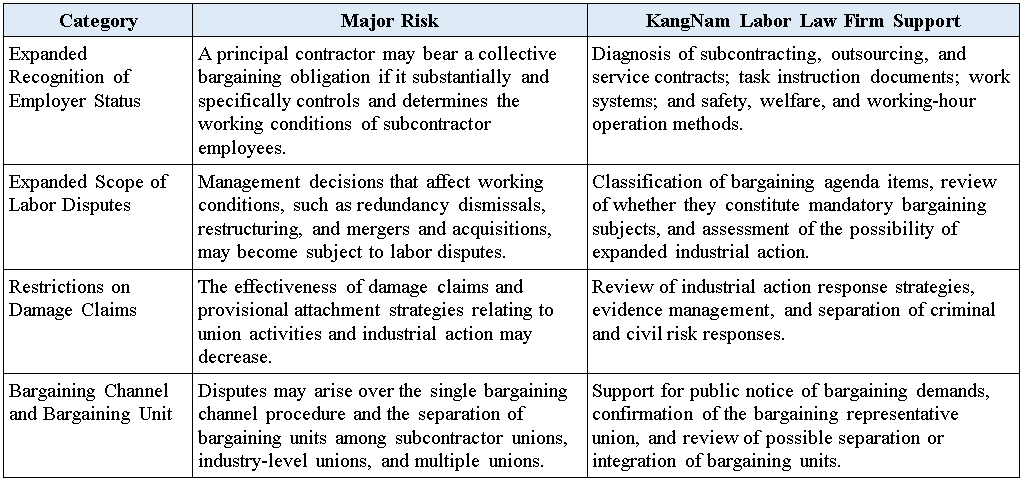
The Yellow Envelope Act directly affects principal contractor-subcontractor relationships, multiple unions, collective bargaining, industrial action, and damage claim risks through the amendments to Articles 2 and 3 of the Trade Union Act. In particular, even a party that did not sign an employment contract may be recognized as an employer if it can substantially and specifically control and determine working conditions. The subject matter of labor disputes is also expanded to include business management decisions that affect working conditions and clear violations of collective agreements.
1. Major Advisory Areas
2. Scope of Service
ㆍDiagnosis of company-specific labor-management risks under amended Articles 2 and 3 of the Trade Union Act.
ㆍReview of the likelihood of recognizing employer status beyond contract privity in principal contractor-subcontractor, service, outsourcing, and commissioned work structures.
ㆍAdvisory support for step-by-step responses to collective bargaining demands by subcontractor unions or industry-level unions.
ㆍAnalysis of whether agenda items such as restructuring, business transfer, outsourcing, and occupational safety and health may become bargaining subjects due to the expanded scope of labor disputes.
ㆍEstablishment of response strategies for civil and criminal risks relating to industrial action, assemblies, workplace occupation, obstruction of business, and damage claims.
ㆍTraining for HR managers and site managers on responding to the Yellow Envelope Act, and provision of practical manuals.
II. How to Deliver
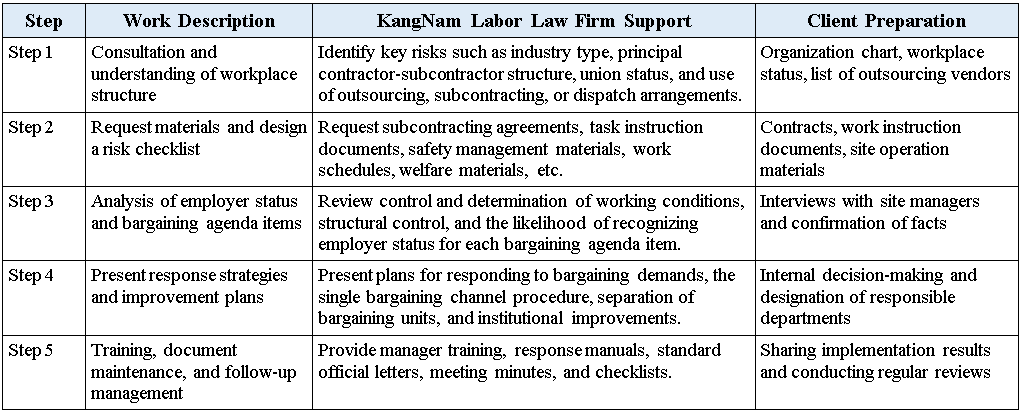
The Yellow Envelope Act Special Advisory Service is not a mere explanation of the law. It is a practical advisory service that evaluates in advance whether collective bargaining obligations may arise based on the company's actual work structure and principal contractor-subcontractor operating methods. It also prepares step-by-step responses from the receipt of bargaining demands to the single bargaining channel procedure, review of bargaining agenda items, and responses to industrial action.
1. Common Process
2. Preliminary Materials to Prepare
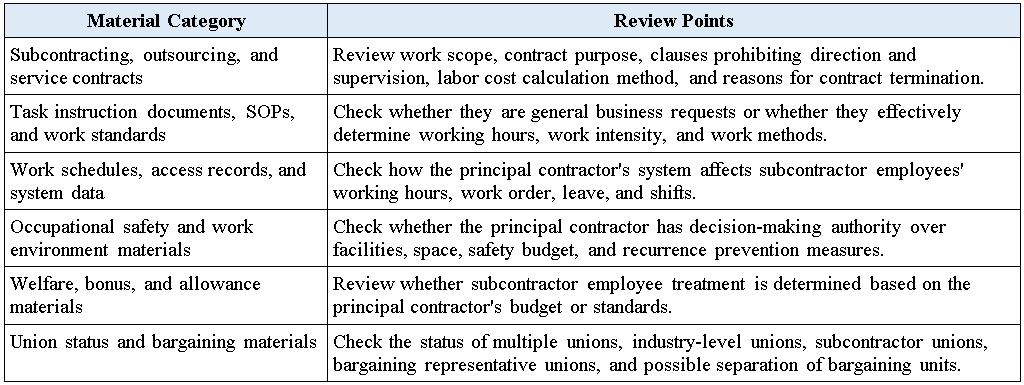
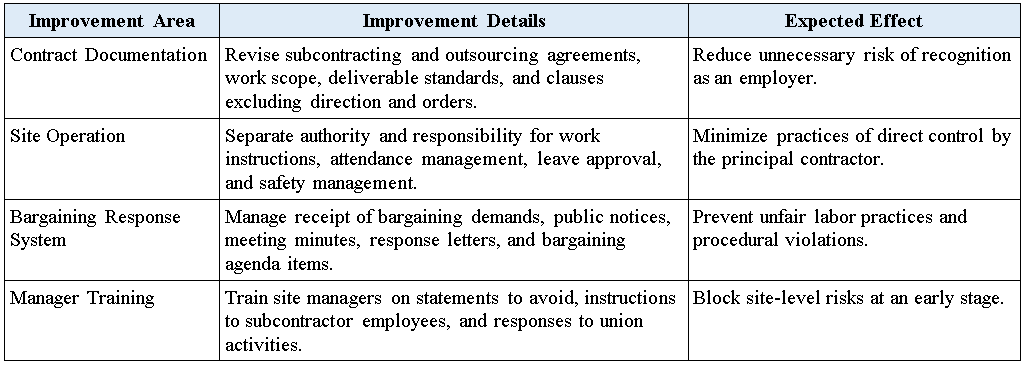
Key Management Point : Responding to the Yellow Envelope Act may be too late if a company waits until bargaining demands arrive after the law takes effect. Companies should check in advance whether their contracts, systems, and site operation practices already structurally control the working conditions of subcontractor employees.
3. Detailed Advisory Support by Major Review Area
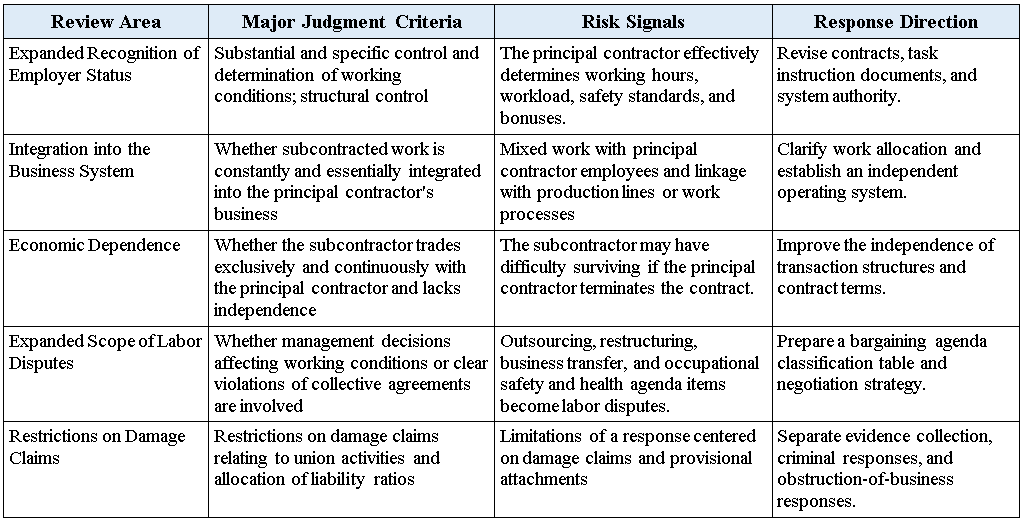
KangNam Labor Law Firm diagnoses the key risks under the amended Trade Union Act by dividing them into employer status, bargaining agenda items, industrial action, damage claims, and bargaining channel procedures. In particular, advance review is necessary for manufacturing, logistics, distribution, facility management, IT operations, security, cleaning, catering, and outsourcing structures used by foreign-invested companies where bargaining demands from subcontractor unions are expected
(1) Key Checklist for the Yellow Envelope Act
(2) Practical Response When Bargaining Demands Arise
ㆍWhen a subcontractor union or industry-level union demands bargaining with the principal contractor, first confirm the entity making the demand, the bargaining agenda items, and the scope of the relevant employees.
ㆍFor each bargaining agenda item, distinguish whether it concerns working conditions that the principal contractor substantially and specifically controls and determines.
ㆍIf multiple unions exist, review the single bargaining channel procedure, determination of the bargaining representative union, and possible separation of bargaining units.
ㆍPrepare a legal opinion in advance on whether refusal to bargain may be deemed an unfair labor practice.
ㆍPrepare a site response manual in anticipation of applications for labor dispute mediation, strike votes, strikes, assemblies, and workplace occupation.
(3) Support for Improving Internal Company Systems
III. Client Benefits
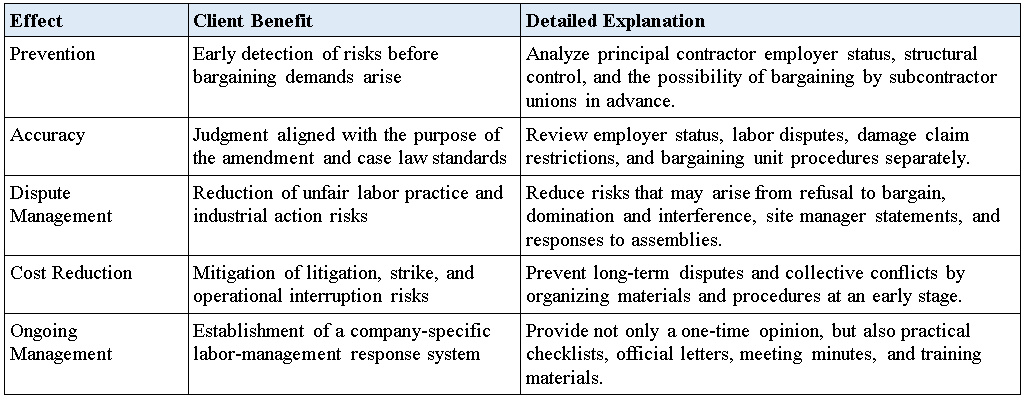
After the Yellow Envelope Act takes effect, corporate labor-management risks may expand beyond internal issues at a single workplace to principal contractor-subcontractor relationships, partner companies, industry-level unions, and multiple-union issues. By engaging KangNam Labor Law Firm, clients can interpret the amended law according to their actual workplace operations and establish a response system before bargaining demands or industrial action occur.
Why Choose KangNam Labor Law Firm
ㆍWe have practical experience comprehensively handling the Trade Union Act, collective bargaining, unfair labor practices, the single bargaining channel procedure, and separation of bargaining units.
ㆍWe can provide Korean and English advisory services for principal contractor-subcontractor relationships, foreign-invested companies, multinational companies, and workplaces with multiple unions.
ㆍWe do not stop at legal review, but also provide practical materials, including contracts, task instruction documents, site operation guidelines, manager training, and bargaining-related official letters.
ㆍWe do not unnecessarily conclude that there is “no problem.” Instead, we present the risk level and improvement direction based on the facts and supporting evidence of each workplace.
ㆍWe can connect regular reviews and follow-up management in line with institutional changes before and after implementation of the Yellow Envelope Act.
Consultation Notes
Risks under the Yellow Envelope Act may vary depending on the industry, the number of subcontractors, the subcontracting contract structure, the method of site instructions, the union organization type, bargaining agenda items, and the contents of existing collective agreements. For an accurate diagnosis, the workplace structure and related supporting documents must first be reviewed through a preliminary consultation.
※ This material has been prepared for general information and promotional purposes. Individual workplaces should confirm the applicable requirements through separate consultation.
FAQ
Q7
What should companies prepare for the enforcement of the Yellow Envelope Act?
First, companies must review structures involving subcontracting, outsourcing, dispatching, platform work, and freelancers. In particular, even if there is no direct employment relationship, employer status issues may arise if there is substantial influence over working conditions, so on-site command structures and decision-making processes must be clearly defined.Second, when a bargaining request is made, companies should not simply refuse on the basis that “they are not our employees,” but must first examine whether the company substantially and specifically controls the relevant working conditions.Third, when industrial actions occur, companies should not rely solely on post-event responses such as damages, disciplinary action, or criminal complaints, but should establish systems for prior bargaining, mediation, and dialogue.Fourth, training of on-site managers is important. If managers directly issue work instructions to subcontracted workers or improperly interfere with union activities, this may lead to employer status issues and unfair labor practice risks for the entire company.Ultimately, the key task for companies after the enforcement of the Yellow Envelope Act is to accurately understand the distinction between “contractual employer” and “substantive employer,” and to align actual workplace operations with legal standards.
Q6
What should companies be most careful about after the enforcement of the Yellow Envelope Act?
Companies should first review whether they are exercising any influence over working conditions of subcontracted, outsourced, or dispatched workers, not only their directly employed workers. If a parent company is substantially involved in subcontracted workers’ work methods, working hours, staffing allocation, safety management, evaluation, or manpower operations, issues of employer status may arise.In addition, when labor union activities or industrial actions occur, companies should not immediately respond only with damage claims or disciplinary measures, but should also review bargaining obligations, whether the situation qualifies as a labor dispute, the legality of industrial actions, and risks of unfair labor practices.In particular, companies with parent?subcontractor structures must verify whether service contracts match actual operations, whether subcontractors independently handle personnel and labor management, and whether instructions are properly channeled through subcontractor supervisors.
Q5
Does the Yellow Envelope Act fully exempt damages caused by illegal strikes?
No. The Yellow Envelope Act does not completely exempt labor unions or workers from liability for damages. Its purpose is to limit excessive claims for damages against lawful union activities and industrial actions.If an industrial action involves unlawful means such as violence, destruction, occupation of facilities, or obstruction of business, civil liability for damages or criminal liability may still arise. However, even when damages are recognized, courts must consider each individual’s conduct, level of participation, and degree of contribution to the damage in a specific and differentiated manner.In other words, the Yellow Envelope Act is not a law that allows “no liability for any strike,” but rather a law that restricts excessive and blanket damage claims against labor activities.
Q4
How is the scope of labor disputes expanded?
The Yellow Envelope Act expands the scope of labor disputes. Previously, labor disputes were mainly understood as conflicts regarding the “determination” of working conditions such as wages, working hours, welfare, and dismissal. The amended law expands this to include disagreements concerning working conditions more broadly.As a result, disputes involving restructuring, employment succession, bargaining obligations of parent companies, implementation of collective agreements, and managerial actions affecting working conditions may more broadly fall within the scope of labor disputes.However, not all disputes automatically qualify as lawful industrial actions. To be lawful, industrial actions must satisfy legal requirements in terms of subject, purpose, procedures, and methods. Therefore, even with the expanded scope of labor disputes, illegal acts such as violence, destruction, or occupation are not protected.
Q3
Must a parent company engage in collective bargaining with all subcontracted unions?
No. A parent company is not required to engage in collective bargaining with all subcontracted labor unions without exception. Whether a parent company has employer status is determined on a case-by-case basis depending on whether it has substantial and specific authority to control and decide particular working conditions.For example, if a subcontractor independently determines wages, personnel management, attendance, work assignment, and disciplinary actions, and the parent company only manages contractual outputs or quality standards under the service agreement, the employer status of the parent company may be limited. Conversely, if the parent company directly controls subcontracted workers’ work methods, working hours, staffing allocation, or work execution methods, or if the subcontractor cannot exercise independent decision-making authority in practice, the parent company’s duty to bargain may arise.Therefore, companies must review the actual command-and-control structure, work instruction methods, contractual authority, on-site operational practices, and the locus of decision-making power over working conditions in parent?subcontractor relationships.
Q2
How does the scope of “employer” change under the Yellow Envelope Act?
Under the previous framework, an “employer” was mainly understood as the direct party to the employment contract, such as the business owner, business manager, or a person acting on behalf of the employer. However, the amended law expands this definition so that a person who is not a direct party to the employment contract may still be regarded as an employer within the relevant scope if they are in a position to substantially and specifically control or determine the worker’s working conditions.Accordingly, if a parent company (original contractor) exercises substantial and concrete influence over subcontracted workers’ wages, working hours, work methods, manpower management, safety management, or contract terms, it may be recognized as an employer to a certain extent. However, a parent company is not automatically recognized as an employer for all subcontracted workers solely by virtue of being a parent company; the key criterion is whether it has substantial and specific control over particular working conditions.
Q1
What is the Yellow Envelope Act?
The Yellow Envelope Act refers to amendments to Articles 2 and 3 of the Trade Union and Labor Relations Adjustment Act. The main contents are strengthening the protection of labor union activities and industrial actions, expanding bargaining obligations of employers with substantial influence such as parent companies, and limiting liability for damages related to industrial actions.The reason this law is called the “Yellow Envelope Act” is that in the past, large claims for damages against workers after industrial actions became an issue, and a fundraising campaign by citizens to support them symbolically used yellow envelopes. Therefore, the core of the Yellow Envelope Act is not limited to restricting damages, but rather expanding bargaining between those who actually determine working conditions in parent?subsidiary structures and labor unions.양식의 맨 아래
Key Representative Cases