

HR & Labor Audit Labor Consulting & Legal Representation
Consultation Request
HR & Labor Law Audit Service | Preventive Diagnosis for Labor Law Compliance and HR Risk Management
The HR and labor law audit service is a preventive labor management service in which a licensed labor attorney objectively reviews the company’s HR and labor systems and actual operations, identifies in advance possible legal violations, wage and working-hour risks, and deficiencies in HR systems, and supports improvement measures.
I. What Service Is Provided
An HR and labor law audit is a process of investigating and reviewing whether a company’s HR and labor management system is being operated properly based on laws, regulations, or objective standards, and then presenting improvement measures based on the findings. While audits in the past focused mainly on detecting violations after the fact, a modern HR and labor law audit is a preventive consulting audit that checks issues in advance so that the company does not operate in the wrong direction.
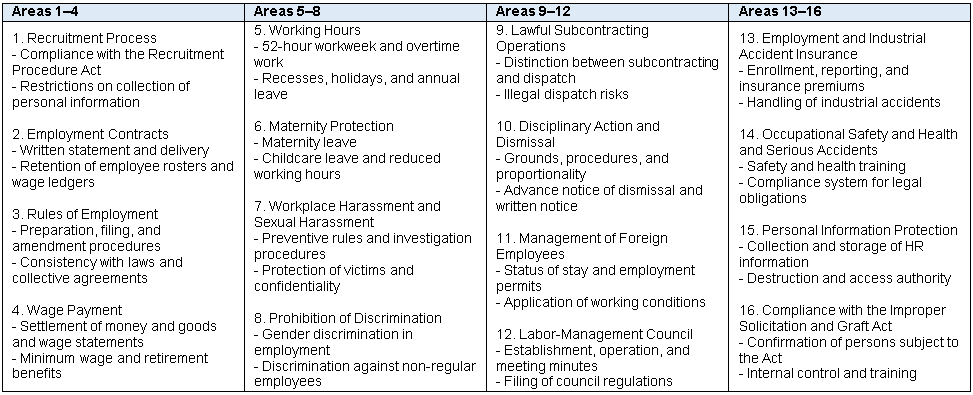
Based on its HR and Labor Law Audit Manual and practical checklists, KangNam Labor Law Firm comprehensively reviews the major HR and labor areas of the workplace, including recruitment, employment contracts, rules of employment, wages, working hours, leave, maternity protection, workplace harassment and sexual harassment, discrimination, subcontracting, disciplinary action and dismissal, foreign employees, labor-management councils, the four major social insurances, occupational safety and health, and personal information protection.
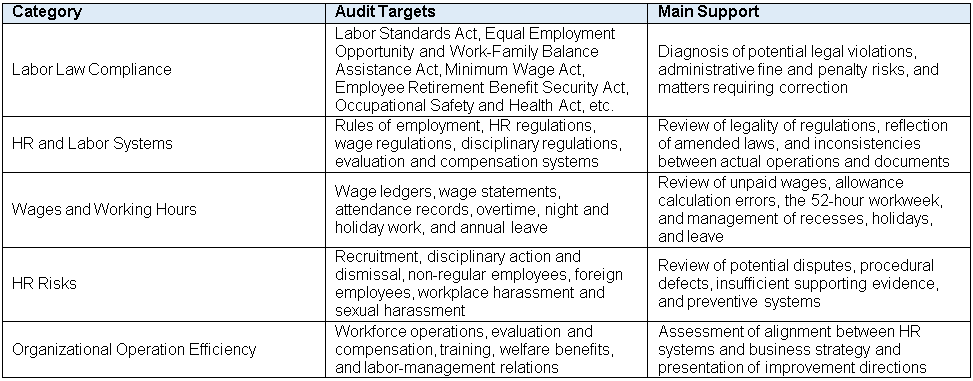
1. Major Service Areas
2. Scope of Service
ㆍHR and labor diagnosis through an on-site visit by a licensed labor attorney or a remote document review
ㆍComprehensive review from the perspectives of labor law compliance and the efficiency of human resource operations
ㆍReview of key supporting documents such as employment contracts, wage ledgers, attendance records, rules of employment, and HR regulations
ㆍInterviews with the representative, HR personnel, and field managers, and confirmation of on-site operating practices when necessary
ㆍProvision of an HR and labor law audit report summarizing potential violations, required improvements, and priorities for correction
ㆍSupport for supplementary forms, amendments to regulations, wage recalculation, training, and follow-up management
II. How the Service Is Delivered
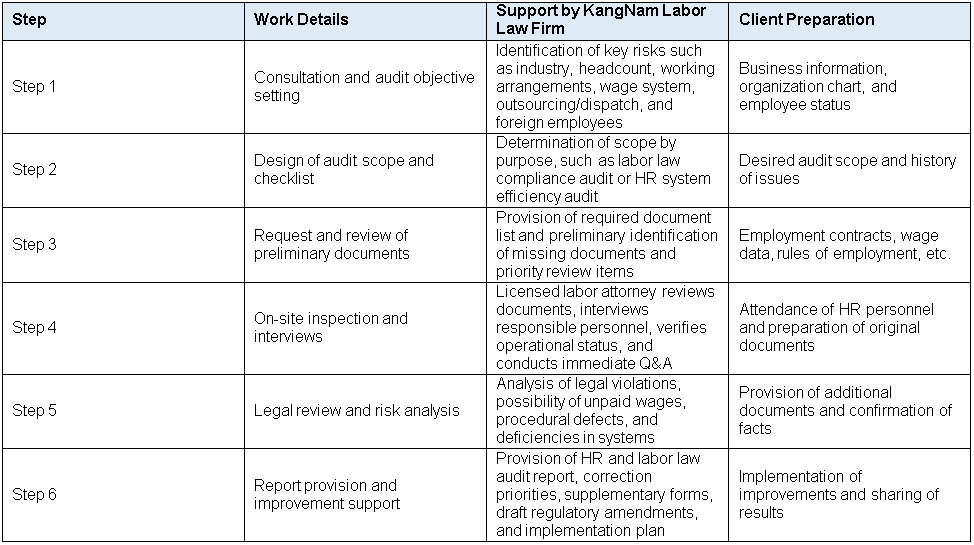
The HR and labor law audit service proceeds in the order of “diagnosis → analysis → improvement → follow-up management.” Its purpose is not merely to complete a checklist, but to verify whether the company’s actual operating practices match its documents and to reduce in advance the risk factors that may lead to a labor office investigation, labor inspection, or labor dispute.
1. Common Procedure
2. Documents to Prepare in Advance
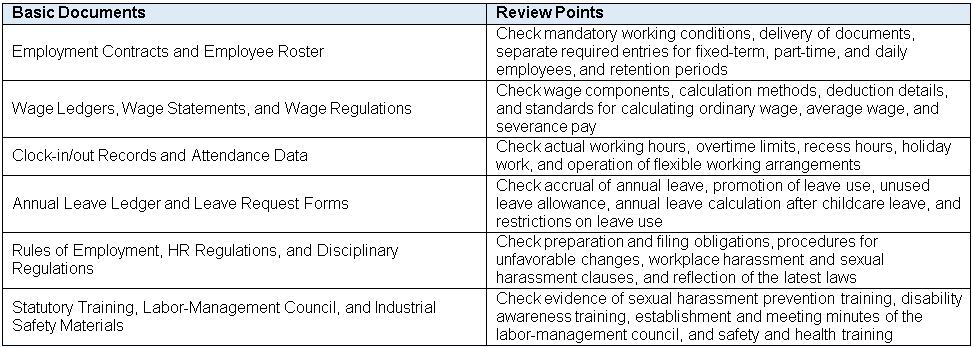
Key management point: An HR and labor law audit is not a procedure that reviews only one document. The key is to compare wage ledgers, attendance data, employment contracts, rules of employment, and actual operating practices to identify inconsistencies between the “documented system” and “on-site operations.”
3. Detailed Support by Major Audit Area/div>
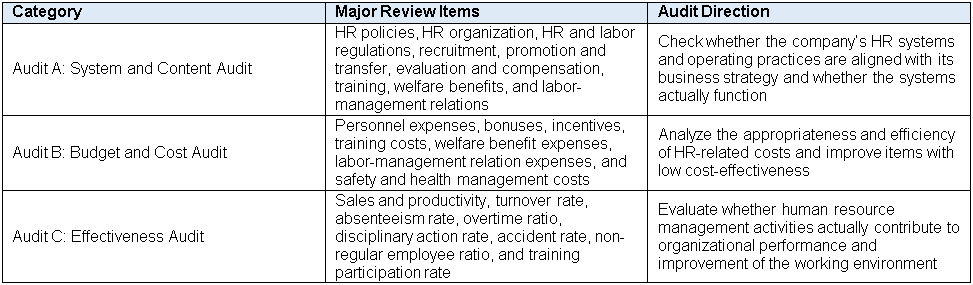
KangNam Labor Law Firm conducts HR and labor law audits from two perspectives: compliance with labor-related laws and the efficiency of HR and labor operations. In particular, items that may escalate into unpaid wages, administrative fines, criminal penalties, labor relations commission cases, labor office complaints, or collective disputes in the event of a legal violation are managed as priority review items.
ㆍComprehensive HR and labor law audit report: summary of the audit scope, major findings, legal risks, and improvement measures
ㆍChecklist result table: grading as excellent / requires supplementation / prompt correction / urgent correction
ㆍCorrective action table: presentation of potential violations, required measures, responsible department, required documents, and completion deadline
ㆍSupplementary forms and draft regulations: provision of employment contracts, wage statements, annual leave management ledgers, draft amendments to the rules of employment, and related documents
ㆍFollow-up meeting: confirmation of whether improvement measures have been implemented and additional Q&A
The cost of checking and improving issues in advance through an HR and labor law audit is far lower than the cost of responding after a problem occurs. By entrusting an audit to KangNam Labor Law Firm, clients can identify potential violations of labor-related laws in advance and systematically reorganize their HR and labor systems and actual operations.
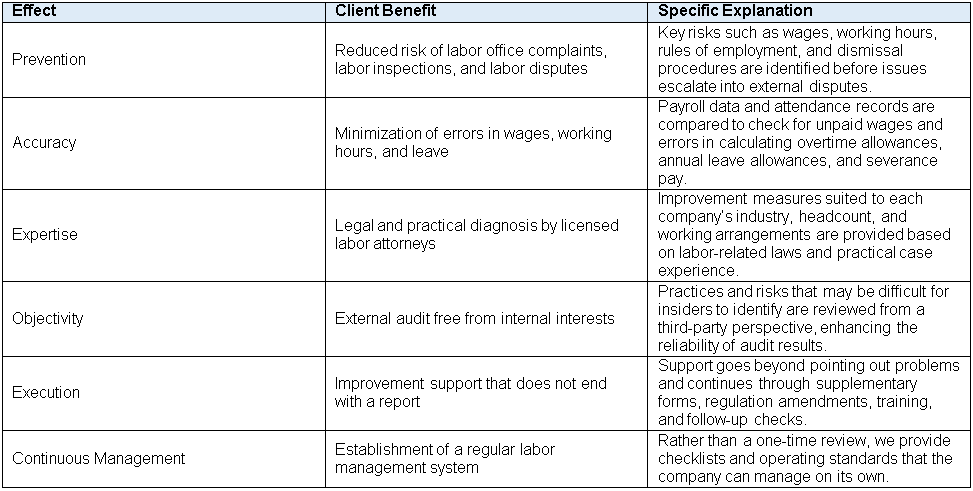
ㆍWe provide a systematic audit process based on the HR and Labor Law Audit Manual and labor law compliance checklists.
ㆍWe diagnose risks based on practical experience in responding to labor inspections, unpaid wage cases, rules of employment, disciplinary action and dismissal, workplace harassment and sexual harassment, and cases involving foreign employees.
ㆍRather than merely confirming that there are “no problems,” we explain the possibility of violations and improvement measures in detail based on the facts and supporting evidence.
ㆍWe can provide Korean- and English-based consultation and document organization to address HR and labor issues faced by foreign-invested companies and multinational companies.
ㆍWe can review not only compliance with labor-related laws, but also the efficiency of human resource management, organizational culture, and improvement of labor-management relations.
The scope and depth of an HR and labor law audit may vary depending on the industry, the number of regular employees, wage system, working arrangements, use of outsourcing or dispatch workers, employment of foreign employees, and whether the company operates rules of employment and a labor-management council. For an accurate diagnosis, the workplace status and relevant supporting documents should first be confirmed through a preliminary consultation.
KangNam Labor Law Firm conducts HR and labor law audits from two perspectives: compliance with labor-related laws and the efficiency of HR and labor operations. In particular, items that may escalate into unpaid wages, administrative fines, criminal penalties, labor relations commission cases, labor office complaints, or collective disputes in the event of a legal violation are managed as priority review items.
(1) Labor Law Compliance Audit: 16 Areas
(2) Audit of HR and Labor Operational Efficiency
(3) Audit Deliverables
ㆍComprehensive HR and labor law audit report: summary of the audit scope, major findings, legal risks, and improvement measures
ㆍChecklist result table: grading as excellent / requires supplementation / prompt correction / urgent correction
ㆍCorrective action table: presentation of potential violations, required measures, responsible department, required documents, and completion deadline
ㆍSupplementary forms and draft regulations: provision of employment contracts, wage statements, annual leave management ledgers, draft amendments to the rules of employment, and related documents
ㆍFollow-up meeting: confirmation of whether improvement measures have been implemented and additional Q&A
III. Benefits of Entrusting the Audit to KangNam Labor Law Firm
The cost of checking and improving issues in advance through an HR and labor law audit is far lower than the cost of responding after a problem occurs. By entrusting an audit to KangNam Labor Law Firm, clients can identify potential violations of labor-related laws in advance and systematically reorganize their HR and labor systems and actual operations.
Reasons to Entrust the Audit to KangNam Labor Law Firm
ㆍWe provide a systematic audit process based on the HR and Labor Law Audit Manual and labor law compliance checklists.
ㆍWe diagnose risks based on practical experience in responding to labor inspections, unpaid wage cases, rules of employment, disciplinary action and dismissal, workplace harassment and sexual harassment, and cases involving foreign employees.
ㆍRather than merely confirming that there are “no problems,” we explain the possibility of violations and improvement measures in detail based on the facts and supporting evidence.
ㆍWe can provide Korean- and English-based consultation and document organization to address HR and labor issues faced by foreign-invested companies and multinational companies.
ㆍWe can review not only compliance with labor-related laws, but also the efficiency of human resource management, organizational culture, and improvement of labor-management relations.
Consultation Notes
The scope and depth of an HR and labor law audit may vary depending on the industry, the number of regular employees, wage system, working arrangements, use of outsourcing or dispatch workers, employment of foreign employees, and whether the company operates rules of employment and a labor-management council. For an accurate diagnosis, the workplace status and relevant supporting documents should first be confirmed through a preliminary consultation.
※ This material has been prepared for general informational and promotional purposes. Requirements for each individual workplace should be confirmed through a separate consultation.
FAQ
Q10
What should a company be careful about when managing foreign workers?
The most important point when managing foreign workers is that the company must manage both immigration status and labor law working conditions simultaneously.
Foreign workers are also employees under Korean labor law and are therefore protected by basic labor laws concerning employment contracts, wages, working hours, holidays and leave, minimum wage, the four major social insurance programs, industrial accidents, severance pay, and restrictions on dismissal.
Accordingly, foreign workers should not be treated less favorably than Korean employees merely because they are foreign nationals.
First, at the hiring stage, the company should accurately verify the foreign worker’s immigration status, permitted job duties, workplace location, and period of stay.
Certain work visas are closely tied to the employer, workplace, and job duties authorized under the visa. Therefore, where there is a change of employer, job duties, or workplace location, the company should verify whether prior approval or reporting is required.
If the period of stay expires or the worker loses an immigration status that permits employment, lawful provision of work may become difficult. Therefore, the possibility of visa extension and the relevant procedures should be managed in advance before visa expiration.
In addition, dismissal or contract termination involving foreign workers requires justifiable grounds and lawful procedures in the same manner as for other employees.
Visa expiration does not always mean that the employment contract automatically terminates. Therefore, the employment contract period, possibility of visa extension, whether the company bears responsibility for the situation, and contractual termination provisions should all be reviewed together.
Where dismissal is necessary, there must be objective and reasonable grounds, and written notice specifying the grounds and timing of dismissal must be provided. The company should also verify whether advance notice of dismissal or payment of dismissal notice allowance is required.
Where accommodation or dormitory facilities are provided, the safety, sanitary condition, cost allocation, and wage deduction methods relating to the accommodation should be clearly established.
If lodging and meal expenses are deducted from wages, employee consent and reasonable standards are required, and it should also be verified that the actual amount paid after deductions does not fall below the minimum wage.
Providing inadequate accommodation or imposing excessive deductions may result in labor disputes.
Furthermore, foreign workers who provide labor in Korea may generally be subject to coverage under the four major social insurance programs.
However, the applicability of the National Pension Scheme may vary depending on nationality, immigration status, and reciprocity arrangements, and the scope of Employment Insurance coverage may also differ depending on immigration status and employment type.
Nevertheless, National Health Insurance and Industrial Accident Compensation Insurance are important protection systems for foreign workers as well. Therefore, at the hiring stage, the company should review both immigration status and insurance eligibility.
Finally, to prevent disputes arising from language barriers, it is important to provide sufficient explanations, and where possible written documentation, regarding working conditions, company policies, disciplinary grounds, safety rules, wage deductions, accommodation arrangements, working hours, leave, contract termination, and visa-related matters in a manner that the employee can understand.
If a foreign worker signs or agrees to documents without properly understanding their contents, the validity of the agreement or the fairness of the procedure may later become an issue.
Accordingly, companies should systematically document and manage the entire process relating to foreign workers, from hiring, employment, visa extensions, job changes, and accommodation arrangements to contract termination.
Foreign workers are also employees under Korean labor law and are therefore protected by basic labor laws concerning employment contracts, wages, working hours, holidays and leave, minimum wage, the four major social insurance programs, industrial accidents, severance pay, and restrictions on dismissal.
Accordingly, foreign workers should not be treated less favorably than Korean employees merely because they are foreign nationals.
First, at the hiring stage, the company should accurately verify the foreign worker’s immigration status, permitted job duties, workplace location, and period of stay.
Certain work visas are closely tied to the employer, workplace, and job duties authorized under the visa. Therefore, where there is a change of employer, job duties, or workplace location, the company should verify whether prior approval or reporting is required.
If the period of stay expires or the worker loses an immigration status that permits employment, lawful provision of work may become difficult. Therefore, the possibility of visa extension and the relevant procedures should be managed in advance before visa expiration.
In addition, dismissal or contract termination involving foreign workers requires justifiable grounds and lawful procedures in the same manner as for other employees.
Visa expiration does not always mean that the employment contract automatically terminates. Therefore, the employment contract period, possibility of visa extension, whether the company bears responsibility for the situation, and contractual termination provisions should all be reviewed together.
Where dismissal is necessary, there must be objective and reasonable grounds, and written notice specifying the grounds and timing of dismissal must be provided. The company should also verify whether advance notice of dismissal or payment of dismissal notice allowance is required.
Where accommodation or dormitory facilities are provided, the safety, sanitary condition, cost allocation, and wage deduction methods relating to the accommodation should be clearly established.
If lodging and meal expenses are deducted from wages, employee consent and reasonable standards are required, and it should also be verified that the actual amount paid after deductions does not fall below the minimum wage.
Providing inadequate accommodation or imposing excessive deductions may result in labor disputes.
Furthermore, foreign workers who provide labor in Korea may generally be subject to coverage under the four major social insurance programs.
However, the applicability of the National Pension Scheme may vary depending on nationality, immigration status, and reciprocity arrangements, and the scope of Employment Insurance coverage may also differ depending on immigration status and employment type.
Nevertheless, National Health Insurance and Industrial Accident Compensation Insurance are important protection systems for foreign workers as well. Therefore, at the hiring stage, the company should review both immigration status and insurance eligibility.
Finally, to prevent disputes arising from language barriers, it is important to provide sufficient explanations, and where possible written documentation, regarding working conditions, company policies, disciplinary grounds, safety rules, wage deductions, accommodation arrangements, working hours, leave, contract termination, and visa-related matters in a manner that the employee can understand.
If a foreign worker signs or agrees to documents without properly understanding their contents, the validity of the agreement or the fairness of the procedure may later become an issue.
Accordingly, companies should systematically document and manage the entire process relating to foreign workers, from hiring, employment, visa extensions, job changes, and accommodation arrangements to contract termination.
Q9
How should occupational safety, health, and serious accident prevention matters be reviewed in a labor audit?
In a labor audit, not only wages, working hours, rules of employment, non-regular workers, and the four major social insurance programs, but also compliance with obligations under the Occupational Safety and Health Act and the Serious Accidents Punishment Act should be reviewed.
This is because the Occupational Safety and Health Act establishes specific safety and health obligations to prevent industrial accidents in workplaces, while the Serious Accidents Punishment Act determines responsibility based on whether management has properly established and implemented a safety and health management system when a serious industrial accident occurs.
First, it should be verified whether the company has established safety and health objectives and management policies, secured a dedicated safety and health organization and personnel, and appropriately allocated safety and health budgets and authority. Under the Serious Accidents Punishment Act, the key issue is not simply whether an accident occurred at the worksite, but whether a safety and health management system was actually established and operated at the company level.
In addition, it should be reviewed whether risk assessments are conducted regularly to identify and improve workplace hazards and risk factors in advance. Risk assessments should not be limited to formal document preparation. Rather, they should be operated in a manner that identifies actual workplace hazards, establishes corrective measures, and continuously manages their implementation.
Basic obligations under the Occupational Safety and Health Act are also important review items. The company should verify whether measures are in place for prevention of machinery and equipment hazards, prevention of falls, entanglement, and electric shock accidents, management of hazardous chemicals, provision of personal protective equipment, workplace environment management, and implementation of safety and health training.
In particular, it should be reviewed whether appropriate training has been provided to newly hired employees, employees whose job duties have changed, and employees engaged in hazardous work, and whether related records such as training dates, training contents, and participant lists have been retained.
Where subcontracting, service contracts, or outsourced work arrangements exist, measures to secure the safety and health of external workers should also be reviewed. If contractor employees perform work at locations substantially controlled by the company, it should be examined whether workplace hazards are communicated, safety and health consultations are conducted, work activities are coordinated, and necessary safety measures are verified.
The company’s safety and health responsibilities are not completely excluded merely because the workers belong to an external contractor.
The response system for industrial accidents should also be reviewed. In the event of an accident, it should be verified whether worker rescue and treatment were provided, workplace safety measures were taken to prevent additional accidents, accident causes were investigated, workers’ compensation reports or serious accident reports were submitted where required, and recurrence prevention measures were established and implemented.
It is important that all response processes and measures taken after an accident be documented and managed.
Therefore, a labor audit should not merely confirm whether safety and health regulations and records formally exist, but should verify whether an operational management system is actually functioning in the workplace.
In particular, when a serious accident occurs, a key issue will be whether management has adequately established and implemented safety and health budgets, personnel, organizational structures, inspection systems, and corrective measures in advance. Accordingly, companies should regularly review their safety and health management systems and systematically retain related records.
This is because the Occupational Safety and Health Act establishes specific safety and health obligations to prevent industrial accidents in workplaces, while the Serious Accidents Punishment Act determines responsibility based on whether management has properly established and implemented a safety and health management system when a serious industrial accident occurs.
First, it should be verified whether the company has established safety and health objectives and management policies, secured a dedicated safety and health organization and personnel, and appropriately allocated safety and health budgets and authority. Under the Serious Accidents Punishment Act, the key issue is not simply whether an accident occurred at the worksite, but whether a safety and health management system was actually established and operated at the company level.
In addition, it should be reviewed whether risk assessments are conducted regularly to identify and improve workplace hazards and risk factors in advance. Risk assessments should not be limited to formal document preparation. Rather, they should be operated in a manner that identifies actual workplace hazards, establishes corrective measures, and continuously manages their implementation.
Basic obligations under the Occupational Safety and Health Act are also important review items. The company should verify whether measures are in place for prevention of machinery and equipment hazards, prevention of falls, entanglement, and electric shock accidents, management of hazardous chemicals, provision of personal protective equipment, workplace environment management, and implementation of safety and health training.
In particular, it should be reviewed whether appropriate training has been provided to newly hired employees, employees whose job duties have changed, and employees engaged in hazardous work, and whether related records such as training dates, training contents, and participant lists have been retained.
Where subcontracting, service contracts, or outsourced work arrangements exist, measures to secure the safety and health of external workers should also be reviewed. If contractor employees perform work at locations substantially controlled by the company, it should be examined whether workplace hazards are communicated, safety and health consultations are conducted, work activities are coordinated, and necessary safety measures are verified.
The company’s safety and health responsibilities are not completely excluded merely because the workers belong to an external contractor.
The response system for industrial accidents should also be reviewed. In the event of an accident, it should be verified whether worker rescue and treatment were provided, workplace safety measures were taken to prevent additional accidents, accident causes were investigated, workers’ compensation reports or serious accident reports were submitted where required, and recurrence prevention measures were established and implemented.
It is important that all response processes and measures taken after an accident be documented and managed.
Therefore, a labor audit should not merely confirm whether safety and health regulations and records formally exist, but should verify whether an operational management system is actually functioning in the workplace.
In particular, when a serious accident occurs, a key issue will be whether management has adequately established and implemented safety and health budgets, personnel, organizational structures, inspection systems, and corrective measures in advance. Accordingly, companies should regularly review their safety and health management systems and systematically retain related records.
Q8
How often should a labor audit be conducted?
In general, an annual labor audit is recommended. However, depending on the company’s circumstances, it may be necessary to conduct audits more frequently.
In particular, ad hoc labor audits are necessary in the following situations.
Situation Need for Review
Number of employees increases to 10 or more Need to prepare and report rules of employment
Wage system or comprehensive wage system is being changed Need to review risks of wage arrears and disadvantageous changes
Flexible working arrangements or remote work systems are introduced Need to review the working time management system
Restructuring or encouraged resignation is being considered Need to review risks of dismissal and retirement disputes
A workplace harassment complaint has been filed Need to review the legality of investigation procedures and protective measures
Foreign workers are being hired Need to verify immigration status and permitted scope of employment
Notice of a labor inspection has been received Need to review anticipated findings in advance
As a company grows, the number of matters requiring management increases, including employment contracts, wages, working hours, leave, discipline, personal information, and occupational safety.
Therefore, it is advisable to operate labor audits not as a one-time event but as a regular compliance management procedure.
In particular, ad hoc labor audits are necessary in the following situations.
Situation Need for Review
Number of employees increases to 10 or more Need to prepare and report rules of employment
Wage system or comprehensive wage system is being changed Need to review risks of wage arrears and disadvantageous changes
Flexible working arrangements or remote work systems are introduced Need to review the working time management system
Restructuring or encouraged resignation is being considered Need to review risks of dismissal and retirement disputes
A workplace harassment complaint has been filed Need to review the legality of investigation procedures and protective measures
Foreign workers are being hired Need to verify immigration status and permitted scope of employment
Notice of a labor inspection has been received Need to review anticipated findings in advance
As a company grows, the number of matters requiring management increases, including employment contracts, wages, working hours, leave, discipline, personal information, and occupational safety.
Therefore, it is advisable to operate labor audits not as a one-time event but as a regular compliance management procedure.
Q7
What should be done if problems are discovered as a result of a labor audit?
If problems are discovered through a labor audit, the company should first distinguish between matters that require immediate correction and matters that require institutional improvement.
For example, failure to deliver employment contracts, omission of required items from wage statements, failure to report rules of employment, and inadequate annual leave management registers can generally be corrected relatively quickly.
On the other hand, restructuring a comprehensive wage system, changing a fixed bonus system, implementing disadvantageous amendments to rules of employment, reorganizing a shift system, or introducing a low-performance employee management system may require employee consent procedures or institutional design and therefore should be approached gradually.
In practice, the following order is appropriate.
1) First classify items that have a high likelihood of legal violations.
2) For items involving financial risks, such as wage arrears, calculate the potential amounts involved.
3) Prepare document revision plans for rules of employment, employment contracts, wage regulations, and related documents.
4) Where disadvantageous amendments are required, review the procedures for obtaining the consent of a majority of employees.
5) Retain documentation showing that corrective measures have been completed in preparation for future labor inspections.
6) Improve HR training and internal processes to prevent recurrence.
The most important point is not to leave problems unaddressed after they have been identified. The value of a labor audit lies not in the “discovery of problems” but in the “implementation of improvements.”
For example, failure to deliver employment contracts, omission of required items from wage statements, failure to report rules of employment, and inadequate annual leave management registers can generally be corrected relatively quickly.
On the other hand, restructuring a comprehensive wage system, changing a fixed bonus system, implementing disadvantageous amendments to rules of employment, reorganizing a shift system, or introducing a low-performance employee management system may require employee consent procedures or institutional design and therefore should be approached gradually.
In practice, the following order is appropriate.
1) First classify items that have a high likelihood of legal violations.
2) For items involving financial risks, such as wage arrears, calculate the potential amounts involved.
3) Prepare document revision plans for rules of employment, employment contracts, wage regulations, and related documents.
4) Where disadvantageous amendments are required, review the procedures for obtaining the consent of a majority of employees.
5) Retain documentation showing that corrective measures have been completed in preparation for future labor inspections.
6) Improve HR training and internal processes to prevent recurrence.
The most important point is not to leave problems unaddressed after they have been identified. The value of a labor audit lies not in the “discovery of problems” but in the “implementation of improvements.”
Q6
What documents should a company prepare for a labor audit?
For a labor audit, it is advisable to prepare at least the following documents.
Category Documents to Prepare
Basic Documents Business registration certificate, organizational chart, job grade structure, workforce status
Employment Contracts Employment contracts, annual salary agreements, fixed-term employment contracts
Rules of Employment Rules of employment, amendment history, reporting confirmation documents, employee opinion and consent materials
Wages Payroll ledgers, wage statements, allowance calculation materials, bonus and incentive regulations
Working Hours Attendance records, overtime application and approval forms, shift system operation materials
Leave Annual leave registers, annual leave usage promotion documents, leave and leave-of-absence application forms
Retirement Resignation letters, severance pay calculation materials, retirement pension enrollment materials
Discipline and Dismissal Disciplinary regulations, personnel committee meeting minutes, warning letters, dismissal notices
Harassment and Sexual Harassment Complaint forms, investigation reports, protective measure materials, preventive education materials
Foreign Workers Passports, alien registration cards, immigration status documents, employment contracts
Labor-Management Council Labor-management council regulations, list of members, meeting minutes
Occupational Safety Safety and health education materials, risk assessments, safety and health management system materials
A labor audit can still be conducted even if the documentation is not complete. In fact, identifying which documents are missing and which systems have not been properly established is itself one of the important purposes of a labor audit.
Category Documents to Prepare
Basic Documents Business registration certificate, organizational chart, job grade structure, workforce status
Employment Contracts Employment contracts, annual salary agreements, fixed-term employment contracts
Rules of Employment Rules of employment, amendment history, reporting confirmation documents, employee opinion and consent materials
Wages Payroll ledgers, wage statements, allowance calculation materials, bonus and incentive regulations
Working Hours Attendance records, overtime application and approval forms, shift system operation materials
Leave Annual leave registers, annual leave usage promotion documents, leave and leave-of-absence application forms
Retirement Resignation letters, severance pay calculation materials, retirement pension enrollment materials
Discipline and Dismissal Disciplinary regulations, personnel committee meeting minutes, warning letters, dismissal notices
Harassment and Sexual Harassment Complaint forms, investigation reports, protective measure materials, preventive education materials
Foreign Workers Passports, alien registration cards, immigration status documents, employment contracts
Labor-Management Council Labor-management council regulations, list of members, meeting minutes
Occupational Safety Safety and health education materials, risk assessments, safety and health management system materials
A labor audit can still be conducted even if the documentation is not complete. In fact, identifying which documents are missing and which systems have not been properly established is itself one of the important purposes of a labor audit.
Q5
If a company undergoes a labor audit, will its legal violations become known externally?
Generally, no. Since a labor audit is a voluntary internal review conducted by the company, its results are not automatically reported to external authorities.
The purpose of a labor audit is not to punish the company but to help the company identify and improve its existing legal risks.
However, if the audit reveals serious legal violations or potential wage arrears, the company should not leave them unaddressed. In particular, issues such as wage arrears, minimum wage violations, non-payment of severance pay, failure to investigate workplace harassment complaints, and failure to follow procedures for disadvantageous amendments to rules of employment may become significant problems in future employee complaints or labor inspections and should therefore be corrected promptly.
The purpose of a labor audit is not to punish the company but to help the company identify and improve its existing legal risks.
However, if the audit reveals serious legal violations or potential wage arrears, the company should not leave them unaddressed. In particular, issues such as wage arrears, minimum wage violations, non-payment of severance pay, failure to investigate workplace harassment complaints, and failure to follow procedures for disadvantageous amendments to rules of employment may become significant problems in future employee complaints or labor inspections and should therefore be corrected promptly.
Q4
What items are reviewed in a labor audit?
The key review items in a labor audit are as follows.
Area Main Review Items
Recruitment Compliance with the Recruitment Procedure Act, collection of personal information, risk of rescinding employment offers
Employment Contracts Preparation and delivery of employment contracts, mandatory terms, management of fixed-term employees
Rules of Employment Whether prepared and reported, procedures for disadvantageous amendments, reflection of the latest legal requirements
Wages Ordinary wages, average wages, minimum wage, calculation of allowances, wage statements
Working Hours Overtime, night work, holiday work, break times, attendance records, flexible working arrangements
Leave and Leave of Absence Annual leave, maternity protection, childcare leave, family care leave
Workplace Harassment and Sexual Harassment Preventive education, reporting procedures, investigation procedures, protective measures for victims
Discipline and Dismissal Grounds for discipline, disciplinary procedures, written notice of dismissal, operation of PIP
Contracting and Dispatch Risks relating to disguised subcontracting, illegal worker dispatch, and in-house subcontracting arrangements
Foreign Workers Immigration status, eligibility to work, management of contract periods
Labor-Management Council Obligation to establish, holding of meetings, preparation of meeting minutes
Occupational Safety Safety and health management system, response to the Serious Accidents Punishment Act
Personal Information Retention of HR records, CCTV, monitoring of emails and messaging systems
Four Major Social Insurance Programs Acquisition and loss reporting, application of workers’ compensation and employment insurance
The labor audit checklist of Gangnam Labor Consulting Firm also includes these major human resources and labor management areas and is structured so that companies can independently review their compliance status.
Area Main Review Items
Recruitment Compliance with the Recruitment Procedure Act, collection of personal information, risk of rescinding employment offers
Employment Contracts Preparation and delivery of employment contracts, mandatory terms, management of fixed-term employees
Rules of Employment Whether prepared and reported, procedures for disadvantageous amendments, reflection of the latest legal requirements
Wages Ordinary wages, average wages, minimum wage, calculation of allowances, wage statements
Working Hours Overtime, night work, holiday work, break times, attendance records, flexible working arrangements
Leave and Leave of Absence Annual leave, maternity protection, childcare leave, family care leave
Workplace Harassment and Sexual Harassment Preventive education, reporting procedures, investigation procedures, protective measures for victims
Discipline and Dismissal Grounds for discipline, disciplinary procedures, written notice of dismissal, operation of PIP
Contracting and Dispatch Risks relating to disguised subcontracting, illegal worker dispatch, and in-house subcontracting arrangements
Foreign Workers Immigration status, eligibility to work, management of contract periods
Labor-Management Council Obligation to establish, holding of meetings, preparation of meeting minutes
Occupational Safety Safety and health management system, response to the Serious Accidents Punishment Act
Personal Information Retention of HR records, CCTV, monitoring of emails and messaging systems
Four Major Social Insurance Programs Acquisition and loss reporting, application of workers’ compensation and employment insurance
The labor audit checklist of Gangnam Labor Consulting Firm also includes these major human resources and labor management areas and is structured so that companies can independently review their compliance status.
Q3
What companies should undergo a labor audit?
The following companies are particularly in need of a labor audit.
Type of Company Reason
Companies with rapidly increasing employee numbers Need to organize employment contracts, rules of employment, and wage systems
Foreign-invested companies Need to identify differences between global HR policies and Korean labor law
Companies operating a comprehensive wage system Need to review risks relating to overtime, night work, and holiday work allowances
Companies operating shift systems or flexible working arrangements Need to review the legality of working hours, break times, and overtime limits
Companies with a high number of retirees or resigning employees Need to identify risks relating to wage arrears, severance pay, and dismissal
Companies with frequent disputes involving departing employees Need to prevent disputes concerning encouraged resignation, dismissal, wage settlement, and severance pay
Companies that have received workplace harassment complaints Need to review the legality of investigation procedures and protective measures
Companies where industrial accidents repeatedly occur Need to review accident reporting, workers’ compensation processing, recurrence prevention measures, and implementation of safety and health measures
Companies where violations of occupational safety and health laws are at issue Need to verify the legality of safety and health education, risk assessments, provision of protective equipment, facility inspections, and contractor management
Companies in industries with a high possibility of serious industrial accidents Need to review whether a safety and health management system has been established and implemented under the Serious Accidents Punishment Act
Companies planning mergers, acquisitions, or organizational restructuring Need to identify potential labor liabilities and workforce adjustment risks
Companies expecting a labor inspection Need to address anticipated findings in advance
In particular, workplaces with ten or more employees have an obligation to prepare and report rules of employment. Therefore, it is necessary to review in advance whether basic human resources and labor systems, such as employment contracts, rules of employment, wage systems, working hours, and annual leave, have been properly established in accordance with applicable laws and regulations.
In addition, disputes relating to wage arrears, overtime, night work and holiday work allowances, severance pay, dismissal, encouraged resignation, and workplace harassment may arise regardless of the size of the workplace. Therefore, even small companies are advised to identify potential risks in advance through a labor audit.
Furthermore, companies where industrial accidents repeatedly occur or where there is a possibility of violations of occupational safety and health laws should definitely be included among the targets for labor audits. In such cases, the review should not be limited to whether individual accidents were properly handled. Rather, it should comprehensively examine compliance with obligations under occupational safety and health laws, including accident reporting, workers’ compensation processing, recurrence prevention measures, safety and health education, risk assessments, provision of protective equipment, facility inspections, and contractor management.
In particular, where the application of the Serious Accidents Punishment Act is possible (companies with five or more employees), it is also necessary to verify whether the responsible management executive has appropriately established a safety and health management system and whether that system has actually been implemented.
Type of Company Reason
Companies with rapidly increasing employee numbers Need to organize employment contracts, rules of employment, and wage systems
Foreign-invested companies Need to identify differences between global HR policies and Korean labor law
Companies operating a comprehensive wage system Need to review risks relating to overtime, night work, and holiday work allowances
Companies operating shift systems or flexible working arrangements Need to review the legality of working hours, break times, and overtime limits
Companies with a high number of retirees or resigning employees Need to identify risks relating to wage arrears, severance pay, and dismissal
Companies with frequent disputes involving departing employees Need to prevent disputes concerning encouraged resignation, dismissal, wage settlement, and severance pay
Companies that have received workplace harassment complaints Need to review the legality of investigation procedures and protective measures
Companies where industrial accidents repeatedly occur Need to review accident reporting, workers’ compensation processing, recurrence prevention measures, and implementation of safety and health measures
Companies where violations of occupational safety and health laws are at issue Need to verify the legality of safety and health education, risk assessments, provision of protective equipment, facility inspections, and contractor management
Companies in industries with a high possibility of serious industrial accidents Need to review whether a safety and health management system has been established and implemented under the Serious Accidents Punishment Act
Companies planning mergers, acquisitions, or organizational restructuring Need to identify potential labor liabilities and workforce adjustment risks
Companies expecting a labor inspection Need to address anticipated findings in advance
In particular, workplaces with ten or more employees have an obligation to prepare and report rules of employment. Therefore, it is necessary to review in advance whether basic human resources and labor systems, such as employment contracts, rules of employment, wage systems, working hours, and annual leave, have been properly established in accordance with applicable laws and regulations.
In addition, disputes relating to wage arrears, overtime, night work and holiday work allowances, severance pay, dismissal, encouraged resignation, and workplace harassment may arise regardless of the size of the workplace. Therefore, even small companies are advised to identify potential risks in advance through a labor audit.
Furthermore, companies where industrial accidents repeatedly occur or where there is a possibility of violations of occupational safety and health laws should definitely be included among the targets for labor audits. In such cases, the review should not be limited to whether individual accidents were properly handled. Rather, it should comprehensively examine compliance with obligations under occupational safety and health laws, including accident reporting, workers’ compensation processing, recurrence prevention measures, safety and health education, risk assessments, provision of protective equipment, facility inspections, and contractor management.
In particular, where the application of the Serious Accidents Punishment Act is possible (companies with five or more employees), it is also necessary to verify whether the responsible management executive has appropriately established a safety and health management system and whether that system has actually been implemented.
Q2
What is the difference between a labor audit and a labor inspection?
A labor audit is a voluntary preventive review conducted by the company, whereas a labor inspection is an official investigation conducted by the Ministry of Employment and Labor.
Category Labor Audit Labor Inspection
Conducted by Company or external expert Ministry of Employment and Labor labor inspector
Nature Preventive review, internalinspection Investigation of legal violations
Purpose Risk diagnosis and improvement Detection and correction of violations
Result Improvement recommendations, system improvement Corrective orders, administrative fines, possible criminal penalties
Timing Whenever the company considers it necessary Inspection plans, complaints, reports, special inspections, etc.
A labor audit is a procedure in which a company independently, or with the assistance of external experts, examines its overall human resources and labor management. Its purpose is to identify in advance whether there is a possibility of legal violations in areas such as employment contracts, payroll ledgers, working hours, annual leave, rules of employment, discipline and dismissal, workplace harassment, and occupational safety, and to improve any problems that are discovered.
Therefore, a labor audit is not a procedure intended to punish a company but rather a voluntary risk management procedure aimed at preventing future labor inspections or labor disputes.
The biggest difference between a labor audit and a labor inspection system lies in whether it is preventive or investigative. A labor audit is a procedure through which a company voluntarily examines and improves itself before problems become serious, whereas a labor inspection is an official investigation conducted because there is already suspicion of a legal violation or pursuant to a government inspection plan.
From a company’s perspective, rather than attempting to resolve problems only after receiving a labor inspection, it is advisable to identify and supplement vulnerable areas in advance through regular labor audits. In particular, it is effective to conduct labor audits in advance to reduce legal risks in areas where disputes frequently arise, such as wages, working hours, annual leave, rules of employment, workplace harassment, and discipline and dismissal.
A labor audit may be viewed as a preventive procedure that identifies and supplements a company’s vulnerabilities before a labor inspection occurs.
The website of Gangnam Labor Consulting Firm also distinguishes labor audits and labor inspections as separate areas and includes self-diagnosis tools, manuals, and video content within the labor audit category.
Category Labor Audit Labor Inspection
Conducted by Company or external expert Ministry of Employment and Labor labor inspector
Nature Preventive review, internalinspection Investigation of legal violations
Purpose Risk diagnosis and improvement Detection and correction of violations
Result Improvement recommendations, system improvement Corrective orders, administrative fines, possible criminal penalties
Timing Whenever the company considers it necessary Inspection plans, complaints, reports, special inspections, etc.
A labor audit is a procedure in which a company independently, or with the assistance of external experts, examines its overall human resources and labor management. Its purpose is to identify in advance whether there is a possibility of legal violations in areas such as employment contracts, payroll ledgers, working hours, annual leave, rules of employment, discipline and dismissal, workplace harassment, and occupational safety, and to improve any problems that are discovered.
Therefore, a labor audit is not a procedure intended to punish a company but rather a voluntary risk management procedure aimed at preventing future labor inspections or labor disputes.
The biggest difference between a labor audit and a labor inspection system lies in whether it is preventive or investigative. A labor audit is a procedure through which a company voluntarily examines and improves itself before problems become serious, whereas a labor inspection is an official investigation conducted because there is already suspicion of a legal violation or pursuant to a government inspection plan.
From a company’s perspective, rather than attempting to resolve problems only after receiving a labor inspection, it is advisable to identify and supplement vulnerable areas in advance through regular labor audits. In particular, it is effective to conduct labor audits in advance to reduce legal risks in areas where disputes frequently arise, such as wages, working hours, annual leave, rules of employment, workplace harassment, and discipline and dismissal.
A labor audit may be viewed as a preventive procedure that identifies and supplements a company’s vulnerabilities before a labor inspection occurs.
The website of Gangnam Labor Consulting Firm also distinguishes labor audits and labor inspections as separate areas and includes self-diagnosis tools, manuals, and video content within the labor audit category.
Q1
What is a labor audit?
A labor audit is a procedure for checking in advance whether a company’s human resources and labor management system is being operated in compliance with labor-related laws and regulations.
Simply put, it is a process of identifying and improving the company’s legal risks in advance before events such as a Ministry of Employment and Labor labor inspection, a wage arrears complaint, a workplace harassment report, or an unfair dismissal case occur.
A labor audit does not merely stop at identifying unlawful matters. Its purpose is to prevent future disputes by examining the company’s overall human resources and labor management, including employment contracts, rules of employment, wage systems, working hours, annual leave, discipline and dismissal, workplace harassment, foreign worker management, and occupational safety and health.
Simply put, it is a process of identifying and improving the company’s legal risks in advance before events such as a Ministry of Employment and Labor labor inspection, a wage arrears complaint, a workplace harassment report, or an unfair dismissal case occur.
A labor audit does not merely stop at identifying unlawful matters. Its purpose is to prevent future disputes by examining the company’s overall human resources and labor management, including employment contracts, rules of employment, wage systems, working hours, annual leave, discipline and dismissal, workplace harassment, foreign worker management, and occupational safety and health.