

Collective Bargaining Representation Labor Consulting & Legal Representation
Consultation Request
Support for collective bargaining requests, bargaining-channel unification, bargaining strategy, collective agreement execution, and Labor Relations Commission mediation
Collective Bargaining Representation Service is a professional labor-management relations service in which a certified labor attorney represents an employer or a labor union to design the procedures and strategy for collective bargaining and provides comprehensive support, including attendance at bargaining meetings, analysis of bargaining demands, drafting of collective agreement clauses, Labor Relations Commission mediation, and responses to risks involving industrial action and unfair labor practices.
I. What Service
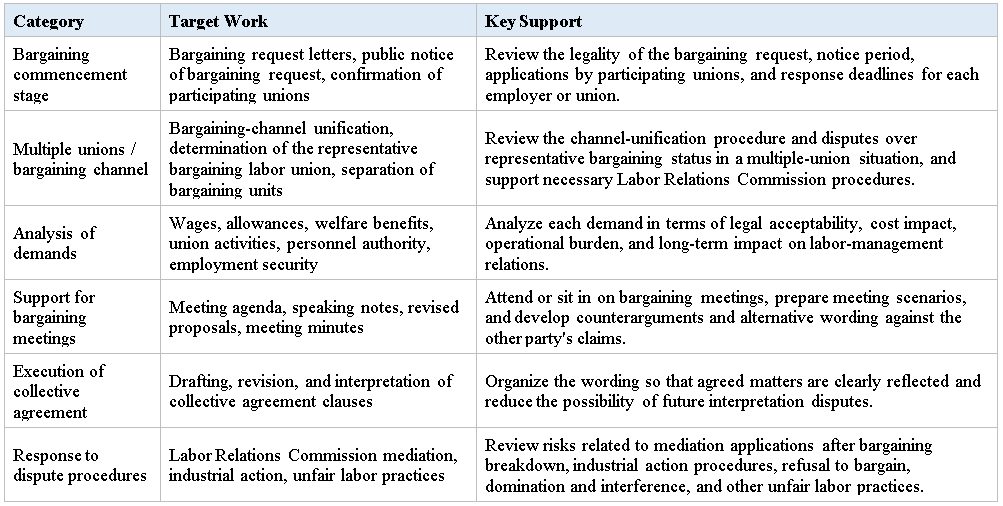
Collective bargaining is a process in which a labor union and an employer discuss wages, working hours, welfare benefits, union activities, personnel systems, employment security, the conclusion of a collective agreement, and other matters concerning working conditions and overall labor-management relations. Collective bargaining representation is not simply attending meetings. It is comprehensive labor-management relations support that manages the entire process from the bargaining request stage through bargaining-channel unification, determination of the representative bargaining labor union, analysis of demands, establishment of bargaining strategy, review of collective agreement clauses, Labor Relations Commission mediation, and risks involving industrial action.
1. Main Service Areas
2. When Expert Review Is Needed
ㆍWhen a company has received a collective bargaining request from a labor union, or when a labor union intends to demand bargaining from an employer
ㆍWhen multiple unions exist and the bargaining-channel unification procedure or the status of the representative bargaining labor union is at issue
ㆍWhen sensitive demands are presented, such as wages, allowances, welfare benefits, union activities, employment security, or restrictions on personnel authority
ㆍWhen an existing collective agreement must be renewed, interpreted, amended, or supplemented by a follow-up agreement
ㆍWhen the matter may escalate into breakdown of bargaining, Labor Relations Commission mediation, industrial action, or unfair labor practice issues
II. How to Deliver
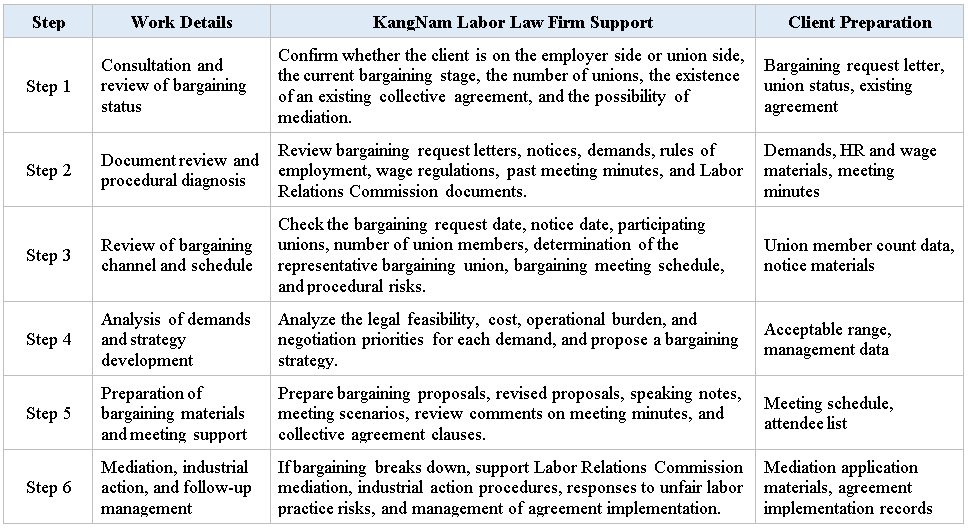
The collective bargaining representation service is customized according to the current bargaining stage and the client's position. KangNam Labor Law Firm reviews the legal procedures of bargaining, the other party's demands, existing collective agreements, the existence of multiple unions, and the overall labor-management relations situation from the employer's or labor union's perspective, and then provides practical strategies and documents that can be used in actual bargaining meetings.
1. Common Process
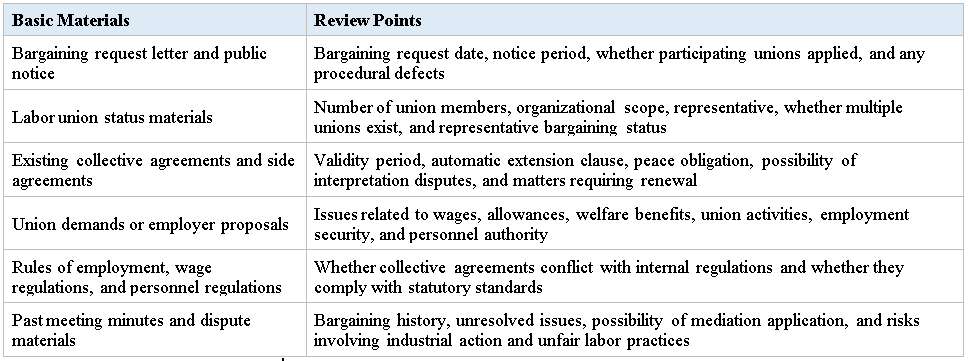
2. Documents to Prepare in Advance
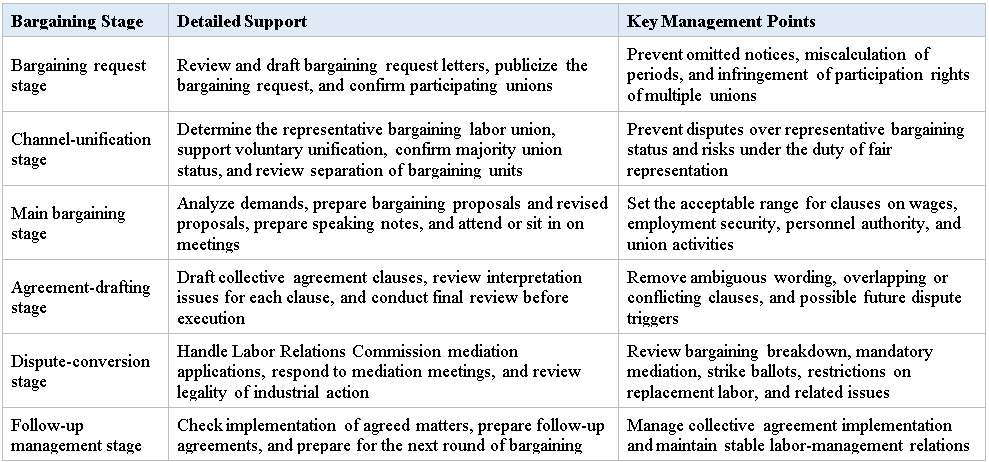
3. Detailed Support by Bargaining Stage | Detailed Support
III. Client Benefits
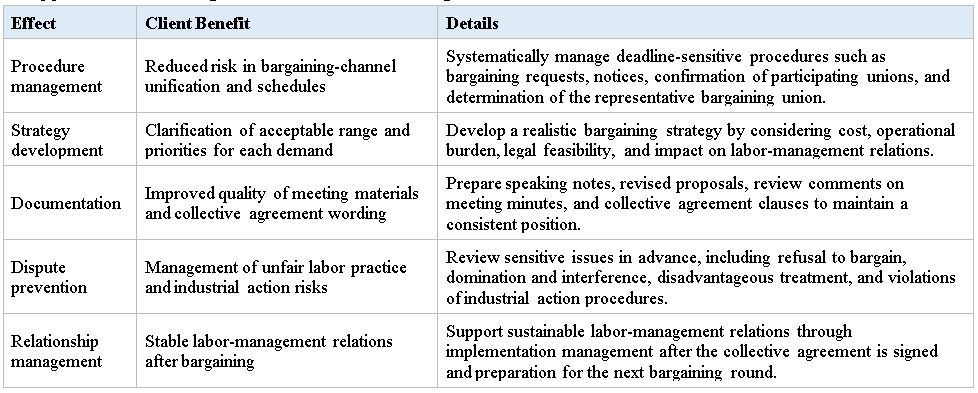
Collective bargaining is an important process that establishes the basic order for company operations and union activities. If procedural steps are missed, the matter can expand into refusal or delay of bargaining, violation of the duty of fair representation, unfair labor practices, Labor Relations Commission mediation, or industrial action. By entrusting the matter to KangNam Labor Law Firm, clients can manage both legal procedures and practical strategies from the early stage of bargaining, reduce unnecessary disputes, and receive support for concluding a reasonable collective agreement.
Why Choose KangNam Labor Law Firm
ㆍBased on experience representing both employers and labor unions, we consider the other party's expected strategy and likely response.
ㆍWe provide practical review of procedural issues such as multiple unions, bargaining-channel unification, determination of the representative bargaining labor union, and separation of bargaining units.
ㆍWe analyze the legal meaning and long-term impact of demands concerning wages, allowances, welfare benefits, union activities, employment security, and personnel authority.
ㆍWe provide speaking notes, revised proposals, meeting-minute review comments, and collective agreement clauses that can be used directly in bargaining meetings.
ㆍFrom the initial stage, we prepare with the possibility that a bargaining breakdown may escalate into Labor Relations Commission mediation, industrial action, or unfair labor practice proceedings.
ㆍWe can provide Korean- and English-based advice and documentation for labor-management relations issues involving foreign-invested and multinational companies.
Consultation Note
Collective bargaining risks may vary depending on the number of labor unions, size of union membership, timing of the bargaining request, existence of an existing collective agreement, bargaining agenda, workplace labor-management relations, and possibility of industrial action. For accurate advice, related materials such as the bargaining request letter, public notice, union demands, existing collective agreement, rules of employment, wage regulations, and past meeting minutes should be reviewed in advance.
※ This material has been prepared for general information and promotional purposes. Each workplace must receive separate consultation to confirm the applicable requirements.
FAQ
Q11
Can KangNam Labor Law Firm represent both the employer side and the labor union side?
Yes. Depending on the case, KangNam Labor Law Firm may support the collective bargaining procedure from either the employer’s side or the labor union’s side.
For the employer side, KangNam Labor Law Firm may provide support in reviewing the bargaining channel unification procedure, preparing public notices of bargaining requests, confirming participating unions, establishing bargaining strategies, analyzing union demands, reviewing collective agreement wording, responding to mediation before the Labor Relations Commission, and responding to industrial action.
For the labor union side, KangNam Labor Law Firm may provide support in preparing bargaining requests, organizing demands, establishing bargaining strategies, reviewing collective agreement wording, filing mediation applications, and supporting bargaining meetings.
However, KangNam Labor Law Firm cannot represent both the employer side and the labor union side in the same case. Therefore, any potential conflict of interest must first be reviewed.
For the employer side, KangNam Labor Law Firm may provide support in reviewing the bargaining channel unification procedure, preparing public notices of bargaining requests, confirming participating unions, establishing bargaining strategies, analyzing union demands, reviewing collective agreement wording, responding to mediation before the Labor Relations Commission, and responding to industrial action.
For the labor union side, KangNam Labor Law Firm may provide support in preparing bargaining requests, organizing demands, establishing bargaining strategies, reviewing collective agreement wording, filing mediation applications, and supporting bargaining meetings.
However, KangNam Labor Law Firm cannot represent both the employer side and the labor union side in the same case. Therefore, any potential conflict of interest must first be reviewed.
Q10
How is the representative of a joint bargaining representative body determined?
The representative of a joint bargaining representative body is first determined by agreement among the labor unions participating in the joint bargaining representative body. For example, the representative may be determined by considering the number of union members, bargaining experience, organizational size, and bargaining issues. However, if the participating labor unions fail to reach an agreement on the selection of the representative, the representative of the labor union with the largest number of union members who are employees engaged in the business or workplace becomes the representative of the joint bargaining representative body under Article 14-9(6) of the Enforcement Decree of the Trade Union and Labor Relations Adjustment Act.
The representative of the joint bargaining representative body plays a central role in bargaining with the employer, but should not unilaterally conduct bargaining while excluding the opinions of other participating labor unions. Since the joint bargaining representative body is a representative body jointly formed by several labor unions, it is advisable to clearly establish internal decision-making procedures, the roles of bargaining committee members, meeting methods, and the list of bargaining committee members to be notified to the employer.
The representative of the joint bargaining representative body plays a central role in bargaining with the employer, but should not unilaterally conduct bargaining while excluding the opinions of other participating labor unions. Since the joint bargaining representative body is a representative body jointly formed by several labor unions, it is advisable to clearly establish internal decision-making procedures, the roles of bargaining committee members, meeting methods, and the list of bargaining committee members to be notified to the employer.
Q9
Can all labor unions participate in a joint bargaining representative body?
No. Only labor unions that participated in the bargaining channel unification procedure and satisfy certain membership requirements may participate in a joint bargaining representative body.
Under the Trade Union and Labor Relations Adjustment Act, a labor union may participate in a joint bargaining representative body only if it has at least 10 percent of the total union members of all labor unions that participated in the bargaining channel unification procedure. Therefore, a minority union whose members account for less than 10 percent of the total union membership is, in principle, unlikely to participate directly in the joint bargaining representative body under Article 29-2(5) of the Trade Union and Labor Relations Adjustment Act.
However, this does not mean that the opinions of minority unions should be completely excluded. Since the joint bargaining representative body or the bargaining representative union has the status of representing all labor unions and union members that participated in the bargaining channel unification procedure, it must reasonably collect the opinions of minority unions and comply with the duty of fair representation.
Under the Trade Union and Labor Relations Adjustment Act, a labor union may participate in a joint bargaining representative body only if it has at least 10 percent of the total union members of all labor unions that participated in the bargaining channel unification procedure. Therefore, a minority union whose members account for less than 10 percent of the total union membership is, in principle, unlikely to participate directly in the joint bargaining representative body under Article 29-2(5) of the Trade Union and Labor Relations Adjustment Act.
However, this does not mean that the opinions of minority unions should be completely excluded. Since the joint bargaining representative body or the bargaining representative union has the status of representing all labor unions and union members that participated in the bargaining channel unification procedure, it must reasonably collect the opinions of minority unions and comply with the duty of fair representation.
Q8
What is a joint bargaining representative body?
A joint bargaining representative body is a bargaining representative body jointly formed by several labor unions when there are multiple labor unions in one business or workplace and a single bargaining representative union cannot be determined through the bargaining channel unification procedure.
A bargaining representative union is generally determined in the following order. First, the labor unions voluntarily determine the bargaining representative union. If they fail to reach an agreement, the labor union representing a majority of union members becomes the bargaining representative union. If there is no majority union, labor unions satisfying certain requirements form a joint bargaining representative body and bargain with the employer under Article 29-2(3) and (4) of the Trade Union and Labor Relations Adjustment Act. In other words, a joint bargaining representative body is a system under which several labor unions jointly conduct collective bargaining with the employer in a multiple-union situation where it is difficult for any one labor union to become the sole bargaining representative union.
A bargaining representative union is generally determined in the following order. First, the labor unions voluntarily determine the bargaining representative union. If they fail to reach an agreement, the labor union representing a majority of union members becomes the bargaining representative union. If there is no majority union, labor unions satisfying certain requirements form a joint bargaining representative body and bargain with the employer under Article 29-2(3) and (4) of the Trade Union and Labor Relations Adjustment Act. In other words, a joint bargaining representative body is a system under which several labor unions jointly conduct collective bargaining with the employer in a multiple-union situation where it is difficult for any one labor union to become the sole bargaining representative union.
Q7
Why should the wording of a collective agreement be reviewed carefully?
A collective agreement should be reviewed carefully because, once executed, it may have long-term legal binding force on both the company and the labor union. Provisions concerning wages, allowances, working hours, holidays and leave, personnel authority, disciplinary action, transfers, employment security, union activities, paid time-off for union activities, and welfare benefits may become the standard for future disputes. In particular, expressions such as “the company shall be required to,” “the company must obtain the consent of the labor union,” or “the company may not make unfavorable changes” may restrict the company’s personnel and management authority. Therefore, agreed wording should be drafted after considering its legal meaning, cost burden, relationship with the existing rules of employment, and future operational feasibility.
Q6
If bargaining breaks down, can the labor union immediately go on strike?
No. The fact that bargaining has broken down does not mean that the labor union may immediately engage in industrial action. In order for a labor union to lawfully engage in industrial action, it must first go through the mediation procedure before the Labor Relations Commission, and mediation must either fail or a decision to terminate mediation must be issued. In addition, internal procedures, such as a vote by union members for or against industrial action, are also required. If industrial action such as a strike is carried out without following these procedures, the legitimacy of the industrial action may become an issue. The company should review whether a mediation application has been filed, the mediation period, the procedure for the vote on industrial action, and the legitimacy of the purpose and means of the industrial action.
Q5
What should be done if the employer delays or refuses bargaining?
If the employer refuses bargaining without justifiable reason or responds only formally, this may raise an issue of unfair labor practice. For example, problems may arise if the company repeatedly postpones bargaining schedules, sends only persons without bargaining authority, rejects all demands without any review, or excludes a specific labor union. The company should systematically retain relevant records, including the date of receipt of the bargaining request, the date of public announcement, the contents of its replies, meeting schedules, attendees, meeting minutes, proposals, and revised proposals. The labor union should also organize and retain records such as the bargaining request, meeting requests, the company’s replies, and the progress of bargaining.
Q4
What kinds of demands may a labor union present?
A labor union may present demands mainly concerning matters related to working conditions, such as wages, working hours, holidays and leave, welfare benefits, employment security, personnel systems, occupational safety, and the guarantee of union activities. However, not all demands necessarily become mandatory subjects of collective bargaining. For example, matters concerning the essential aspects of management rights or the company’s inherent personnel and management decisions may have limited bargainability. Conversely, even matters concerning personnel systems or job transfers may become subjects of bargaining if they directly affect working conditions. Therefore, each demand should be reviewed separately to determine whether it is a mandatory bargaining subject, a voluntary bargaining subject, or a non-bargaining subject.
Q3
Is the company required to accept all demands made by the labor union?
The employer must respond in good faith to a legitimate request for collective bargaining made by a labor union. If the employer refuses or delays bargaining without justifiable reason, this may constitute an unfair labor practice. However, this does not mean that the employer must accept all demands as presented. The company may determine whether each demand can be accepted by reviewing its legal feasibility, cost burden, consistency with existing personnel systems, fairness in relation to other employees, and impact on business operations. What is important is that the company should not avoid bargaining itself, but should sincerely explain its position with supporting reasons.
Q2
If there are multiple labor unions, can the company immediately begin bargaining?
No. If there are multiple labor unions, the bargaining channel unification procedure must, in principle, be completed first. If the company first bargains only with a specific labor union or fails to guarantee other labor unions the opportunity to participate, procedural issues may arise. Therefore, the company should sequentially review the public announcement of the bargaining request, confirmation of participating unions, the period for voluntary unification, confirmation of whether there is a majority union, and the determination of the bargaining representative union. However, if there is exceptional consent to individual bargaining, the company may bargain individually with each labor union. Therefore, the company should carefully choose its bargaining method.
Q1
In what cases does collective bargaining begin?
The collective bargaining procedure begins when a labor union requests collective bargaining from the employer. After receiving the bargaining request, the employer must publicly announce the fact that a bargaining request has been made and confirm whether any other labor unions wish to participate in the bargaining process. Thereafter, the procedures for confirming the participating unions, unifying the bargaining channel, and determining the bargaining representative union will follow. In particular, in a workplace with multiple labor unions, the company should first confirm whether the bargaining channel unification procedure is required, rather than immediately commencing individual bargaining.
Key Representative Cases