

Labor Union Establishment Labor Consulting & Legal Representation
Consultation Request
A practical service supporting workers’ autonomous right to organize, labor union establishment reporting, bylaw drafting, inaugural meetings, and securing collective bargaining rights
The Labor Union Establishment Service supports a labor union establishment preparation committee or worker representatives through a certified labor attorney, enabling them to lawfully establish a labor union that satisfies both the substantive and formal requirements under the Trade Union and Labor Relations Adjustment Act. The service does not merely prepare documents; it comprehensively reviews the scope of union members, bylaws, the inaugural general meeting, establishment reporting, bargaining channel unification, and the possible separation of bargaining units.
I. What Service
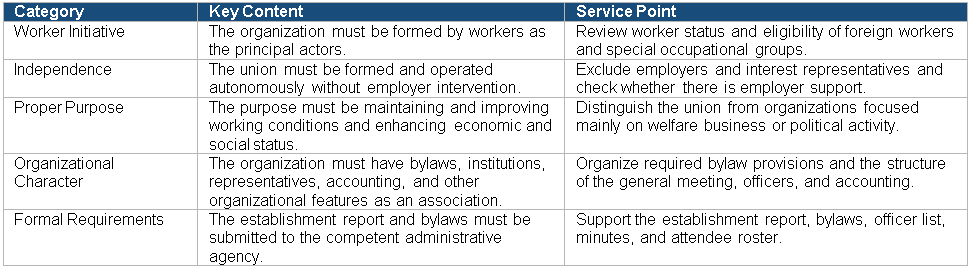
Establishing a labor union is a procedure through which workers autonomously organize to maintain and improve working conditions and to enhance their economic and social status. After establishment, a labor union becomes the principal actor in collective labor relations, including collective bargaining, execution of collective agreements, applications for labor dispute mediation, and applications for remedy against unfair labor practices. To be recognized as a lawful labor union, however, it must satisfy both substantive requirements - worker initiative, independence, proper purpose, and organizational character - and the formal requirement of filing an establishment report.
1. Major Service Areas
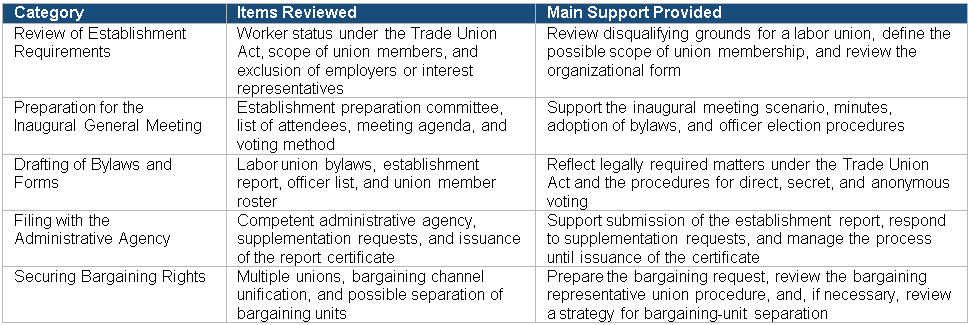
2. Scope of Service
ㆍPreliminary legal review of the possibility of establishing a labor union, the scope of union members, disqualifying grounds, and organizational form
ㆍPreparation of practical forms, including the inaugural general meeting plan, attendee roster, ballots, and minutes
ㆍPreparation of required documents, including the labor union bylaws, establishment report, names and addresses of officers, and union member roster
ㆍSupport for filing with the competent administrative agency, responding to supplementation requests, and obtaining the establishment report certificate
ㆍReview of collective bargaining requests to the employer after establishment, bargaining channel unification procedures, and the need for bargaining-unit separation
ㆍCustomized support for special cases, including labor unions for foreign workers, professionals, public institutions, and minority occupational groups
II. How to Deliver
The Labor Union Establishment Service is carried out with the goal of “lawful establishment + securing practical bargaining rights.” KangNam Labor Law Firm guides workers so that they may autonomously establish a labor union, while reviewing not only the formal requirements of the establishment report and bylaws but also issues that may arise in future collective bargaining, including bargaining channel unification, the bargaining representative labor union, and separation of bargaining units.
1. Common Procedure
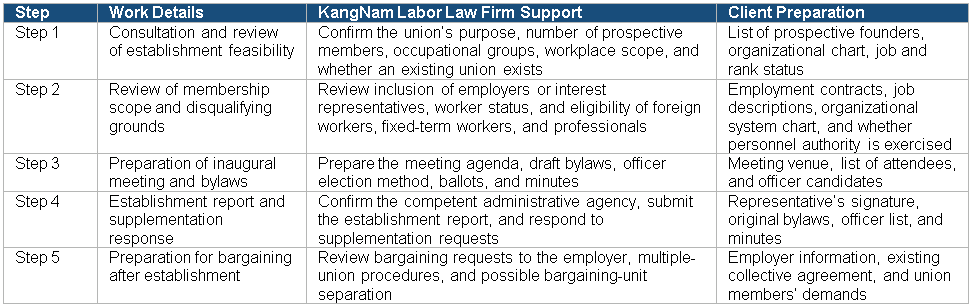
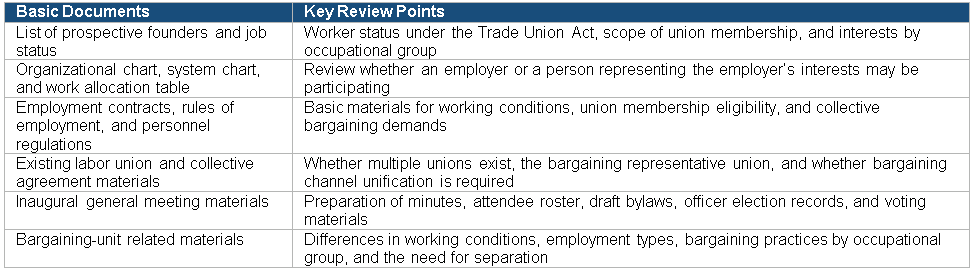
2. Documents to Prepare in Advance
3. Key Checkpoints for the Inaugural General Meeting and Establishment Report
ㆍAt the inaugural general meeting, the necessary agenda items for establishment are resolved, including adoption of bylaws, election of officers, business plans, and budget.
ㆍAs a rule, adoption of the bylaws and election of officers should be conducted by direct, secret, and anonymous voting.
ㆍThe establishment report must state the union name, principal office, number of union members, names and addresses of officers, and affiliated federation, if any.
ㆍIn principle, the administrative agency issues the report certificate within three days; however, it may request supplementation if there are omissions or defects.
ㆍWhen the labor union receives the report certificate, the union is deemed established as of the time the establishment report was received.
4.Detailed Support by Major Issue
In labor union establishment, the more important issues are not the establishment report itself, but “who may become a union member,” “whether the bylaws guarantee independence and democracy,” and “whether the union can actually engage in collective bargaining after establishment.” KangNam Labor Law Firm reviews anticipated issues from the establishment stage through the future bargaining stage.
(1) Review of Labor Union Establishment Requirements and Disqualifying Grounds
(2) Support for Labor Unions of Foreign Workers, Professionals, and Minority Occupational Groups
Foreign instructors, performers, professionals, and workers in specific occupational groups may differ from general workers in terms of working conditions, employment type, language, visa status, and bargaining interests. In an actual case, foreign instructors sought to establish a labor union after issues such as unpaid overtime allowances and dismissals arose. Korean and English establishment documents and bylaws were prepared, and the establishment report certificate was issued. This example shows that foreign workers may establish a labor union if they meet the worker-status and establishment requirements.
ㆍPrepare Korean and English bylaws and meeting materials so that foreign union members can understand them.
ㆍReview the need to establish an independent union when the working conditions, employment type, evaluation system, or compensation system of a specific occupational group differ from others.
ㆍReview the possibility of bargaining-unit separation if the interests of a minority occupational group are not reflected in the bargaining representative union procedure after establishment.
(3) Review of Multiple Unions and Bargaining-Unit Separation
If two or more labor unions exist in one business or workplace, the bargaining channel unification procedure must generally be followed. However, if it is unreasonable to bind them into one bargaining unit in light of significant differences in working conditions, employment types, bargaining practices, and other factors, an application for bargaining-unit separation may be filed with the Labor Relations Commission. In the K National Gugak Center case, the National Labor Relations Commission recognized bargaining-unit separation because there were significant differences between the members of the Korean traditional music performance group and public service workers in terms of duties, working hours, wage system, and employment type.
Key management point: If a labor union fails to secure bargaining rights after establishment, it will be difficult to conclude a collective agreement. Therefore, from the establishment stage, it is necessary to review the existing labor union, bargaining representative union, bargaining channel unification, and the possibility of bargaining-unit separation.
III. Client Benefits
Establishing a labor union is the starting point for workers to exercise the three constitutional labor rights. However, if the establishment procedure is unlawful, the bylaws contain defects, or persons disqualified from union membership are included, the union may face rejection of the establishment report, supplementation requests, non-statutory union issues, and restrictions on collective bargaining rights. By entrusting the matter to KangNam Labor Law Firm, clients can proceed systematically from preparation for establishment to securing bargaining rights.
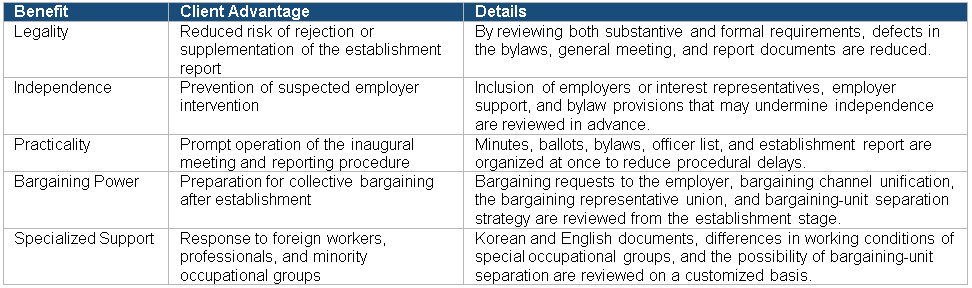
Why Entrust This Matter to KangNam Labor Law Firm
ㆍWe provide practical procedures based on labor union manuals, actual labor union establishment cases, and experience with bargaining-unit separation cases.
ㆍWe prepare required documents, including the labor union establishment report, bylaws, minutes of the inaugural general meeting, and officer list, in compliance with statutory requirements.
ㆍWe review the scope of union members and disqualifying grounds in advance to prevent legal risks caused by inclusion of employers or interest representatives.
ㆍBased on experience with foreign workers and multinational companies, we can provide Korean and English documents and explanations together.
ㆍWe provide follow-up support linked to collective bargaining, bargaining channel unification, bargaining-unit separation, and response to unfair labor practices after establishment.
Matters to Confirm at Consultation
The possibility of establishing a labor union and the necessary procedures may vary depending on the establishing body, number of union members, occupational group, existence of an existing labor union, workplace scope, affiliation with an upper-level federation, and future bargaining objectives. For an accurate diagnosis, the list of prospective founders, job and rank status, existing rules of employment and collective agreements, and bargaining demands should be reviewed in advance.
※ This material has been prepared for general informational and promotional purposes. Requirements for individual cases must be confirmed through separate consultation.
FAQ
Q8
What should the company and the union first confirm after the establishment of a labor union?
After the establishment of a labor union, it is first necessary to confirm the union’s representative, bargaining requester, scope of membership, subject of bargaining, and whether a unified bargaining channel is required.The company must not disadvantage members because of the establishment of the labor union, and the union must also request bargaining in accordance with proper procedures. In addition, both parties need to organize major issues such as improvement of working conditions, guarantee of union activities, union dues deduction, paid time off for union activities, and schedule of collective bargaining so that labor-management relations do not expand into unnecessary disputes.Ultimately, the most important thing at the stage of establishing a labor union is to ensure the autonomy and democracy of the labor union and to proceed with the establishment report and bargaining procedures in accordance with the law.양식의 맨 위
Q7
Once a labor union is established, must the company respond to collective bargaining?
If a labor union is legally established and requests collective bargaining from the employer, the company must not refuse or neglect bargaining without justifiable reason. Refusal of collective bargaining without justifiable reason may constitute an unfair labor practice.However, if there are two or more labor unions in one business or workplace, procedures for unified bargaining channels may apply. In this case, each labor union designates a bargaining representative union according to legal procedures, and the bargaining representative union conducts collective bargaining with the employer.
Q6
Can the labor union establishment report be rejected?
Yes. A labor union establishment report is not always accepted. The administrative authority may request supplementation or reject the report if there are defects in the report or rules, or if legal requirements for a labor union are not satisfied.For example, cases where a person representing the employer’s interests joins and the autonomy of the union is at issue, cases where non-workers form the main membership, cases where mandatory items in the rules are missing, or cases where the purpose or organizational structure of the union does not comply with the law may be problematic.Therefore, before filing the establishment report, basic materials such as membership eligibility, rules, election procedures, and meeting minutes must be accurately organized.
Q5
Can a company block the establishment of a labor union?
A company cannot block the establishment of a labor union. The establishment and joining of a labor union by workers are rights protected under the Constitution and the Labor Union Act.If a company gives disadvantages to members, demands withdrawal from the union, interferes with joining a specific union, or monitors or pressures union establishment activities, it may constitute an unfair labor practice. Employers must remain neutral during the establishment process and must not dominate or interfere with the operation of the labor union.
Q4
What documents are required when reporting labor union establishment?
Basically, a labor union establishment report and labor union rules are required. The rules must include basic matters concerning the operation of the labor union such as the name of the labor union, purpose, location of the main office, membership eligibility, organization and meetings, election of representatives and officers, union dues, accounting, and procedures for amendment of the rules.In addition, in practice, it is advisable to prepare materials such as minutes of the founding general meeting, list of officers, list of members, and documents related to the establishment of rules and election of officers. If the documents are unclear or the rules do not meet legal requirements, a request for supplementation may be made.
Q3
How is the labor union establishment procedure carried out?
Generally, the establishment of a labor union proceeds as follows. First, workers agree to establish a labor union and hold a founding general meeting to establish the rules. Then representatives and officers are elected, and the name of the labor union, location of the office, and scope of organization are determined.Next, the labor union establishment report and required documents including the rules are submitted to the competent administrative authority. When the administrative authority reviews the report and issues a certificate of establishment, the labor union may operate as a legally recognized labor union.
Q2
What is the minimum number of people required to establish a labor union?
A labor union is based on collectivity, so in principle it can be established with two or more workers. However, in practice, for a labor union to operate stably, it is important to have a structure that enables organizational operation such as membership size, election of representatives, establishment of rules, and holding of general meetings.At the stage of establishing a labor union, what is more important than simply meeting the number requirement is whether the members are autonomously organizing with the common purpose of improving working conditions.
Q1
Who can establish a labor union?
A labor union can be established autonomously by workers as the主?. Here, a worker means a person who lives on wages, salary, or other equivalent income regardless of the type of occupation. Therefore, not only full-time employees but also fixed-term workers, part-time workers, daily workers, and temporary workers may establish or join a labor union if their worker status is recognized. Under the Labor Union Act, a worker is defined as “a person who lives on wages, salary, or other equivalent income regardless of the type of occupation.”In addition, it is not required that only workers of the same rank or same job type can establish a labor union. Production workers, office workers, sales workers, research workers, on-site workers, etc. may also establish a labor union if they share the common purpose of maintaining and improving working conditions. A labor union may be formed within a single company, or it may be organized by job type, industry, or region.However, persons who are employers or who always act representing the interests of the employer may be restricted from establishing or joining a labor union. For example, business owners, CEOs, persons responsible for business management, persons who substantially exercise employer authority such as personnel, labor, discipline, or dismissal, or persons who handle confidential labor management information and act on behalf of the employer may be subject to issues regarding union eligibility because they may undermine the autonomy of the union. Under the Labor Union Act, “employer” includes the business owner, a person responsible for business management, and a person who acts on behalf of the employer regarding matters concerning workers.However, the mere fact that a person has a managerial title such as manager, deputy manager, team leader, or supervisor does not automatically mean they are prohibited from establishing or joining a labor union. It must be determined based on whether they actually exercise authority over hiring, evaluation, discipline, dismissal, or wage decisions, whether they are in a position to represent the employer’s interests, and whether union activities may lead to employer domination or interference. The eligibility of managerial workers as union members should be judged based on actual authority and duties rather than job titles.Therefore, workers who may establish a labor union are, in principle, all workers who do not fall under the category of employer or persons representing the employer’s interests. A labor union must be organized autonomously by such workers for the purpose of maintaining and improving working conditions and enhancing their economic and social status, and if the company leads the establishment or intervenes in its operation, the autonomy of the union may be at issue.
Key Representative Cases