

In-house Subcontracting Labor Consulting & Legal Representation
Consultation Request
Preliminary diagnosis of sham subcontracting and illegal dispatch risks in in-house subcontracting and outsourcing operations
The Lawful Subcontracting Operation Due Diligence Service is a preventive labor-management service that reviews whether the in-house subcontracting, outsourcing, and service contractor structures used by a company maintain the independence and expertise required for lawful subcontracting, and whether they may be regarded as sham subcontracting or illegal dispatch due to the principal company’s direction and orders or integration into the principal company’s business. The service supports the company in identifying and improving such risks in advance.
I. What Service
This due diligence service diagnoses illegal dispatch and implied employment-contract risks that may arise even when the parties have formally entered into a subcontracting agreement, if the actual operation shows that the principal company directly instructs the contractor’s employees, determines work assignments, working hours, or overtime, or has the contractor’s employees perform the same work together with the principal company’s employees.
1. Major Service Areas
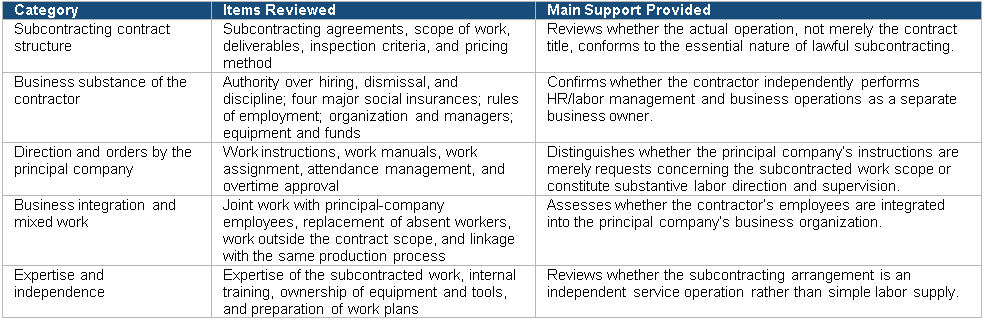
2. Scope of Representation
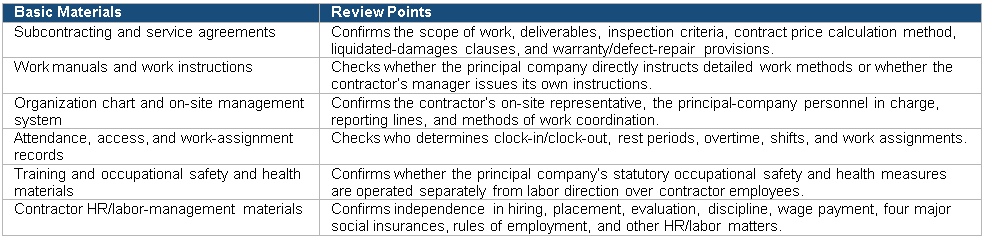
ㆍReview of contract documents, including subcontracting, service, and outsourcing agreements, scope-of-work statements, service level agreements (SLAs), work instructions, and inspection materials.
ㆍInterviews with the responsible personnel of the principal company and the contractor, and confirmation of actual on-site operation methods.
ㆍDiagnosis of the contractor’s business substance, the principal company’s direction and orders, business integration, expertise and technical capability, and possession of corporate organization, equipment, and facilities.
ㆍAssessment of sham subcontracting and illegal dispatch risks, including risks of direct employment obligations, criminal sanctions, and wage claims.
ㆍSupport for contract supplementation, redesign of work allocation, improvement of instruction channels, training for on-site managers, and provision of post-audit checklists.
II. How to Deliver
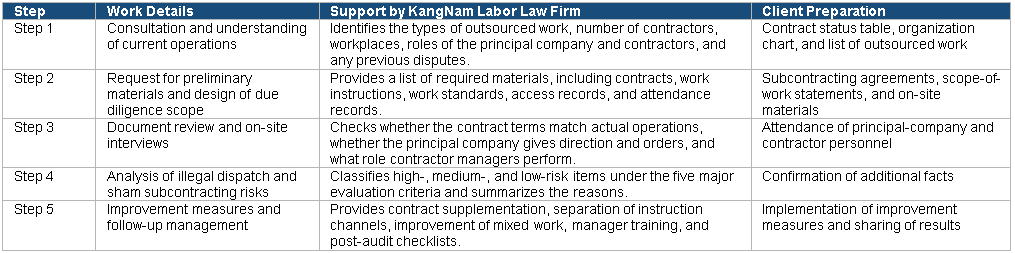
This service is not limited to a review of the contract. It is a practical due diligence service that examines how the principal company and the contractor actually operate the work on site. KangNam Labor Law Firm carries out the service in the order of document review, interviews with responsible personnel, confirmation of on-site operations, risk grading, and presentation of improvement measures.
1. Common Process
2. Preliminary Materials
3. Key Management Points
ㆍEven if the contract is labeled as subcontracting, illegal dispatch risks may arise if the principal company directly directs and supervises the contractor’s employees in actual operation.
ㆍIf the contractor lacks the substance or independence of a business owner, an implied employment-contract relationship may be recognized.
ㆍMixed work, replacement of absent workers, instructions for work outside the contract scope, and the principal company’s decisions on attendance or overtime are high-risk factors.
ㆍThe principal company’s occupational safety and health obligations under the Occupational Safety and Health Act must be managed separately from labor direction over contractor employees.
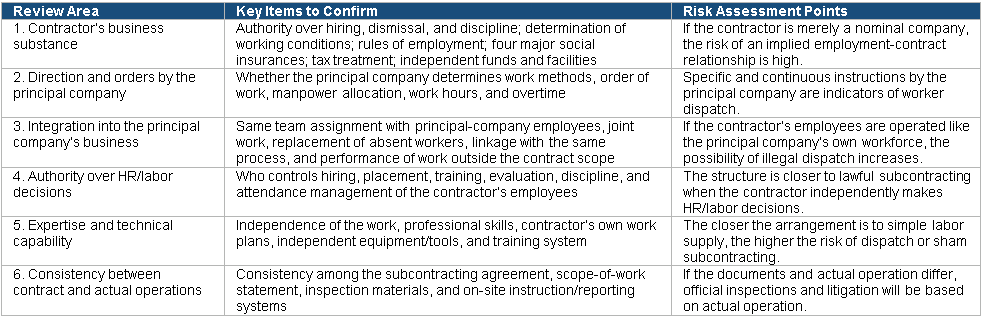
4. Detailed Support by Major Review Area
강KangNam Labor Law Firm first confirms the contractor’s business substance under the evaluation process for sham subcontracting and illegal dispatch, and then reviews whether the principal company actually directs, orders, and uses the contractor’s employees. The judgment is based not on the title of the contract, but on the facts and actual on-site operations.
Deliverables Provided After Due Diligence
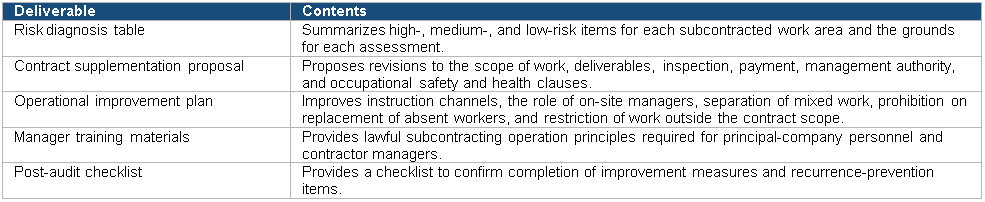
Examples of Improvement Measures
ㆍPrincipal-company personnel should make requests concerning work results and the subcontracted scope, while direct instructions to contractor employees should be unified through the contractor’s manager.
ㆍThe operation system should be separated so that HR/labor matters such as work assignment, attendance, leave, and overtime approval are determined directly by the contractor.
ㆍEven where work at the same location is unavoidable, the work scope, work tools, reporting lines, and deliverable inspection methods should be clearly distinguished.
ㆍThe contractor’s expertise, internal training, work plans, and management responsibility should be documented so that the subcontracted work does not appear to be simple labor supply.
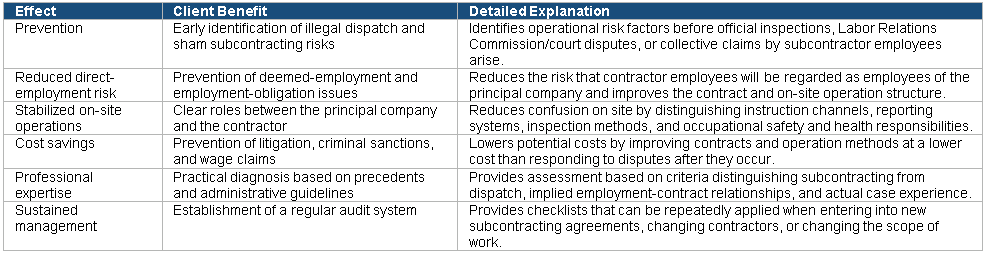
III. Client Benefits
Lawful subcontracting operation due diligence helps companies identify and improve, in advance, risks that may escalate into illegal dispatch, direct employment obligations, criminal sanctions, wage claims, and collective disputes while using outsourcing and subcontracting for cost efficiency and operational effectiveness.
Why Choose KangNam Labor Law Firm
ㆍBased on practical experience in non-regular employment, dispatch, subcontracting, and employee-status determinations, we diagnose workplace-specific risks in detail.
ㆍWe review not only contract language but also actual facts, including on-site operations, work instructions, attendance management, and mixed work.
ㆍWe identify in advance issues that may escalate into labor inspections, Labor Relations Commission cases, or court disputes, and propose practical improvement measures.
ㆍWe can provide Korean- and English-based consultation and documentation for outsourcing and subcontracting operations of foreign-invested and multinational companies.
ㆍWe do not simply conclude that there is “no problem”; instead, we transparently explain risk levels and improvement priorities based on evidence and facts.
Notice for Consultation
Lawful subcontracting risks may vary depending on the industry, characteristics of the work, degree of mixed operations on site, the principal company’s instruction method, the contractor’s independence, and consistency between the contract and actual operations. For an accurate diagnosis, it is necessary to first review the subcontracting agreement, scope-of-work statement, work-instruction and reporting materials, attendance and access records, contractor organization materials, and related documents through a preliminary consultation.
※ This material has been prepared for general informational and promotional purposes. Individual workplaces require separate consultation to confirm the applicable requirements
FAQ
Q16
What deliverables are provided after the audit?
The following deliverables are generally provided upon completion of the audit:
- Lawful Subcontracting Compliance Audit Report
- Risk assessment of illegal worker dispatch by audit category
- Recommendations for revising subcontracting agreements and work specifications
- Improvements to work instruction and reporting systems
- Operational guidelines for managers of the principal company and the subcontractor’s on-site managers
- Prioritized corrective action plan
- Compliance training for managers on lawful subcontracting practices
Where necessary, a follow-up review may also be conducted to verify whether the recommended corrective measures have been properly implemented.
- Lawful Subcontracting Compliance Audit Report
- Risk assessment of illegal worker dispatch by audit category
- Recommendations for revising subcontracting agreements and work specifications
- Improvements to work instruction and reporting systems
- Operational guidelines for managers of the principal company and the subcontractor’s on-site managers
- Prioritized corrective action plan
- Compliance training for managers on lawful subcontracting practices
Where necessary, a follow-up review may also be conducted to verify whether the recommended corrective measures have been properly implemented.
Q15
Can an audit completely eliminate the risk of illegal worker dispatch?
An audit is a preventive service designed to identify and correct risk factors in the current contractual and operational structure.
Legal risks may be significantly reduced by improving the work instruction system, separation of duties, authority of the subcontractor’s on-site manager, and methods of attendance and personnel management.
However, whether an arrangement constitutes illegal worker dispatch is ultimately determined by the Ministry of Employment and Labor or the courts based on the specific facts of each case. Therefore, an audit cannot provide an absolute guarantee regarding the outcome of a future legal determination.
Legal risks may be significantly reduced by improving the work instruction system, separation of duties, authority of the subcontractor’s on-site manager, and methods of attendance and personnel management.
However, whether an arrangement constitutes illegal worker dispatch is ultimately determined by the Ministry of Employment and Labor or the courts based on the specific facts of each case. Therefore, an audit cannot provide an absolute guarantee regarding the outcome of a future legal determination.
Q14
Does calculating subcontracting fees based on the number of workers or working hours constitute illegal worker dispatch?
The mere fact that subcontracting fees are calculated based on the number of workers or working hours does not automatically mean that the arrangement constitutes illegal worker dispatch.
The method of calculating subcontracting fees must be considered together with other factors, including who exercises supervision and control, whether the subcontractor independently manages its personnel and labor affairs, the independence of the subcontracted work, and whether the subcontractor has a genuine business organization and functions as an independent employer.
However, where the subcontracting fees are effectively linked directly to the workers’ labor costs and the subcontractor assumes no independent responsibility for performing or completing the work, the fee structure may be regarded as a risk factor.
The method of calculating subcontracting fees must be considered together with other factors, including who exercises supervision and control, whether the subcontractor independently manages its personnel and labor affairs, the independence of the subcontracted work, and whether the subcontractor has a genuine business organization and functions as an independent employer.
However, where the subcontracting fees are effectively linked directly to the workers’ labor costs and the subcontractor assumes no independent responsibility for performing or completing the work, the fee structure may be regarded as a risk factor.
Q13
What are common operational practices that present a high risk of illegal worker dispatch?
The risk may be higher in the following circumstances:
- A manager of the principal company directly assigns work to the subcontractor’s workers on a daily basis
- The principal company approves the subcontractor’s workers’ attendance, leave, or overtime work
- Employees of the principal company and workers of the subcontractor work together as a single team without a clear separation of duties
- The subcontractor has no independent on-site manager or organizational structure for performing the contracted work
- The subcontractor merely conveys the principal company’s instructions without exercising independent judgment
- The scope of the contracted work is not specifically defined, and the subcontractor effectively provides only personnel
However, no single factor is conclusive. The legality of the arrangement must be determined by comprehensively reviewing the overall working relationship and actual operational practices.
- A manager of the principal company directly assigns work to the subcontractor’s workers on a daily basis
- The principal company approves the subcontractor’s workers’ attendance, leave, or overtime work
- Employees of the principal company and workers of the subcontractor work together as a single team without a clear separation of duties
- The subcontractor has no independent on-site manager or organizational structure for performing the contracted work
- The subcontractor merely conveys the principal company’s instructions without exercising independent judgment
- The scope of the contracted work is not specifically defined, and the subcontractor effectively provides only personnel
However, no single factor is conclusive. The legality of the arrangement must be determined by comprehensively reviewing the overall working relationship and actual operational practices.
Q12
What documents and operational practices are reviewed during the audit?
The audit generally covers the following:
- Subcontracting agreements, work specifications, and operating manuals
- Work instruction and reporting systems between the principal company and the subcontractor
- Authority over the recruitment, assignment, training, and evaluation of workers
- Responsibility for managing attendance, leave, overtime work, and disciplinary action
- Separation of duties between the principal company’s employees and the subcontractor’s workers
- Appointment of the subcontractor’s on-site manager and the manager’s actual authority
- Ownership and management of equipment, facilities, and work tools
- The method of calculating subcontracting fees and the subcontractor’s independent business organization
- Actual work instruction records, including emails, messenger communications, and work logs
Where necessary, the audit may also include interviews with on-site managers and workers, as well as an on-site workplace inspection.
- Subcontracting agreements, work specifications, and operating manuals
- Work instruction and reporting systems between the principal company and the subcontractor
- Authority over the recruitment, assignment, training, and evaluation of workers
- Responsibility for managing attendance, leave, overtime work, and disciplinary action
- Separation of duties between the principal company’s employees and the subcontractor’s workers
- Appointment of the subcontractor’s on-site manager and the manager’s actual authority
- Ownership and management of equipment, facilities, and work tools
- The method of calculating subcontracting fees and the subcontractor’s independent business organization
- Actual work instruction records, including emails, messenger communications, and work logs
Where necessary, the audit may also include interviews with on-site managers and workers, as well as an on-site workplace inspection.
Q11
May a manager of the principal company directly instruct the subcontractor’s workers?
As a general rule, specific work instructions to individual workers should be communicated through the subcontractor’s on-site manager.
If the principal company directly instructs the subcontractor’s workers regarding the sequence or method of work, workforce allocation, or whether overtime must be performed, such conduct may be regarded as evidence of direct supervision and control.
However, general requirements concerning the specifications, quality, or delivery schedule of the contracted work, as well as instructions necessary to ensure workplace safety, do not automatically constitute illegal worker dispatch. The substance, method, frequency, and binding effect of the instructions must be considered comprehensively.
If the principal company directly instructs the subcontractor’s workers regarding the sequence or method of work, workforce allocation, or whether overtime must be performed, such conduct may be regarded as evidence of direct supervision and control.
However, general requirements concerning the specifications, quality, or delivery schedule of the contracted work, as well as instructions necessary to ensure workplace safety, do not automatically constitute illegal worker dispatch. The substance, method, frequency, and binding effect of the instructions must be considered comprehensively.
Q10
Is it sufficient to have a properly drafted subcontracting agreement?
No.
Even if an agreement is formally described as a subcontracting agreement, the arrangement may be deemed illegal worker dispatch if, in practice, the principal company directly supervises the subcontractor’s workers or manages their attendance and workforce allocation.
It is therefore necessary to verify that the written agreement is consistent with actual workplace practices.
Even if an agreement is formally described as a subcontracting agreement, the arrangement may be deemed illegal worker dispatch if, in practice, the principal company directly supervises the subcontractor’s workers or manages their attendance and workforce allocation.
It is therefore necessary to verify that the written agreement is consistent with actual workplace practices.
Q9
How is lawful subcontracting distinguished from worker dispatch?
Under a lawful subcontracting arrangement, the subcontractor employs, directs, and manages its own workers under its own responsibility and completes the agreed scope of work.
By contrast, there may be a risk that the arrangement will be deemed worker dispatch if the principal company directly instructs the subcontractor’s workers on how to perform their duties or exercises substantial control over their working hours, leave, overtime work, or performance evaluations.
The substance of the actual working arrangement is more important than the title or form of the agreement.
By contrast, there may be a risk that the arrangement will be deemed worker dispatch if the principal company directly instructs the subcontractor’s workers on how to perform their duties or exercises substantial control over their working hours, leave, overtime work, or performance evaluations.
The substance of the actual working arrangement is more important than the title or form of the agreement.
Q8
What is a Lawful Subcontracting Compliance Audit?
A Lawful Subcontracting Compliance Audit is a service that comprehensively examines not only the subcontracting agreement but also actual workplace practices, including work instructions, personnel management, attendance management, and the manner in which the contracted work is performed, in order to identify risks of illegal worker dispatch or disguised subcontracting.
Based on the audit findings, we identify specific risk factors and recommend measures to improve both the contractual structure and actual workplace operations.
Based on the audit findings, we identify specific risk factors and recommend measures to improve both the contractual structure and actual workplace operations.
Q7
What should be considered to properly operate in-house subcontracting?
To ensure legality, the operational reality is more important than the contract itself. In particular, the following points must be checked.First, the prime contractor must not directly instruct subcontractor workers.Second, the subcontractor must independently manage attendance, task assignment, training, evaluation, discipline, and leave approvals.Third, the scope of work and reporting lines between prime contractor employees and subcontractor workers must be clearly separated.Fourth, subcontracted work should be structured as an independent work unit as much as possible.Fifth, instructions from the prime contractor should be delivered to the subcontractor manager, who then instructs its own workers under its responsibility.Sixth, the contractual subcontracting structure must match actual on-site operations.Seventh, in-house subcontracting practices should be regularly reviewed to eliminate illegal dispatch factors.
Ultimately, the key principle of in-house subcontracting is that the subcontractor operates as an independent employer managing its own workers, while the prime contractor manages only the results of the subcontracted work.
Ultimately, the key principle of in-house subcontracting is that the subcontractor operates as an independent employer managing its own workers, while the prime contractor manages only the results of the subcontracted work.
Q6
Does having a subcontractor on-site manager remove the risk of illegal dispatch?
The mere existence of a subcontractor manager is not sufficient.What matters is whether that manager actually exercises authority to direct and supervise its own employees. Even if a subcontractor supervisor formally exists, if the prime contractor is effectively giving work instructions, managing attendance, assigning tasks, or directing overtime, it may still be judged as illegal dispatch.Therefore, the subcontractor manager must function as a real on-site manager. Records of work instructions, attendance approval, task assignment sheets, training materials, and evaluation documents should also be managed under the subcontractor’s name and responsibility.
Q5
What liability arises if in-house subcontracting is recognized as illegal dispatch?
If it is recognized as illegal dispatch, the prime contractor may have a direct employment obligation. In other words, the prime contractor may be legally required to directly hire the subcontractor workers.The Act on the Protection of Dispatched Workers imposes a direct hiring obligation on the user company in certain cases of illegal dispatch, such as violation of permitted dispatch work scope, violation of dispatch period limits, or unlicensed dispatch.In addition, illegal dispatch may lead to criminal penalties, administrative fines, disputes over wages and continuous service years, labor union issues, collective lawsuits, and labor authority investigations. In particular, companies that have maintained long-term subcontracting structures may face significant financial burden due to multiple workers simultaneously claiming direct employment.
Q4
Is it illegal if subcontractor workers work in the same place as prime contractor employees?
Simply working in the same place does not automatically make it illegal dispatch.However, if prime contractor employees and subcontractor workers are mixed within the same process or organization and perform identical work under instructions from the prime contractor’s management, the risk of illegal dispatch increases. In particular, problems arise when job boundaries are unclear, workers are assigned to the same team, or are included in the same attendance or performance management system.To ensure legality, job areas, scope of work, command structure, reporting lines, managerial authority, and the use of equipment and tools must be clearly separated.
Q3
Is it always illegal dispatch if a prime contractor gives work instructions to subcontractor workers?
It is not always the case, but the risk becomes very high.The prime contractor may request general and contractual matters such as the scope of subcontracted work, quality standards, delivery deadlines, safety rules, and facility access rules. However, if the prime contractor directly gives specific orders to individual subcontractor workers?such as “do this task first,” “assign yourself to this line today,” “work overtime,” or “do not approve leave”?this becomes a major factor in determining illegal dispatch.Therefore, instructions from the prime contractor should, in principle, be delivered through the subcontractor’s management, and a structure is required in which the subcontractor manager gives work instructions to its own employees under its own responsibility.
Q2
How is lawful subcontracting distinguished from illegal dispatch?
The key criterion is who exercises actual direction and control over the subcontractor’s workers.
In lawful subcontracting, the subcontractor must independently manage its own employees, including work instructions, attendance management, personnel evaluation, assignment, training, and disciplinary actions. The principal company may set contractual requirements for deliverables or performance standards, but it must not directly instruct individual workers on how to perform their tasks.
In contrast, if the principal company directly instructs subcontractor workers on work methods, sequences, timing, assignment, overtime, leave, or attendance management, there is a high risk that the arrangement will be deemed illegal dispatch. Courts and labor authorities determine the classification based on actual working conditions rather than contract labels.
In lawful subcontracting, the subcontractor must independently manage its own employees, including work instructions, attendance management, personnel evaluation, assignment, training, and disciplinary actions. The principal company may set contractual requirements for deliverables or performance standards, but it must not directly instruct individual workers on how to perform their tasks.
In contrast, if the principal company directly instructs subcontractor workers on work methods, sequences, timing, assignment, overtime, leave, or attendance management, there is a high risk that the arrangement will be deemed illegal dispatch. Courts and labor authorities determine the classification based on actual working conditions rather than contract labels.
Q1
What is in-house subcontracting?
In-house subcontracting refers to a structure where a principal company outsources part of its work to an external contractor, and employees of the contractor perform their duties inside the principal company’s workplace.
For example, in manufacturing plants, logistics centers, hospitals, hotels, IT operations sites, and similar workplaces, tasks such as cleaning, security, production support, packing, logistics, facility management, call center operations, or IT system operations may be performed by subcontracted companies.
However, even if it is formally labeled as a “subcontracting agreement,” if the principal company actually directs and supervises the subcontractor’s workers, it may be legally reclassified as labor dispatch or illegal dispatch.
For example, in manufacturing plants, logistics centers, hospitals, hotels, IT operations sites, and similar workplaces, tasks such as cleaning, security, production support, packing, logistics, facility management, call center operations, or IT system operations may be performed by subcontracted companies.
However, even if it is formally labeled as a “subcontracting agreement,” if the principal company actually directs and supervises the subcontractor’s workers, it may be legally reclassified as labor dispatch or illegal dispatch.