

Industrial Accident Compensation Claim Labor Consulting & Legal Representation
Consultation Request
Support for Workers' Compensation Claims, Benefit Applications, KCOMWEL Investigations, and Appeals against Denials
The Industrial Accident Compensation Claim Service is a professional representation service for workers' compensation cases. When an employee suffers an injury, disease, disability, or death due to work-related reasons, a certified labor attorney reviews the circumstances of the accident and its work-relatedness, assists with filing applications with the Korea Workers' Compensation & Welfare Service (KCOMWEL), responds to investigations, prepares for the Occupational Disease Judgment Committee, and supports appeal procedures when a claim is denied.
I. What Service
Workers' compensation insurance is a social insurance system under which the state compensates employees for the employer's accident compensation liability when an employee is injured, develops a disease, or dies due to work-related reasons. Recognition of an industrial accident is not determined merely by the existence of an accident or disease. It depends on whether work performance and work causation are established, that is, whether a proximate causal relationship between the work and the accident or disease is recognized.
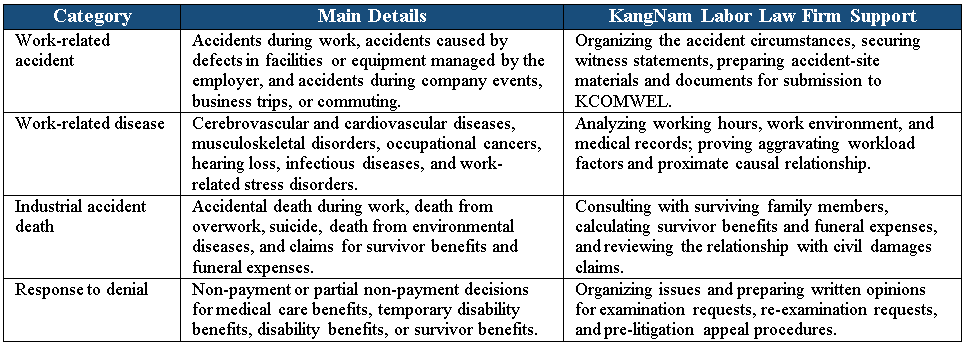
1. Major Types of Workers' Compensation Benefits
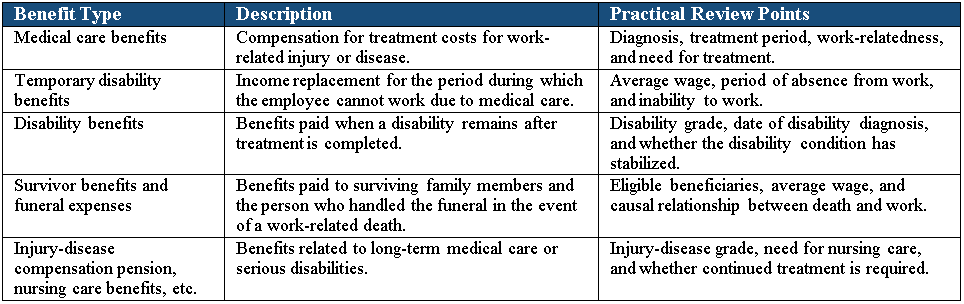
Key management point: The extinctive prescription period and starting point may differ depending on the type of workers' compensation benefit. If a work-related accident or disease is suspected, core evidence such as medical certificates, medical records, working-hour records, work-instruction records, and co-worker statements should be secured at an early stage.
II. How to Deliver
The Industrial Accident Compensation Claim Service is not merely the submission of an application form. It is a process of legally structuring the circumstances of the accident and its work-relatedness, and combining medical materials with objective evidence so that KCOMWEL can understand the evidentiary framework. For accidental injuries, clarity of facts is critical. For disease-related cases, it is important to comprehensively prove the relationship among working hours, work intensity, work environment, stress, and any pre-existing diseases.
1. Common Procedure
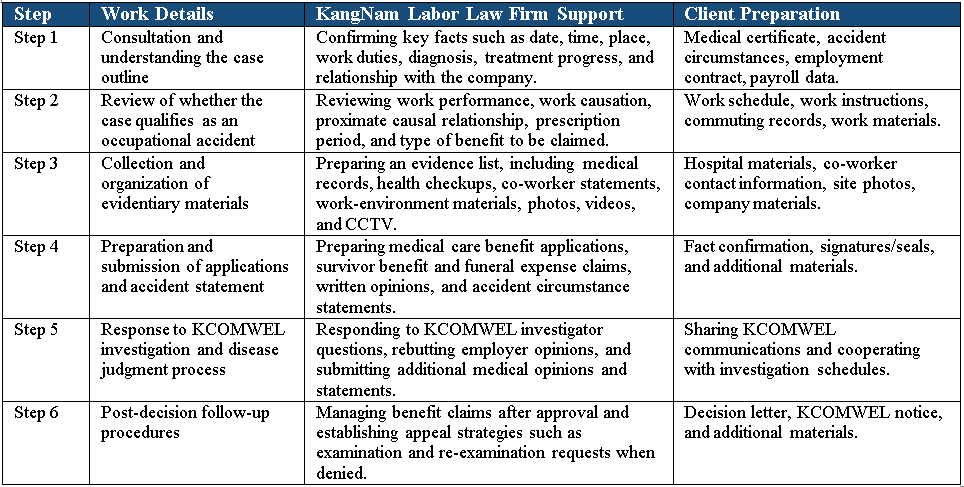
2. Materials to Prepare in Advance
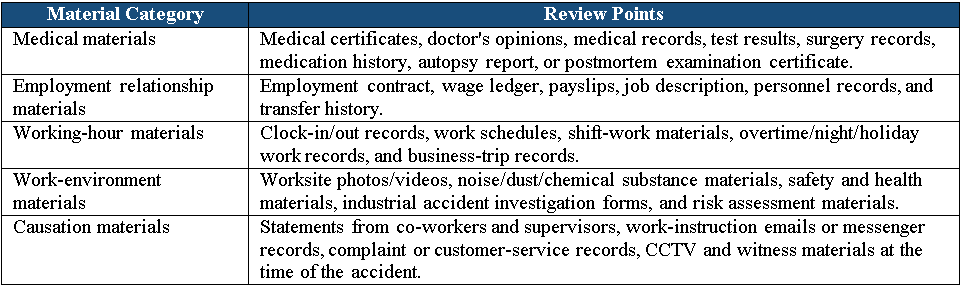
In work-related disease cases, the key issue is not only “what to argue,” but “what evidence will prove it.” KangNam Labor Law Firm organizes the facts, medical materials, working-hour records, and work-environment materials into a structure that KCOMWEL and the Occupational Disease Judgment Committee can review.
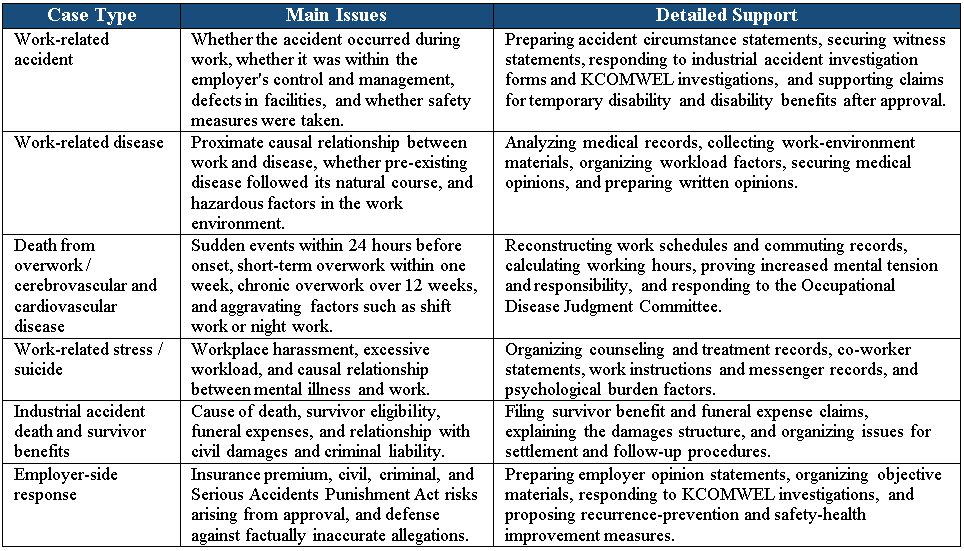
3. Detailed Support by Major Case Type
Workers' compensation claims require different evidentiary approaches depending on the case type, such as accidental injuries, disease-related accidents, death from overwork, commuting accidents, and death cases. KangNam Labor Law Firm distinguishes the required evidence and legal principles for each case type and establishes a consistent strategy from the application stage through the appeal process.
(1) Difference in Approach between Accidental Injuries and Disease-Related Cases
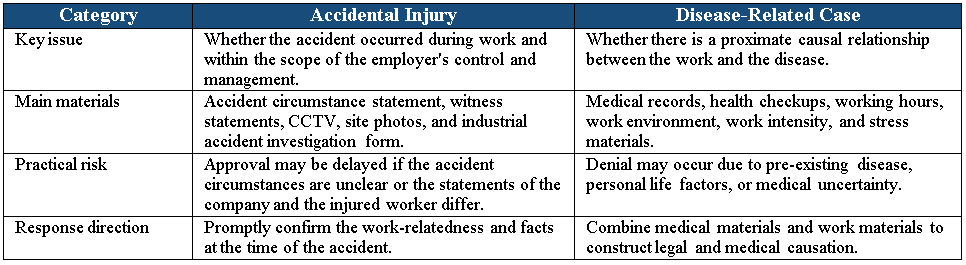
In death cases or death-from-overwork cases, if evidence such as an autopsy, postmortem examination certificate, work records, work-instruction materials, and co-worker statements is not secured at an early stage, later proof may become extremely difficult. The accuracy of the initial response may determine the outcome of the case.
III. Client Benefits
Workers' compensation cases involve treatment and livelihood issues for employees and surviving family members, while for employers they are connected to industrial accident approval, civil damages, criminal liability, and serious-accident risks. By engaging KangNam Labor Law Firm, clients can systematically organize facts and evidence from the initial stage, increase the likelihood of approval, and reduce unnecessary escalation of disputes.
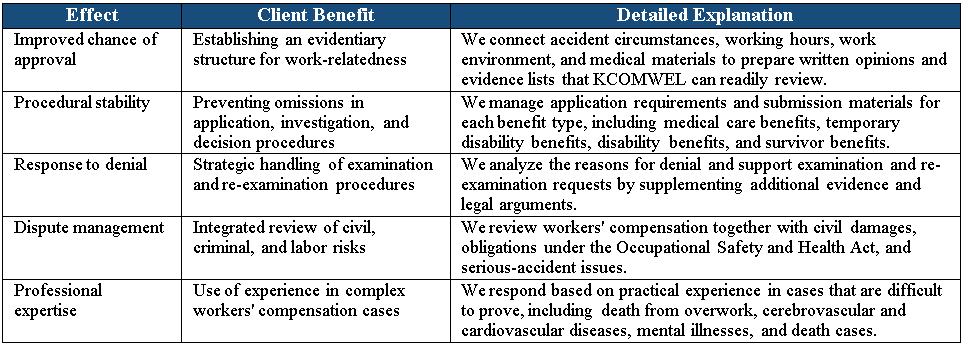
Why Choose KangNam Labor Law Firm
ㆍWe review each case comprehensively by considering the workers' compensation system, accident recognition standards, benefit calculation, and appeal procedures together.
ㆍA certified labor attorney prepares practical documents such as accident circumstance statements, written opinions, evidence lists, and materials for the Occupational Disease Judgment Committee.
ㆍFor difficult cases such as cerebrovascular and cardiovascular diseases, death from overwork, work-related stress, and environmental diseases, we provide concrete proof strategies.
ㆍFor employer-side cases, we review not only whether the industrial accident will be approved, but also civil damages, the Occupational Safety and Health Act, and serious-accident risks.
ㆍFor industrial accident cases involving foreign-invested companies and multinational companies, we can prepare Korean-English fact summaries and reports.
Deliverables and Follow-Up Management
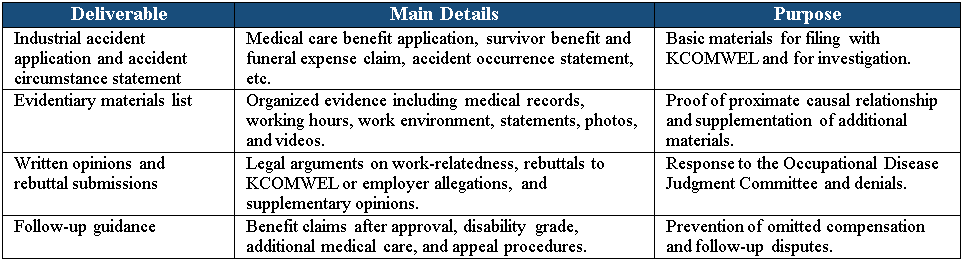
Consultation Notes
Whether an industrial accident is recognized may vary depending on the type of accident, diagnosis, working hours, work environment, pre-existing disease, whether the accident occurred under the employer's control and management, and the degree to which evidence has been secured. For an accurate assessment, materials from immediately after the accident and medical records should be reviewed first.
※ This material has been prepared for general guidance and promotional purposes. For individual cases, the requirements must be confirmed through a separate consultation.
FAQ
Q18
What is the statute of limitations for workers’ compensation benefits?
The right to receive industrial accident compensation insurance benefits may become time-barred if it is not exercised within a certain period. Therefore, if a work-related injury or disease is suspected, it is important to review whether to file a workers’ compensation claim as soon as possible after the accident or the occurrence of the disease. In principle, the statute of limitations for industrial accident compensation insurance benefits is three years. For example, medical care benefits, temporary disability benefits, nursing care benefits, and vocational rehabilitation benefits are generally subject to a three-year limitation period, unless there are special circumstances. In the case of temporary disability benefits, the limitation period generally begins to run from the day following the day on which the employee was unable to work.
However, the right to receive disability benefits, survivors’ benefits, funeral expenses, pneumoconiosis compensation annuity, and pneumoconiosis survivors’ annuity is extinguished by prescription if not exercised for five years. In other words, in cases involving death from an industrial accident or a remaining disability after treatment, the five-year limitation period may become an important issue.
The starting point of the limitation period may vary depending on the type of benefit and the circumstances of the case. In accident-type industrial injury cases, the date of the accident or the time when the benefit could be claimed is often relatively clear. However, in occupational disease cases or disability benefit cases, the date of diagnosis, the date of completion of treatment, or the time when the disability condition became fixed may become important.
In addition, the filing of a claim for industrial accident compensation insurance benefits interrupts the statute of limitations. Article 113 of the Industrial Accident Compensation Insurance Act provides that the statute of limitations for industrial accident compensation insurance benefits is interrupted by a claim for insurance benefits under Article 36(2). In particular, where the first claim requires a determination as to whether the injury or disease constitutes a work-related accident, the interruption of prescription caused by that claim may also extend to other insurance benefits related to the same accident or disease.
The Supreme Court has also held that a claim for insurance benefits under Article 36(1) of the Industrial Accident Compensation Insurance Act constitutes a unique ground for interruption of prescription under the Industrial Accident Compensation Insurance Act, separate from the grounds for interruption of prescription under the Civil Act.
Meanwhile, Article 111 of the Industrial Accident Compensation Insurance Act provides that the filing of a request for review or re-examination is deemed to be a judicial claim for the purpose of interruption of prescription. Therefore, if a request for review or re-examination is filed against a non-approval decision or other disposition by the Korea Workers’ Compensation & Welfare Service, the issue of interruption of prescription should also be reviewed separately.
A claim for industrial accident compensation insurance benefits filed with the Korea Workers’ Compensation & Welfare Service may therefore serve as a ground for interrupting the statute of limitations under the Industrial Accident Compensation Insurance Act. Accordingly, in order to interrupt the limitation period for industrial accident compensation insurance benefits, it is necessary to file a claim for such benefits with the Korea Workers’ Compensation & Welfare Service or, after a decision by the Service, properly proceed with statutory appeal procedures such as a request for review or re-examination.
Therefore, in industrial accident cases, it is necessary to review not only how many years have passed since the date of the accident, but also what type of insurance benefit is being claimed, when the right to claim that benefit arose, whether a workers’ compensation claim or insurance benefit claim has already been filed with the Korea Workers’ Compensation & Welfare Service, and whether only a petition to the Ministry of Employment and Labor or a criminal complaint has been filed.
However, the right to receive disability benefits, survivors’ benefits, funeral expenses, pneumoconiosis compensation annuity, and pneumoconiosis survivors’ annuity is extinguished by prescription if not exercised for five years. In other words, in cases involving death from an industrial accident or a remaining disability after treatment, the five-year limitation period may become an important issue.
The starting point of the limitation period may vary depending on the type of benefit and the circumstances of the case. In accident-type industrial injury cases, the date of the accident or the time when the benefit could be claimed is often relatively clear. However, in occupational disease cases or disability benefit cases, the date of diagnosis, the date of completion of treatment, or the time when the disability condition became fixed may become important.
In addition, the filing of a claim for industrial accident compensation insurance benefits interrupts the statute of limitations. Article 113 of the Industrial Accident Compensation Insurance Act provides that the statute of limitations for industrial accident compensation insurance benefits is interrupted by a claim for insurance benefits under Article 36(2). In particular, where the first claim requires a determination as to whether the injury or disease constitutes a work-related accident, the interruption of prescription caused by that claim may also extend to other insurance benefits related to the same accident or disease.
The Supreme Court has also held that a claim for insurance benefits under Article 36(1) of the Industrial Accident Compensation Insurance Act constitutes a unique ground for interruption of prescription under the Industrial Accident Compensation Insurance Act, separate from the grounds for interruption of prescription under the Civil Act.
Meanwhile, Article 111 of the Industrial Accident Compensation Insurance Act provides that the filing of a request for review or re-examination is deemed to be a judicial claim for the purpose of interruption of prescription. Therefore, if a request for review or re-examination is filed against a non-approval decision or other disposition by the Korea Workers’ Compensation & Welfare Service, the issue of interruption of prescription should also be reviewed separately.
A claim for industrial accident compensation insurance benefits filed with the Korea Workers’ Compensation & Welfare Service may therefore serve as a ground for interrupting the statute of limitations under the Industrial Accident Compensation Insurance Act. Accordingly, in order to interrupt the limitation period for industrial accident compensation insurance benefits, it is necessary to file a claim for such benefits with the Korea Workers’ Compensation & Welfare Service or, after a decision by the Service, properly proceed with statutory appeal procedures such as a request for review or re-examination.
Therefore, in industrial accident cases, it is necessary to review not only how many years have passed since the date of the accident, but also what type of insurance benefit is being claimed, when the right to claim that benefit arose, whether a workers’ compensation claim or insurance benefit claim has already been filed with the Korea Workers’ Compensation & Welfare Service, and whether only a petition to the Ministry of Employment and Labor or a criminal complaint has been filed.
Q17
How are workers’ compensation benefits coordinated with other forms of compensation or liability?
Workers’ compensation benefits are public insurance benefits paid to employees who suffer work-related injuries or diseases. However, when an industrial accident occurs, the issue is not limited to workers’ compensation benefits alone. Depending on the circumstances, criminal liability, civil damages, company consolation payments, group insurance benefits, automobile insurance benefits, personal insurance benefits, or general insurance benefits may also arise. In such cases, the key principle is that double compensation for the same loss is restricted, while compensation or liability of a different legal nature may be recognized separately.
First, criminal liability is a separate issue from workers’ compensation benefits. The fact that an industrial accident has been approved and the employee has received medical care benefits or temporary disability benefits does not automatically exempt the employer, the person responsible for occupational safety and health, or the site manager from criminal liability. In cases involving serious accidents or violations of safety measures, the Occupational Safety and Health Act, the crime of occupational negligence resulting in injury or death under the Criminal Act, and the Serious Accidents Punishment Act may be separately reviewed. However, settlement with the victim, compensation to the bereaved family, and the establishment of measures to prevent recurrence may be considered as mitigating factors in criminal proceedings.
Second, civil damages are coordinated with workers’ compensation benefits. Workers’ compensation is a no-fault compensation system. Therefore, once an injury or disease is recognized as work-related, statutory benefits are paid regardless of whether the employer was intentional or negligent. By contrast, civil damages require the employer’s intent or negligence, violation of the duty of care for safety, tort liability, or contractual default liability. If the employee has received workers’ compensation benefits, the employer may be exempt from civil liability to the extent that those benefits compensate for losses of the same nature. However, losses not covered by workers’ compensation benefits, such as pain and suffering, lost income exceeding the amount covered by workers’ compensation benefits, future medical expenses, or additional nursing care expenses, may be claimed separately depending on the case.
Third, company consolation payments or settlement payments depend on the purpose of payment and the wording of the settlement agreement. If the payment is made as a simple consolation payment, moral compensation, or welfare support, it may be recognized separately from workers’ compensation benefits. On the other hand, if the payment is made to fulfill the employer’s civil liability for damages, it may be coordinated with future civil damages or workers’ compensation benefits. Therefore, when a company pays consolation money or a settlement amount, it should clearly distinguish whether the payment is a simple consolation payment, civil damages, or a settlement payment intended to resolve future claims.
Fourth, group insurance taken out by the company also depends on the nature of the insurance. Insurance benefits paid as fixed amounts under group accident insurance or group life insurance subscribed to by the company as part of employee welfare may be paid separately from workers’ compensation benefits. However, if the insurance is structured in substance to replace the employer’s liability for damages, or if the group insurance policy or settlement agreement provides for coordination with damages, the insurance benefits may be coordinated with the amount of civil damages. Therefore, in reviewing group insurance, it is necessary to check the policyholder, insured person, beneficiary, purpose of the insurance payment, and the terms and conditions of the policy.
Fifth, automobile insurance often becomes an issue in commuting accidents or traffic accidents during work. If a traffic accident is caused by a third party’s driving negligence, the employee may choose which procedure to pursue first, or may proceed with both workers’ compensation benefits and automobile insurance compensation. However, the employee cannot receive full duplicate compensation from both workers’ compensation insurance and automobile insurance for the same medical expenses or the same lost income. If workers’ compensation benefits are paid first, the Korea Workers’ Compensation & Welfare Service may exercise a right of reimbursement against the wrongdoer or the automobile insurer within the amount of benefits paid. Conversely, if the employee first receives damages from automobile insurance, workers’ compensation benefits may be adjusted to the extent that the payment covers the same loss.
Sixth, general insurance or personal insurance depends on whether it is fixed-sum insurance or indemnity insurance. Fixed-sum insurance, such as accidental death benefits, disability benefits, or life insurance benefits, is generally payable separately from workers’ compensation benefits once the insured event occurs. By contrast, indemnity insurance, such as actual medical expense insurance, is designed to compensate for medical expenses actually incurred, and duplicate payment may be restricted for medical expenses already covered by workers’ compensation insurance. Therefore, when reviewing personal insurance or general insurance, it is necessary to examine not only the name of the insurance product but also whether it is fixed-sum insurance or indemnity insurance, and whether the policy contains coordination clauses concerning workers’ compensation or automobile insurance.
In practice, therefore, industrial accident cases should not be reviewed only from the perspective of workers’ compensation benefits. Criminal liability, civil damages, company consolation or settlement payments, group insurance, automobile insurance, and personal insurance should also be reviewed together. In particular, when drafting a settlement agreement, it is important to clearly state what loss the payment is intended to compensate, whether it is paid separately from workers’ compensation benefits, and whether the employee waives any future civil claim for damages.
First, criminal liability is a separate issue from workers’ compensation benefits. The fact that an industrial accident has been approved and the employee has received medical care benefits or temporary disability benefits does not automatically exempt the employer, the person responsible for occupational safety and health, or the site manager from criminal liability. In cases involving serious accidents or violations of safety measures, the Occupational Safety and Health Act, the crime of occupational negligence resulting in injury or death under the Criminal Act, and the Serious Accidents Punishment Act may be separately reviewed. However, settlement with the victim, compensation to the bereaved family, and the establishment of measures to prevent recurrence may be considered as mitigating factors in criminal proceedings.
Second, civil damages are coordinated with workers’ compensation benefits. Workers’ compensation is a no-fault compensation system. Therefore, once an injury or disease is recognized as work-related, statutory benefits are paid regardless of whether the employer was intentional or negligent. By contrast, civil damages require the employer’s intent or negligence, violation of the duty of care for safety, tort liability, or contractual default liability. If the employee has received workers’ compensation benefits, the employer may be exempt from civil liability to the extent that those benefits compensate for losses of the same nature. However, losses not covered by workers’ compensation benefits, such as pain and suffering, lost income exceeding the amount covered by workers’ compensation benefits, future medical expenses, or additional nursing care expenses, may be claimed separately depending on the case.
Third, company consolation payments or settlement payments depend on the purpose of payment and the wording of the settlement agreement. If the payment is made as a simple consolation payment, moral compensation, or welfare support, it may be recognized separately from workers’ compensation benefits. On the other hand, if the payment is made to fulfill the employer’s civil liability for damages, it may be coordinated with future civil damages or workers’ compensation benefits. Therefore, when a company pays consolation money or a settlement amount, it should clearly distinguish whether the payment is a simple consolation payment, civil damages, or a settlement payment intended to resolve future claims.
Fourth, group insurance taken out by the company also depends on the nature of the insurance. Insurance benefits paid as fixed amounts under group accident insurance or group life insurance subscribed to by the company as part of employee welfare may be paid separately from workers’ compensation benefits. However, if the insurance is structured in substance to replace the employer’s liability for damages, or if the group insurance policy or settlement agreement provides for coordination with damages, the insurance benefits may be coordinated with the amount of civil damages. Therefore, in reviewing group insurance, it is necessary to check the policyholder, insured person, beneficiary, purpose of the insurance payment, and the terms and conditions of the policy.
Fifth, automobile insurance often becomes an issue in commuting accidents or traffic accidents during work. If a traffic accident is caused by a third party’s driving negligence, the employee may choose which procedure to pursue first, or may proceed with both workers’ compensation benefits and automobile insurance compensation. However, the employee cannot receive full duplicate compensation from both workers’ compensation insurance and automobile insurance for the same medical expenses or the same lost income. If workers’ compensation benefits are paid first, the Korea Workers’ Compensation & Welfare Service may exercise a right of reimbursement against the wrongdoer or the automobile insurer within the amount of benefits paid. Conversely, if the employee first receives damages from automobile insurance, workers’ compensation benefits may be adjusted to the extent that the payment covers the same loss.
Sixth, general insurance or personal insurance depends on whether it is fixed-sum insurance or indemnity insurance. Fixed-sum insurance, such as accidental death benefits, disability benefits, or life insurance benefits, is generally payable separately from workers’ compensation benefits once the insured event occurs. By contrast, indemnity insurance, such as actual medical expense insurance, is designed to compensate for medical expenses actually incurred, and duplicate payment may be restricted for medical expenses already covered by workers’ compensation insurance. Therefore, when reviewing personal insurance or general insurance, it is necessary to examine not only the name of the insurance product but also whether it is fixed-sum insurance or indemnity insurance, and whether the policy contains coordination clauses concerning workers’ compensation or automobile insurance.
In practice, therefore, industrial accident cases should not be reviewed only from the perspective of workers’ compensation benefits. Criminal liability, civil damages, company consolation or settlement payments, group insurance, automobile insurance, and personal insurance should also be reviewed together. In particular, when drafting a settlement agreement, it is important to clearly state what loss the payment is intended to compensate, whether it is paid separately from workers’ compensation benefits, and whether the employee waives any future civil claim for damages.
Q16
How is the industrial accident compensation insurance premium rate calculated and applied?
The industrial accident compensation insurance premium rate is calculated by considering factors such as the type of business, the level of occupational risk, and the record of insurance benefit payments. Each year, the Ministry of Employment and Labor announces the industrial accident compensation insurance premium rates by business category.
In principle, industrial accident compensation insurance premiums are calculated by multiplying the employee’s remuneration by the applicable insurance premium rate. For ordinary workplaces, the premium is imposed by applying the relevant industrial accident compensation insurance premium rate to each employee’s monthly average remuneration. The applicable premium rate is generally the sum of the premium rate by business category and the commuting accident premium rate.
However, unlike ordinary workplaces, the construction industry and logging industry calculate estimated premiums by multiplying the estimated total remuneration for the relevant year by the applicable premium rate. The employer is responsible for reporting and paying these estimated premiums.
In addition, workplaces that meet certain requirements may be subject to an individual experience rate based on their past record of industrial accidents and insurance benefit payments. The individual experience rate is calculated based on the ratio of industrial accident compensation insurance benefits paid to industrial accident compensation insurance premiums over the three-year period before June 30 of the relevant year. This ratio is referred to as the insurance balance ratio. If the insurance balance ratio exceeds 85% or is 75% or less, the industrial accident compensation insurance premium rate applicable to the workplace may be increased or decreased in the following insurance year.
In other words, even among workplaces in the same business category, a workplace with many industrial accidents and relatively high insurance benefit payments may have its premium rate increased. Conversely, a workplace with fewer industrial accidents and lower insurance benefit payments may have its premium rate decreased.
In principle, industrial accident compensation insurance premiums are fully borne by the employer. Therefore, employees do not separately bear these premiums, and the burden of insurance premiums should not be passed on to employees simply because they have filed a workers’ compensation claim. However, in cases where special rules apply, such as industrial accident compensation insurance for labor providers, the employer and the labor provider may share the insurance premium.
In principle, industrial accident compensation insurance premiums are calculated by multiplying the employee’s remuneration by the applicable insurance premium rate. For ordinary workplaces, the premium is imposed by applying the relevant industrial accident compensation insurance premium rate to each employee’s monthly average remuneration. The applicable premium rate is generally the sum of the premium rate by business category and the commuting accident premium rate.
However, unlike ordinary workplaces, the construction industry and logging industry calculate estimated premiums by multiplying the estimated total remuneration for the relevant year by the applicable premium rate. The employer is responsible for reporting and paying these estimated premiums.
In addition, workplaces that meet certain requirements may be subject to an individual experience rate based on their past record of industrial accidents and insurance benefit payments. The individual experience rate is calculated based on the ratio of industrial accident compensation insurance benefits paid to industrial accident compensation insurance premiums over the three-year period before June 30 of the relevant year. This ratio is referred to as the insurance balance ratio. If the insurance balance ratio exceeds 85% or is 75% or less, the industrial accident compensation insurance premium rate applicable to the workplace may be increased or decreased in the following insurance year.
In other words, even among workplaces in the same business category, a workplace with many industrial accidents and relatively high insurance benefit payments may have its premium rate increased. Conversely, a workplace with fewer industrial accidents and lower insurance benefit payments may have its premium rate decreased.
In principle, industrial accident compensation insurance premiums are fully borne by the employer. Therefore, employees do not separately bear these premiums, and the burden of insurance premiums should not be passed on to employees simply because they have filed a workers’ compensation claim. However, in cases where special rules apply, such as industrial accident compensation insurance for labor providers, the employer and the labor provider may share the insurance premium.
Q15
What happens if a disability remains after industrial accident treatment?
If functional impairment, mobility limitation, chronic pain, nerve damage, or sensory loss remains after treatment is completed, disability benefits may be considered.
Disability benefits are not granted simply because symptoms remain; they are determined based on whether the remaining impairment meets the disability grading standards under industrial accident insurance after medical treatment is completed. Therefore, post-treatment medical opinions, test results, disability evaluation reports, and functional limitation assessments must be clearly documented.
In cases where disability is expected, it is generally safer for worker protection to proceed with industrial accident approval rather than a simple private settlement. Approval directly affects disability benefits, re-treatment, and additional compensation issues.
Disability benefits are not granted simply because symptoms remain; they are determined based on whether the remaining impairment meets the disability grading standards under industrial accident insurance after medical treatment is completed. Therefore, post-treatment medical opinions, test results, disability evaluation reports, and functional limitation assessments must be clearly documented.
In cases where disability is expected, it is generally safer for worker protection to proceed with industrial accident approval rather than a simple private settlement. Approval directly affects disability benefits, re-treatment, and additional compensation issues.
Q14
Can industrial accident compensation be re-applied for if aftereffects occur after treatment ends?
Yes. If the condition recurs or worsens after treatment has ended, requiring further medical care, re-treatment (re-application for medical care benefits) may be requested.
When applying for re-treatment, important documents include a re-treatment application, medical opinion or diagnosis, and materials explaining the causal relationship between the original approved injury and current symptoms. If any compensation or settlement amount has been previously received from the employer or a third party, documents such as agreements or court judgments confirming the details may also be required.
When applying for re-treatment, important documents include a re-treatment application, medical opinion or diagnosis, and materials explaining the causal relationship between the original approved injury and current symptoms. If any compensation or settlement amount has been previously received from the employer or a third party, documents such as agreements or court judgments confirming the details may also be required.
Q13
If an employee works partially during workers’ compensation treatment, does this mean that temporary layoff benefits cannot be received?
Not necessarily. Even while receiving medical care for an industrial accident, an injured employee may be able to work to a limited extent, depending on the employee’s health condition and the progress of treatment. In such cases, either temporary layoff benefits or partial temporary layoff benefits may become an issue, depending on whether the employee was completely unable to work or worked for a certain period or for reduced hours.
Ordinary temporary layoff benefits are paid for the period during which the employee is unable to work due to medical care for a work-related injury or disease. In principle, the amount paid is equivalent to 70% of the employee’s average daily wage. However, no temporary layoff benefits are paid if the period during which the employee is unable to work is three days or less.
On the other hand, if the employee works for a certain period or for reduced hours during the medical care period, partial temporary layoff benefits may apply instead of ordinary temporary layoff benefits. Partial temporary layoff benefits are intended to compensate for the reduction in income where the employee works partially during workers’ compensation treatment but is unable to earn the same level of income as before the injury.
In general, partial temporary layoff benefits may be paid in an amount equivalent to 80% of the difference between the average wage corresponding to the day worked and the wages paid for that day under Article 53(1) of the Industrial Accident Compensation Insurance Act.
Partial temporary layoff benefits = (Average wage for the day worked ? Wages paid for the day worked) × 80%
?※ Example of calculation of partial temporary layoff benefits
- Where the average daily wage is KRW 100,000 and the employee works for four hours and receives KRW 36,000, the partial temporary layoff benefit amount is KRW 46,200.
- Amount of partial temporary layoff benefits for the hours worked: {(KRW 100,000 × 4/8) ? KRW 36,000} × 80% = KRW 11,200
- Amount of partial temporary layoff benefits for the hours not worked: (KRW 100,000 × 70%) × 4/8 = KRW 35,000
Therefore, the total daily amount received by the injured employee is KRW 82,200, consisting of KRW 36,000 in wages from partial work and KRW 46,200 in partial temporary layoff benefits. If the employee had not worked at all and had only received medical care, the temporary layoff benefit would have been KRW 70,000.
However, partial temporary layoff benefits are not granted merely because the employee “worked a little.” The workplace, assigned duties, and working hours during the medical care period must be specifically determined, and a doctor’s opinion must confirm that the work will not delay recovery or worsen the injury or disease. In other words, whether treatment and work can be medically performed in parallel is an important factor.
In practice, the key issue is to clearly prove the period during which the employee was unable to work due to medical care, the amount of wages received on the days of partial work, and whether the work was medically permissible. For this purpose, it is advisable to prepare medical records, a doctor’s opinion, work schedules, attendance records, payslips, wage ledgers, and materials showing the details of the work performed.
In addition, the right to receive temporary layoff benefits does not lapse merely because the employee has resigned. If there was a period during workers’ compensation treatment when the employee was actually unable to work, or if there was a reduction in income due to partial work, but temporary layoff benefits or partial temporary layoff benefits were not paid, the employee may file a claim with the Korea Workers’ Compensation & Welfare Service in accordance with the statutory procedures.
Ordinary temporary layoff benefits are paid for the period during which the employee is unable to work due to medical care for a work-related injury or disease. In principle, the amount paid is equivalent to 70% of the employee’s average daily wage. However, no temporary layoff benefits are paid if the period during which the employee is unable to work is three days or less.
On the other hand, if the employee works for a certain period or for reduced hours during the medical care period, partial temporary layoff benefits may apply instead of ordinary temporary layoff benefits. Partial temporary layoff benefits are intended to compensate for the reduction in income where the employee works partially during workers’ compensation treatment but is unable to earn the same level of income as before the injury.
In general, partial temporary layoff benefits may be paid in an amount equivalent to 80% of the difference between the average wage corresponding to the day worked and the wages paid for that day under Article 53(1) of the Industrial Accident Compensation Insurance Act.
Partial temporary layoff benefits = (Average wage for the day worked ? Wages paid for the day worked) × 80%
?※ Example of calculation of partial temporary layoff benefits
- Where the average daily wage is KRW 100,000 and the employee works for four hours and receives KRW 36,000, the partial temporary layoff benefit amount is KRW 46,200.
- Amount of partial temporary layoff benefits for the hours worked: {(KRW 100,000 × 4/8) ? KRW 36,000} × 80% = KRW 11,200
- Amount of partial temporary layoff benefits for the hours not worked: (KRW 100,000 × 70%) × 4/8 = KRW 35,000
Therefore, the total daily amount received by the injured employee is KRW 82,200, consisting of KRW 36,000 in wages from partial work and KRW 46,200 in partial temporary layoff benefits. If the employee had not worked at all and had only received medical care, the temporary layoff benefit would have been KRW 70,000.
However, partial temporary layoff benefits are not granted merely because the employee “worked a little.” The workplace, assigned duties, and working hours during the medical care period must be specifically determined, and a doctor’s opinion must confirm that the work will not delay recovery or worsen the injury or disease. In other words, whether treatment and work can be medically performed in parallel is an important factor.
In practice, the key issue is to clearly prove the period during which the employee was unable to work due to medical care, the amount of wages received on the days of partial work, and whether the work was medically permissible. For this purpose, it is advisable to prepare medical records, a doctor’s opinion, work schedules, attendance records, payslips, wage ledgers, and materials showing the details of the work performed.
In addition, the right to receive temporary layoff benefits does not lapse merely because the employee has resigned. If there was a period during workers’ compensation treatment when the employee was actually unable to work, or if there was a reduction in income due to partial work, but temporary layoff benefits or partial temporary layoff benefits were not paid, the employee may file a claim with the Korea Workers’ Compensation & Welfare Service in accordance with the statutory procedures.
Q12
How are medical expenses handled before industrial accident approval?
Before industrial accident approval, workers are usually treated first through the National Health Insurance system or by paying out-of-pocket. If the accident is later approved as an industrial accident, medical expenses related to the approved condition can be reimbursed or adjusted through industrial accident medical care benefits.
However, not all medical expenses are automatically covered. The scope of compensation depends on whether the treatment is related to the approved injury/disease, whether it is recognized under industrial accident insurance coverage, and whether it falls under non-covered (non-benefit) items. Therefore, it is advisable to keep receipts, detailed medical bills, diagnostic reports, and medical opinions before and after filing a claim.
However, not all medical expenses are automatically covered. The scope of compensation depends on whether the treatment is related to the approved injury/disease, whether it is recognized under industrial accident insurance coverage, and whether it falls under non-covered (non-benefit) items. Therefore, it is advisable to keep receipts, detailed medical bills, diagnostic reports, and medical opinions before and after filing a claim.
Q11
Can an industrial accident claim be filed even after three years have passed since resignation?
Yes. Even if more than three years have passed after resignation, filing an industrial accident claim itself is still possible. The right to receive industrial accident insurance benefits does not automatically expire simply because the worker has left the company. Therefore, if the accident or occupational disease occurred during employment, the worker may still file a claim by proving the work-relatedness even after resignation.
However, the ability to file a claim and the ability to actually receive benefits must be distinguished. In principle, a three-year statute of limitations applies to major benefits such as medical care benefits and temporary disability benefits. Accordingly, if more than three years have passed from the date of the accident or from the time when the benefit could have been claimed, the Korea Workers’ Compensation & Welfare Service may deny payment based on prescription.
In particular, for occupational diseases or disability benefits, the starting point of the claim period may not necessarily coincide with the accident date or resignation date. It may vary depending on the diagnosis date, treatment start date, treatment completion date, time of disability fixation, or the point when work relevance was recognized. Therefore, a case-by-case analysis is required based on specific facts.
In addition, as time passes, it becomes more difficult to secure evidence such as accident circumstances, witness statements, CCTV footage, work records, and medical records. Therefore, if an industrial accident is suspected even after resignation, it is advisable to collect relevant materials and review the claim as soon as possible.
However, the ability to file a claim and the ability to actually receive benefits must be distinguished. In principle, a three-year statute of limitations applies to major benefits such as medical care benefits and temporary disability benefits. Accordingly, if more than three years have passed from the date of the accident or from the time when the benefit could have been claimed, the Korea Workers’ Compensation & Welfare Service may deny payment based on prescription.
In particular, for occupational diseases or disability benefits, the starting point of the claim period may not necessarily coincide with the accident date or resignation date. It may vary depending on the diagnosis date, treatment start date, treatment completion date, time of disability fixation, or the point when work relevance was recognized. Therefore, a case-by-case analysis is required based on specific facts.
In addition, as time passes, it becomes more difficult to secure evidence such as accident circumstances, witness statements, CCTV footage, work records, and medical records. Therefore, if an industrial accident is suspected even after resignation, it is advisable to collect relevant materials and review the claim as soon as possible.
Q10
What is the difference between company-paid compensation (mutual settlement) and industrial accident compensation?
Company-paid compensation (“mutual settlement”) is a private arrangement where the employer covers medical costs or wages without filing an industrial accident claim. In contrast, industrial accident compensation is a statutory insurance system where the worker applies to the Korea Workers’ Compensation & Welfare Service and receives legally guaranteed benefits upon approval.The key difference is long-term protection. Company compensation is limited to what is agreed, which may lead to disputes if treatment is prolonged or disability remains. Industrial accident compensation provides statutory benefits such as medical care, temporary disability benefits, and disability benefits once approved.Importantly, agreeing to a company settlement does not eliminate the worker’s right to file an industrial accident claim. The right to claim is a public law right, and an agreement not to apply does not legally prevent filing within the statute of limitations (generally up to 3 years from the accident date in practice).Employers must also be careful: concealing or failing to report industrial accidents may violate occupational safety and health laws. Even if a company settlement is made, reporting obligations (such as submitting an accident report for cases involving more than 3 days of absence) may still apply.Therefore, while company settlements may be used for minor cases, industrial accident reporting is generally the safer approach when work causation is clear, treatment is expected to be long, or there is risk of disability. Employers must not obstruct applications or force company-only settlements.
Q9
What should employers and workers be careful about when filing a claim?
Workers should accurately record the accident immediately and clearly state that the injury occurred at work or is work-related when receiving medical treatment. They should also secure objective evidence such as witnesses, photos, CCTV, and work records as early as possible.Employers must not obstruct industrial accident claims or force “company compensation-only” settlements. Blocking or concealing industrial accident reporting may create separate legal issues. Employers should verify facts objectively, cooperate in submitting necessary documents, and implement preventive measures.Ultimately, the most important factor in industrial accident claims is objective proof of the relationship between the work and the injury or disease. Early documentation has a significant impact on approval outcomes.
Q8
What should an employee do if the workers’ compensation claim is denied?
Even if a workers’ compensation claim is denied, the case is not necessarily over. The employee may challenge the denial decision made by the Korea Workers’ Compensation & Welfare Service, and depending on the case, may consider filing a request for review, a request for re-examination, or an administrative lawsuit.
The first step is to carefully review the written denial decision. In denied cases, it is not enough simply to argue that the decision is unfair. It is essential to identify the specific reason why the Service refused to recognize the case as a workers’ compensation case.
For example, the necessary supplementary evidence will differ depending on whether the issue is the occurrence of the accident itself, whether the accident occurred during the performance of work, whether the commuting route was usual and reasonable, or whether there is a medical causal relationship between the work and the disease. If the occurrence of the accident is disputed, witness statements or CCTV footage may be important. In occupational disease cases, medical opinions, working hour records, work intensity materials, and work environment evidence may be crucial.
Therefore, if a denial notice is received, it is important to promptly analyze the reasons for the denial, supplement the missing evidence, and decide which procedure should be used to challenge the decision before the applicable deadline expires.
The first step is to carefully review the written denial decision. In denied cases, it is not enough simply to argue that the decision is unfair. It is essential to identify the specific reason why the Service refused to recognize the case as a workers’ compensation case.
For example, the necessary supplementary evidence will differ depending on whether the issue is the occurrence of the accident itself, whether the accident occurred during the performance of work, whether the commuting route was usual and reasonable, or whether there is a medical causal relationship between the work and the disease. If the occurrence of the accident is disputed, witness statements or CCTV footage may be important. In occupational disease cases, medical opinions, working hour records, work intensity materials, and work environment evidence may be crucial.
Therefore, if a denial notice is received, it is important to promptly analyze the reasons for the denial, supplement the missing evidence, and decide which procedure should be used to challenge the decision before the applicable deadline expires.
Q7
Can an employee apply for workers’ compensation even if the case involves a disease rather than an accident?
Yes. Workers’ compensation applies not only to sudden accidents but also to occupational diseases. If a substantial causal relationship is recognized between the employee’s work and the disease, the disease may be approved as a workers’ compensation case.
Typical examples include musculoskeletal disorders, cerebrovascular and cardiovascular diseases, overwork-related diseases, mental disorders, occupational cancers, and diseases caused by exposure to harmful substances. However, unlike accident-type injuries, occupational disease cases often lack a specific accident scene or moment. Therefore, it is important to explain the relationship between the work and the disease through objective evidence.
For musculoskeletal disorders, important factors include repetitive work, awkward posture, handling of heavy objects, and working hours. For cerebrovascular and cardiovascular diseases, factors such as long working hours, night work, shift work, work-related stress, and sudden changes in the work environment may be relevant. In mental disorder cases, issues such as workplace harassment, excessive workload, traumatic work-related events, and conflicts within the organization may be reviewed.
Therefore, when preparing an occupational disease claim, it is necessary to comprehensively organize evidence such as job duties, working hours, work environment, work intensity, medical records, health examination records, pre-existing medical conditions, statements from co-workers, and work instruction materials.
Typical examples include musculoskeletal disorders, cerebrovascular and cardiovascular diseases, overwork-related diseases, mental disorders, occupational cancers, and diseases caused by exposure to harmful substances. However, unlike accident-type injuries, occupational disease cases often lack a specific accident scene or moment. Therefore, it is important to explain the relationship between the work and the disease through objective evidence.
For musculoskeletal disorders, important factors include repetitive work, awkward posture, handling of heavy objects, and working hours. For cerebrovascular and cardiovascular diseases, factors such as long working hours, night work, shift work, work-related stress, and sudden changes in the work environment may be relevant. In mental disorder cases, issues such as workplace harassment, excessive workload, traumatic work-related events, and conflicts within the organization may be reviewed.
Therefore, when preparing an occupational disease claim, it is necessary to comprehensively organize evidence such as job duties, working hours, work environment, work intensity, medical records, health examination records, pre-existing medical conditions, statements from co-workers, and work instruction materials.
Q6
Can an injury sustained while commuting to or from work be recognized as a workers’ compensation case?
Yes. If an employee is injured while commuting to or from work by a usual route and method, the accident may be recognized as a commuting accident under workers’ compensation.
In commuting accident cases, the key issue is not merely whether the accident occurred while the employee was moving, but whether the movement was part of the commuting process related to employment. Therefore, the starting point, destination, route, means of transportation, time of the accident, whether there was any detour, and the reason for any interruption are important factors.
For example, if a traffic accident occurs while the employee is traveling from home to work, or from work to home, along the usual route, it may be recognized as a workers’ compensation case. On the other hand, if the employee substantially deviated from the usual route for personal reasons, or if the accident occurred while engaging in an activity unrelated to commuting, recognition as a workers’ compensation case may be restricted.
Therefore, in commuting accident cases, it is helpful to secure evidence such as map-based route records, public transportation card records, vehicle black box footage, navigation records, accident confirmation reports, medical records, and company attendance records.
In commuting accident cases, the key issue is not merely whether the accident occurred while the employee was moving, but whether the movement was part of the commuting process related to employment. Therefore, the starting point, destination, route, means of transportation, time of the accident, whether there was any detour, and the reason for any interruption are important factors.
For example, if a traffic accident occurs while the employee is traveling from home to work, or from work to home, along the usual route, it may be recognized as a workers’ compensation case. On the other hand, if the employee substantially deviated from the usual route for personal reasons, or if the accident occurred while engaging in an activity unrelated to commuting, recognition as a workers’ compensation case may be restricted.
Therefore, in commuting accident cases, it is helpful to secure evidence such as map-based route records, public transportation card records, vehicle black box footage, navigation records, accident confirmation reports, medical records, and company attendance records.
Q5
How is income compensated when an employee is unable to work during workers’ compensation treatment?
If an employee is approved for workers’ compensation and is unable to work due to medical treatment, income is generally compensated through temporary disability benefits paid by the Korea Workers’ Compensation & Welfare Service, rather than through wages paid by the company.
Temporary disability benefits are paid for the period during which the employee is unable to work due to medical treatment for the work-related injury or disease. These benefits are generally calculated based on the employee’s average wage. However, the actual payment and amount may vary depending on the average wage, treatment period, ability to work, partial return to work, and progress of treatment.
In particular, if long-term treatment is expected, it is important to accurately prepare materials related to the calculation of average wages from the initial application stage. For example, the employee’s actual wage level and work pattern should be organized through documents such as wage ledgers, employment contracts, payslips, bonus payment records, allowance payment records, and work schedules.
In addition, further benefit issues may arise depending on whether the employee can partially return to work during treatment, whether additional medical treatment is required, or whether any disability remains after treatment. Therefore, it is necessary to review the entire compensation process, rather than focusing only on whether the workers’ compensation claim is approved.
Temporary disability benefits are paid for the period during which the employee is unable to work due to medical treatment for the work-related injury or disease. These benefits are generally calculated based on the employee’s average wage. However, the actual payment and amount may vary depending on the average wage, treatment period, ability to work, partial return to work, and progress of treatment.
In particular, if long-term treatment is expected, it is important to accurately prepare materials related to the calculation of average wages from the initial application stage. For example, the employee’s actual wage level and work pattern should be organized through documents such as wage ledgers, employment contracts, payslips, bonus payment records, allowance payment records, and work schedules.
In addition, further benefit issues may arise depending on whether the employee can partially return to work during treatment, whether additional medical treatment is required, or whether any disability remains after treatment. Therefore, it is necessary to review the entire compensation process, rather than focusing only on whether the workers’ compensation claim is approved.
Q4
What types of compensation can an employee receive if the claim is approved as a workers’ compensation case?
If the claim is approved as a workers’ compensation case, the employee may receive various types of industrial accident compensation insurance benefits, depending on the nature of the injury or disease and the progress of treatment.
First, medical care benefits are provided for treatment. These benefits cover medical expenses related to the work-related injury or disease. If the employee is unable to work due to medical treatment, temporary disability benefits may be paid. If a physical or mental disability remains after treatment is completed, the employee may be entitled to disability benefits.
In the case of death, the bereaved family may receive survivors’ benefits, and funeral expenses may also be paid. In addition, where long-term treatment is required or nursing care is necessary after treatment, benefits such as an injury-disease compensation annuity, nursing care benefits, and vocational rehabilitation benefits may also be considered, depending on the circumstances.
However, the specific benefits available may vary depending on the type of accident or disease, treatment period, disability grade, average wage, whether death occurred, and the need for nursing care. Therefore, even after the claim is approved, it is advisable to separately review which benefits may be available.
First, medical care benefits are provided for treatment. These benefits cover medical expenses related to the work-related injury or disease. If the employee is unable to work due to medical treatment, temporary disability benefits may be paid. If a physical or mental disability remains after treatment is completed, the employee may be entitled to disability benefits.
In the case of death, the bereaved family may receive survivors’ benefits, and funeral expenses may also be paid. In addition, where long-term treatment is required or nursing care is necessary after treatment, benefits such as an injury-disease compensation annuity, nursing care benefits, and vocational rehabilitation benefits may also be considered, depending on the circumstances.
However, the specific benefits available may vary depending on the type of accident or disease, treatment period, disability grade, average wage, whether death occurred, and the need for nursing care. Therefore, even after the claim is approved, it is advisable to separately review which benefits may be available.
Q3
What documents and supporting evidence are required to apply for workers’ compensation?
In general, the basic documents required for a workers’ compensation claim include an Application for Medical Care Benefits, a doctor’s medical opinion or diagnosis, and a written statement describing how the accident occurred. However, in workers’ compensation cases, it is more important to prove that the injury or disease is work-related than simply to submit the application form.
In the case of an accident-type industrial injury, the date, time, place, work details, and circumstances of the accident should be clearly organized. To support these facts, it is advisable to prepare additional evidence such as witness statements, photos of the accident site, CCTV footage, work logs, work schedules, work instructions, KakaoTalk messages, emails, other work-related communications, and medical records.
For commuting accidents, important evidence includes materials showing the commuting route, means of transportation, accident location, and whether there was any detour or interruption. In the case of occupational diseases, key factors include the employee’s job duties, working hours, working posture, repetitive work, handling of heavy objects, degree of exposure to harmful factors, overwork, stress factors, and pre-existing medical conditions.
Therefore, before filing a workers’ compensation claim, it is necessary to first identify the potential issues in dispute and then systematically prepare evidence to address those issues.
In the case of an accident-type industrial injury, the date, time, place, work details, and circumstances of the accident should be clearly organized. To support these facts, it is advisable to prepare additional evidence such as witness statements, photos of the accident site, CCTV footage, work logs, work schedules, work instructions, KakaoTalk messages, emails, other work-related communications, and medical records.
For commuting accidents, important evidence includes materials showing the commuting route, means of transportation, accident location, and whether there was any detour or interruption. In the case of occupational diseases, key factors include the employee’s job duties, working hours, working posture, repetitive work, handling of heavy objects, degree of exposure to harmful factors, overwork, stress factors, and pre-existing medical conditions.
Therefore, before filing a workers’ compensation claim, it is necessary to first identify the potential issues in dispute and then systematically prepare evidence to address those issues.
Q2
What is the process for filing an industrial accident compensation claim, and how long does it take?
An industrial accident compensation claim begins when a worker or surviving family member submits an application for medical care benefits to the workers’ compensation authority. After the application is filed, the authority reviews the accident circumstances, work-relatedness, medical opinions, and supporting documents to determine whether the case qualifies as an industrial accident. Additional documents or fact-finding investigations may be requested when necessary. The processing time varies depending on the complexity of the case and the scope of the review, but it generally takes several weeks to several months. Cases involving occupational diseases or complex work-relatedness issues may require a longer review period.
Q1
Can a worker apply for industrial accident compensation even if the company does not agree?
Yes. A worker can directly file an industrial accident claim. Even if the employer does not agree or refuses to confirm the incident, the application itself is not prevented.If the company does not cooperate, the worker may submit supporting materials such as the accident report, medical certificate, treatment records, witness statements, photos, CCTV footage, and work-related documents directly to the Korea Workers’ Compensation & Welfare Service. The agency will determine whether the injury is work-related based on the submitted materials and its own investigation.
Key Representative Cases