

Employment Contract Labor Consulting & Legal Representation
Consultation Request
Drafting, review, amendment, and customized employment contract design by employment type
The Employment Contract Drafting Service is not a simple service that provides a standard form. It is a customized service in which a certified labor attorney reviews the company’s industry, job duties, wage system, work arrangements, and rules of employment, reflects the legally required items under the Labor Standards Act, and drafts, reviews, and revises employment contracts to prevent future wage arrears, unfair dismissal, and working-hour disputes.
I. What Service
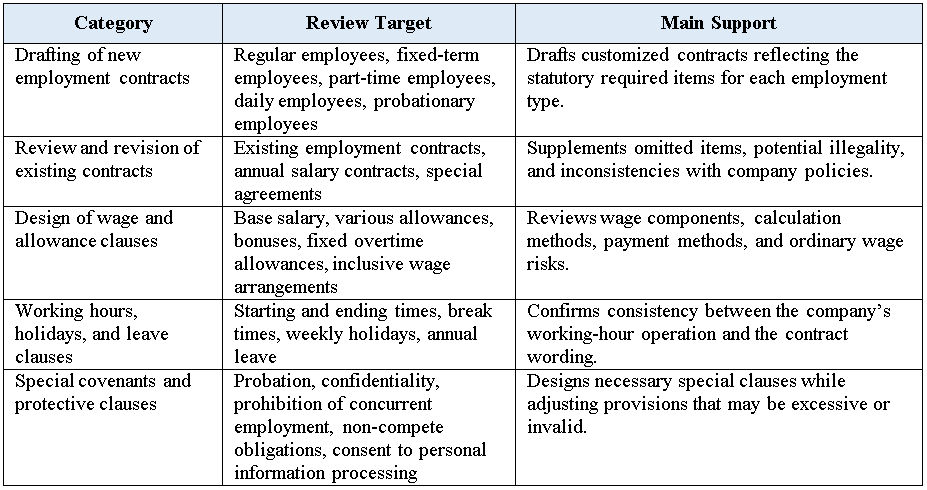
An employment contract is the most basic HR and labor-management document that clearly specifies key working conditions, including wages, contractual working hours, holidays, annual paid leave, the place of work, and duties to be performed. When entering into an employment contract, the employer must state major working conditions in writing and provide the document to the employee. Additional items may also be required depending on the employment type. KangNam Labor Law Firm drafts employment contracts so that the company’s actual working conditions and the statutory required items are consistent, and reviews legal risks in existing contracts.
1. Main Service Areas
2. Key Items to Check When Drafting Employment Contracts
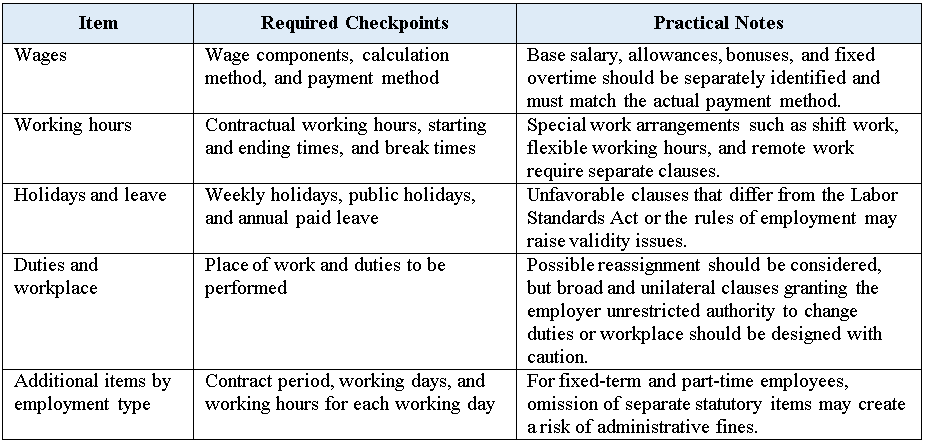
Note: Failure to prepare or provide an employment contract, or omission of required items, can become a significant company risk in labor inspections, labor office complaints, and wage arrears cases.
II. How to Deliver
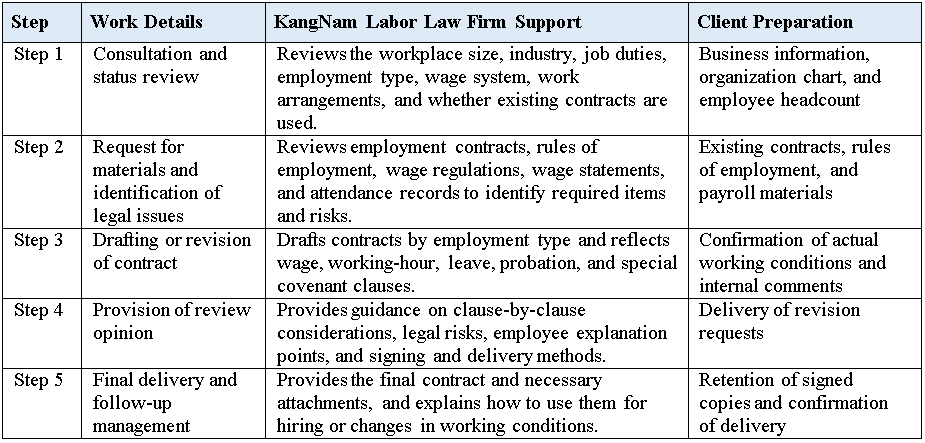
The Employment Contract Drafting Service is not merely the preparation of a standard form. It is the legal documentation of each company’s working conditions. KangNam Labor Law Firm reviews the company’s actual wage system, working-hour operation, job scope, rules of employment, and HR practices, and then organizes the employment contract so that it does not conflict with laws, rules of employment, wage statements, or actual operational practices.
1. Common Process
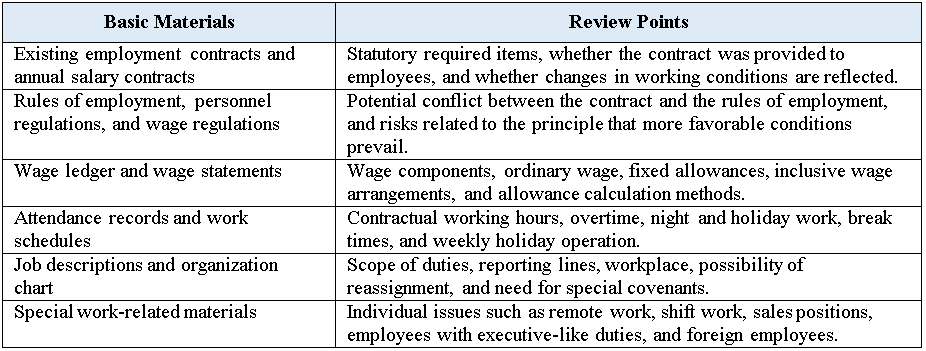
2. Preliminary Materials
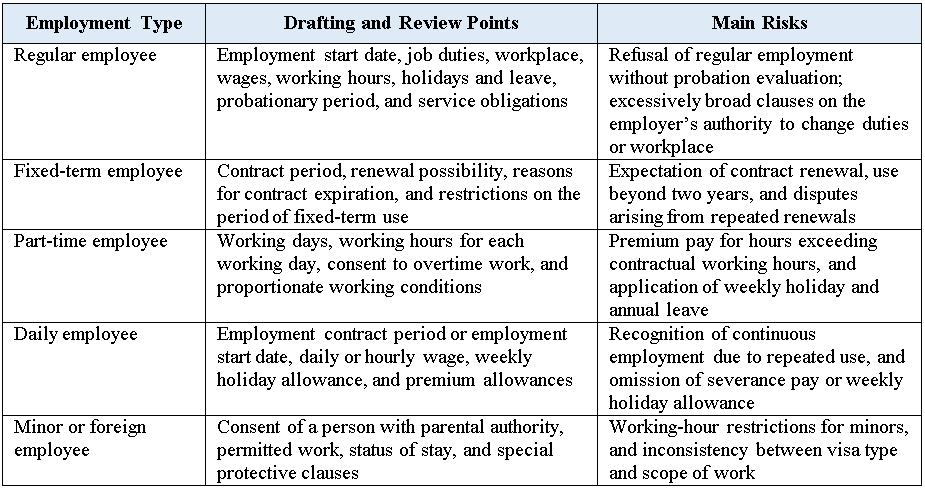
3. Detailed Support by Employment Type
III. Client Benefits
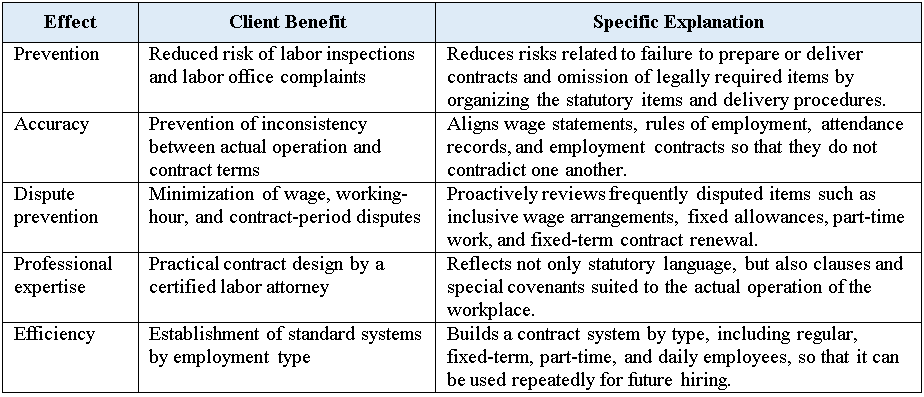
The employment contract is the starting point of the employment relationship. If the contract is deficient, the company may be placed in a disadvantageous position in almost every HR and labor dispute, including wage arrears, overtime allowances, inclusive wage arrangements, termination of probation, expiration of a contract term, changes in job duties, confidentiality, and non-compete obligations. By entrusting this service to KangNam Labor Law Firm, the company can reduce legal risks from the hiring stage and establish a document system that can respond to labor inspections and labor office complaints.
Why Choose KangNam Labor Law Firm
ㆍWe review employment contracts, rules of employment, wage statements, and attendance records together to reduce risks arising from inconsistencies between documents.
ㆍWe reflect statutory required items and practical issues by employment type, including regular, fixed-term, part-time, daily, minor, and foreign employees.
ㆍWe adjust high-risk clauses, such as inclusive wage arrangements, fixed overtime allowances, probationary periods, contract renewal, confidentiality, and non-compete obligations, in accordance with legal standards.
ㆍWe provide preventive employment contracts based on actual dispute experience in labor inspections, wage arrears, unfair dismissal, workplace harassment, and workplace sexual harassment cases.
ㆍWe can review Korean-English employment contracts and prepare explanatory materials for foreign-invested companies and multinational companies.
Consultation Notes
The legality of an employment contract may vary depending on the industry, number of regular employees, wage system, work arrangements, rules of employment, collective agreement, and whether foreign employees are employed. For accurate contract drafting, it is necessary to review related materials such as existing contracts, rules of employment, wage statements, and attendance records together.
※ This material has been prepared for general informational and promotional purposes. Each individual workplace should confirm the applicable requirements through separate consultation..
FAQ
Q13
How long can fixed-term workers be employed?
Fixed-term workers generally cannot be employed for more than two years. If the same worker is continuously employed for more than two years, the worker is deemed to have converted to an indefinite-term (permanent) employment status. In such cases, terminating the employment relationship upon contract expiration may be considered unfair dismissal.
However, the two-year limit does not apply to all fixed-term workers. Exceptions include cases where the contract period is tied to completion of a specific project or task, where the worker is filling a vacancy due to leave or dispatch, or where the worker falls under categories such as older workers or certain professional occupations defined by law.
Accordingly, when hiring fixed-term workers, employers must review in advance the contract period, job duties, purpose of employment, possibility of renewal, and whether any statutory exceptions to the two-year rule apply, and clearly document these in the employment contract and related records.
However, the two-year limit does not apply to all fixed-term workers. Exceptions include cases where the contract period is tied to completion of a specific project or task, where the worker is filling a vacancy due to leave or dispatch, or where the worker falls under categories such as older workers or certain professional occupations defined by law.
Accordingly, when hiring fixed-term workers, employers must review in advance the contract period, job duties, purpose of employment, possibility of renewal, and whether any statutory exceptions to the two-year rule apply, and clearly document these in the employment contract and related records.
Q12
What can a worker do if the actual working conditions differ from the stated contractual conditions?
Article 19 of the Labor Standards Act provides special remedies where working conditions stated at the time of contract formation differ from actual working conditions. The key point is that if an employer fails to comply with promised working conditions, the worker may claim damages and immediately terminate the employment contract.
Article 17 of the Labor Standards Act requires employers to clearly state key working conditions such as wages, prescribed working hours, holidays, and annual paid leave. Article 19 defines the legal effect when such stated conditions differ from reality.
For example, if a contract states a monthly wage of 3,000,000 KRW, a five-day workweek, Seoul-based work, and specific job duties, but in reality the wage is reduced or the working location, duties, or hours are significantly different, this may constitute a violation. In such cases, the worker may claim damages due to breach of working conditions and may immediately terminate the contract with intent not to continue employment.
Importantly, workers are not limited to filing civil lawsuits in court. Article 19(2) allows workers to file a claim for damages with the Labor Relations Commission, meaning they may seek remedies through the Labor Relations Commission when stated and actual working conditions differ. However, this remedy is not a general damages system for all labor violations but is limited to cases where conditions stated under Article 17 differ from actual conditions.
In addition, if a worker terminates the contract, the employer must provide return travel expenses to workers who relocated for employment purposes. For example, if a worker moved from another region or from overseas based on promised conditions and later terminates the contract due to discrepancies, the employer may be required to cover return travel costs.
In summary, this provision is designed to prevent employers from operating employment conditions differently from what was presented at hiring or contract formation. Therefore, employers must ensure that wages, working hours, workplace, job duties, and holidays stated in the employment contract match actual operations, and any changes must be made through proper agreement or lawful procedures.
Article 17 of the Labor Standards Act requires employers to clearly state key working conditions such as wages, prescribed working hours, holidays, and annual paid leave. Article 19 defines the legal effect when such stated conditions differ from reality.
For example, if a contract states a monthly wage of 3,000,000 KRW, a five-day workweek, Seoul-based work, and specific job duties, but in reality the wage is reduced or the working location, duties, or hours are significantly different, this may constitute a violation. In such cases, the worker may claim damages due to breach of working conditions and may immediately terminate the contract with intent not to continue employment.
Importantly, workers are not limited to filing civil lawsuits in court. Article 19(2) allows workers to file a claim for damages with the Labor Relations Commission, meaning they may seek remedies through the Labor Relations Commission when stated and actual working conditions differ. However, this remedy is not a general damages system for all labor violations but is limited to cases where conditions stated under Article 17 differ from actual conditions.
In addition, if a worker terminates the contract, the employer must provide return travel expenses to workers who relocated for employment purposes. For example, if a worker moved from another region or from overseas based on promised conditions and later terminates the contract due to discrepancies, the employer may be required to cover return travel costs.
In summary, this provision is designed to prevent employers from operating employment conditions differently from what was presented at hiring or contract formation. Therefore, employers must ensure that wages, working hours, workplace, job duties, and holidays stated in the employment contract match actual operations, and any changes must be made through proper agreement or lawful procedures.
Q11
What is the maximum number of overtime hours allowed?
As a general rule, statutory working hours are 8 hours per day and 40 hours per week. Where there is agreement between the parties, overtime work is allowed up to 12 hours per week. Therefore, in most cases, the maximum total working hours per week, including overtime, is 52 hours.
Accordingly, an employer cannot unilaterally require overtime without the worker’s consent, and when overtime is performed, an additional 50% or more of the ordinary wage must be paid as overtime allowance. If the weekly 12-hour overtime limit is exceeded, it may constitute a violation of the Labor Standards Act, and employers must accurately manage actual working hours.
However, in cases where special exceptions apply?such as exceptional industries, flexible working hour systems, or supervisory/intermittent workers?the calculation of working hours or the application of overtime limits may differ, and such systems must be separately reviewed.
Accordingly, an employer cannot unilaterally require overtime without the worker’s consent, and when overtime is performed, an additional 50% or more of the ordinary wage must be paid as overtime allowance. If the weekly 12-hour overtime limit is exceeded, it may constitute a violation of the Labor Standards Act, and employers must accurately manage actual working hours.
However, in cases where special exceptions apply?such as exceptional industries, flexible working hour systems, or supervisory/intermittent workers?the calculation of working hours or the application of overtime limits may differ, and such systems must be separately reviewed.
Q10
Are working hour regulations applied differently to “supervisory or intermittent workers”?
Yes. Where a worker is classified as a supervisory or intermittent worker and approved by the Minister of Employment and Labor, certain provisions on working hours, rest periods, and holidays may not apply. Supervisory work generally refers to duties involving monitoring or supervision where physical and mental fatigue is relatively low, while intermittent work refers to work where actual labor is not continuously performed and there are long waiting periods with occasional tasks.
However, an employer cannot arbitrarily designate a worker as supervisory or intermittent. Approval from the Minister of Employment and Labor is required, and working hour regulations cannot be excluded merely because a worker is a security guard, facility manager, or night-duty staff. In addition, even if approval is granted, this does not exempt the employer from other labor law protections such as minimum wage, wage payment obligations, or restrictions on dismissal, so caution is required.
However, an employer cannot arbitrarily designate a worker as supervisory or intermittent. Approval from the Minister of Employment and Labor is required, and working hour regulations cannot be excluded merely because a worker is a security guard, facility manager, or night-duty staff. In addition, even if approval is granted, this does not exempt the employer from other labor law protections such as minimum wage, wage payment obligations, or restrictions on dismissal, so caution is required.
Q9
Can an employer set a pre-determined penalty (liquidated damages) if a worker fails to keep an employment agreement?
As a general rule, an employer may not enter into an agreement that pre-estimates liquidated damages or penalty payments in advance for breach of an employment contract (Article 20 of the Labor Standards Act (Prohibition of Predetermined Compensation for Breach of Contract)). This is intended to prevent workers from being discouraged or practically prevented from resigning due to the burden of penalty payments. However, whether an employer may separately claim actual damages in a specific case is determined based on the individual circumstances.
Q8
How is continuous service calculated when contracts are repeatedly renewed?
Even if a labor contract is repeatedly executed in separate forms, if the employment relationship has continued without actual interruption, the entire period may be considered a single continuous employment period.
Even short gaps between contracts may be treated as formalities if the worker continued performing the same duties, in which case continuous service is likely to be recognized.
Even short gaps between contracts may be treated as formalities if the worker continued performing the same duties, in which case continuous service is likely to be recognized.
Q7
What is the most important point when reviewing a labor contract?
The key point is whether the actual working conditions match what is stated in the contract.
This includes wage structure, working hours, rest periods, overtime/night/holiday pay, contract period, job duties, workplace, probation period, termination clauses, confidentiality, and non-compete clauses.
Employers must ensure compliance with mandatory legal requirements and prevent wage-related risks, while employees must confirm that agreed wages, working hours, and duties are clearly stated.
This includes wage structure, working hours, rest periods, overtime/night/holiday pay, contract period, job duties, workplace, probation period, termination clauses, confidentiality, and non-compete clauses.
Employers must ensure compliance with mandatory legal requirements and prevent wage-related risks, while employees must confirm that agreed wages, working hours, and duties are clearly stated.
Q6
What happens if a labor contract is less favorable than the law or rules of employment?
If the terms of an employment contract fall below the standards prescribed by mandatory provisions such as the Labor Standards Act, those parts become null and void, and the statutory standards apply instead under Article 15 of the Labor Standards Act.
In addition, if the working conditions stipulated in an employment contract are less favorable to the employee than the standards set forth in the rules of employment, the validity of those unfavorable parts may become an issue. The rules of employment are internal regulations that prescribe the company’s working conditions and rules of service, whereas an employment contract is an agreement entered into between an individual employee and the company.
Article 97 of the Labor Standards Act provides that “an employment contract that stipulates working conditions below the standards set by the rules of employment shall be null and void with respect to those parts. In such cases, the parts rendered null and void shall be governed by the standards set forth in the rules of employment.”
Therefore, if the working conditions stipulated in an employment contract fall below the standards set by the rules of employment, the deficient parts become null and void, and the standards set forth in the rules of employment apply instead. Accordingly, the company should regularly review its employment contracts, rules of employment, wage regulations, and actual operating practices to ensure that they do not conflict with one another.
In addition, if the working conditions stipulated in an employment contract are less favorable to the employee than the standards set forth in the rules of employment, the validity of those unfavorable parts may become an issue. The rules of employment are internal regulations that prescribe the company’s working conditions and rules of service, whereas an employment contract is an agreement entered into between an individual employee and the company.
Article 97 of the Labor Standards Act provides that “an employment contract that stipulates working conditions below the standards set by the rules of employment shall be null and void with respect to those parts. In such cases, the parts rendered null and void shall be governed by the standards set forth in the rules of employment.”
Therefore, if the working conditions stipulated in an employment contract fall below the standards set by the rules of employment, the deficient parts become null and void, and the standards set forth in the rules of employment apply instead. Accordingly, the company should regularly review its employment contracts, rules of employment, wage regulations, and actual operating practices to ensure that they do not conflict with one another.
Q5
Can an employment contract include a probationary period or trial period?
Yes. A company may include a probationary period or trial period in the employment contract in order to assess the employee’s job performance, adaptability, diligence, and organizational fit. However, in order to operate such a period effectively and validly, the employment contract should clearly specify the period, evaluation criteria, evaluation procedure, and the method for determining whether the employee will be converted to regular employment.
The fact that an employee is in a probationary or trial period does not mean that the employer may freely dismiss the employee or refuse regular employment. In order to refuse regular employment or terminate the contract, there must be objective evaluation materials concerning the employee’s job performance, work attitude, and organizational adaptability, and the decision must be recognized as reasonable by social norms.
In addition, when refusing regular employment, it may not be sufficient simply to notify the employee that the “probationary period has expired” or that the employee “failed the evaluation.” The employer should provide written notice stating the specific and substantive reasons so that the employee can understand the grounds for the refusal.
If wages are reduced during the probationary period, the employer must still comply with the Minimum Wage Act and other relevant laws. In particular, cases where a reduced minimum wage may be applied during the probationary period are limited. Therefore, the term of the employment contract, the nature of the duties, and the length of the probationary period should be reviewed in advance.
The fact that an employee is in a probationary or trial period does not mean that the employer may freely dismiss the employee or refuse regular employment. In order to refuse regular employment or terminate the contract, there must be objective evaluation materials concerning the employee’s job performance, work attitude, and organizational adaptability, and the decision must be recognized as reasonable by social norms.
In addition, when refusing regular employment, it may not be sufficient simply to notify the employee that the “probationary period has expired” or that the employee “failed the evaluation.” The employer should provide written notice stating the specific and substantive reasons so that the employee can understand the grounds for the refusal.
If wages are reduced during the probationary period, the employer must still comply with the Minimum Wage Act and other relevant laws. In particular, cases where a reduced minimum wage may be applied during the probationary period are limited. Therefore, the term of the employment contract, the nature of the duties, and the length of the probationary period should be reviewed in advance.
Q4
How should fixed (comprehensive) wage system contracts be reviewed?
A fixed or comprehensive wage system is not safe merely because it states that overtime, night work, and holiday allowances are included.
It is necessary to examine the distinction between base salary and fixed allowances, the number of overtime/night/holiday hours assumed in the wage, whether actual working hours are properly managed, and whether wages meet minimum wage and statutory allowance requirements.
If actual working hours exceed the assumed hours or the wage structure is unclear, additional wage claims may arise.
The fixed wage system is not a statutory system expressly provided under the Labor Standards Act, but rather a method of wage payment that has been exceptionally recognized by court precedents. The Supreme Court has held that the fixed wage system may be valid only where, due to the nature of working hours, work patterns, and the characteristics of the job, it is difficult to calculate actual working hours, provided that the arrangement does not disadvantage the employee and is recognized as reasonable in light of all relevant circumstances.
However, where working hours can be calculated, the principles under the Labor Standards Act regarding working hours and statutory allowances apply. Therefore, if the statutory allowances included in the fixed wage amount fall short of the statutory allowances actually owed, the deficient portion is invalid, and the employer must pay the difference.
The Ministry of Employment and Labor takes the same position. Since April 9, 2026, the Ministry has implemented the “Guidelines for Preventing Abuse of Fixed Wage Arrangements to Eliminate Unpaid Work.” Under these guidelines, even where a fixed wage arrangement or fixed overtime arrangement exists, if the statutory allowances for overtime, night, or holiday work calculated based on the employee’s actual working hours exceed the amount already paid, the employer must pay the difference.
It is necessary to examine the distinction between base salary and fixed allowances, the number of overtime/night/holiday hours assumed in the wage, whether actual working hours are properly managed, and whether wages meet minimum wage and statutory allowance requirements.
If actual working hours exceed the assumed hours or the wage structure is unclear, additional wage claims may arise.
The fixed wage system is not a statutory system expressly provided under the Labor Standards Act, but rather a method of wage payment that has been exceptionally recognized by court precedents. The Supreme Court has held that the fixed wage system may be valid only where, due to the nature of working hours, work patterns, and the characteristics of the job, it is difficult to calculate actual working hours, provided that the arrangement does not disadvantage the employee and is recognized as reasonable in light of all relevant circumstances.
However, where working hours can be calculated, the principles under the Labor Standards Act regarding working hours and statutory allowances apply. Therefore, if the statutory allowances included in the fixed wage amount fall short of the statutory allowances actually owed, the deficient portion is invalid, and the employer must pay the difference.
The Ministry of Employment and Labor takes the same position. Since April 9, 2026, the Ministry has implemented the “Guidelines for Preventing Abuse of Fixed Wage Arrangements to Eliminate Unpaid Work.” Under these guidelines, even where a fixed wage arrangement or fixed overtime arrangement exists, if the statutory allowances for overtime, night, or holiday work calculated based on the employee’s actual working hours exceed the amount already paid, the employer must pay the difference.
Q3
What must be included in a labor contract?
A labor contract must generally include wages, prescribed working hours, rest periods, holidays, annual leave, workplace, job duties, and contract period.
For fixed-term and part-time workers, the contract must explicitly state the contract period, working hours and rest periods, wage structure (components, calculation method, and payment method), holidays and leave, and workplace and job description.
For fixed-term and part-time workers, the contract must explicitly state the contract period, working hours and rest periods, wage structure (components, calculation method, and payment method), holidays and leave, and workplace and job description.
Q2
Is a written labor contract mandatory for all employees, including regular, fixed-term, and part-time workers?
Yes. When concluding a labor contract, the employer must specify key working conditions such as wages, prescribed working hours, holidays, and annual paid leave. In particular, details such as wage components, calculation methods, payment methods, prescribed working hours, holidays, and annual leave must be provided in writing and delivered to the employee.
This obligation applies not only to full-time employees but also to fixed-term workers, part-time workers, interns, and day laborers. Therefore, the obligation to prepare and deliver a written labor contract is not exempted based on the type or duration of employment.
Failure to provide written terms of employment constitutes a violation of Article 17 of the Labor Standards Act and may result in a fine of up to KRW 5 million under Article 114 of the same Act.
In addition, for fixed-term and part-time workers, the Act on the Protection of Fixed-Term and Part-Time Employees requires written specification of key terms such as contract period, working hours, wage structure, holidays, workplace, and job duties. Violations may result in an administrative fine of up to KRW 5 million.
Accordingly, employers must prepare and provide written labor contracts regardless of employment type. Verbal agreements alone may not only violate the law but also significantly increase the risk of disputes over wages, working hours, contract duration, and job duties.
This obligation applies not only to full-time employees but also to fixed-term workers, part-time workers, interns, and day laborers. Therefore, the obligation to prepare and deliver a written labor contract is not exempted based on the type or duration of employment.
Failure to provide written terms of employment constitutes a violation of Article 17 of the Labor Standards Act and may result in a fine of up to KRW 5 million under Article 114 of the same Act.
In addition, for fixed-term and part-time workers, the Act on the Protection of Fixed-Term and Part-Time Employees requires written specification of key terms such as contract period, working hours, wage structure, holidays, workplace, and job duties. Violations may result in an administrative fine of up to KRW 5 million.
Accordingly, employers must prepare and provide written labor contracts regardless of employment type. Verbal agreements alone may not only violate the law but also significantly increase the risk of disputes over wages, working hours, contract duration, and job duties.
Q1
How is a labor contract formed, and is a written contract mandatory?
A labor contract is formed when a worker agrees to provide labor to an employer in exchange for wages. Therefore, a labor contract does not require a written document to be legally valid; it can also be established through oral agreement or by the actual commencement of work.
However, at the time of concluding a labor contract, the employer must clearly specify and provide key working conditions such as wages, prescribed working hours, holidays, and annual paid leave. A labor contract does not necessarily have to be on paper; it may also be concluded and delivered via electronic documents or email. What is important is that the worker can clearly understand and retain the essential working conditions.
However, at the time of concluding a labor contract, the employer must clearly specify and provide key working conditions such as wages, prescribed working hours, holidays, and annual paid leave. A labor contract does not necessarily have to be on paper; it may also be concluded and delivered via electronic documents or email. What is important is that the worker can clearly understand and retain the essential working conditions.
Key Representative Cases