

Labor-Management Council Labor Consulting & Legal Representation
Consultation Request
Review of the obligation to establish a Labor-Management Council, drafting of regulations, election of employee members, appointment of employer members, filing, and establishment of the initial operating system
The Labor-Management Council Establishment Service is not limited to formally setting up a council required for workplaces with 30 or more regular employees. It is a practical service that builds an operational system, from the establishment notice, election of employee members, appointment of employer members, drafting and filing of Labor-Management Council Regulations, appointment of grievance-handling members, and operation of the first meeting.
I. What Service
A Labor-Management Council is a statutory consultative body through which employees and the employer promote employee welfare and the sound development of the company through participation and cooperation. A business or workplace that regularly employs 30 or more employees must establish and operate a Labor-Management Council under the Act on the Promotion of Workers’ Participation and Cooperation. Unlike collective bargaining, a Labor-Management Council is not a bargaining body that determines working conditions such as wages. Rather, it is a system for discussing matters of common interest between labor and management, including the sharing of management information, productivity improvement, welfare, grievance handling, and improvement of the work environment.
KangNam Labor Law Firm reviews the company’s number of regular employees, workplace structure, existence of a labor union, existing operating documents, and grievance-handling system, and provides a comprehensive set of establishment procedures and operating documents tailored to the company.
1. Main Service Areas
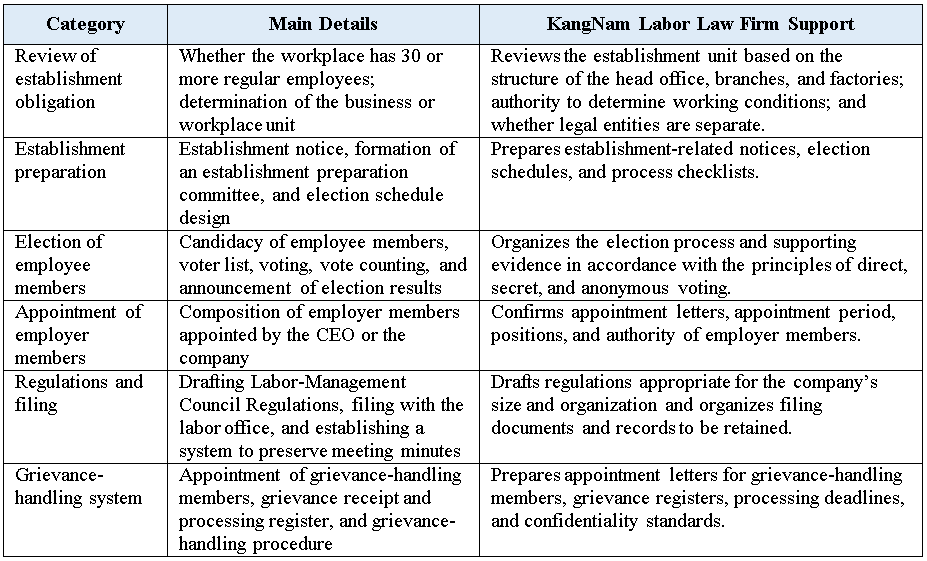
2. Scope of Service
ㆍReview of the obligation to establish a Labor-Management Council and the appropriate establishment unit: number of regular employees, whether workplaces are dispersed, and whether a labor union exists.
ㆍAdvice on the establishment notice for the Labor-Management Council and the method of forming an establishment preparation committee.
ㆍPreparation of documents for the election of employee members, including candidacy notices, candidate registration forms, recommendation forms, voter lists, ballots, vote counting records, and elected-member announcements.
ㆍPreparation of appointment letters for employer members, appointment letters for grievance-handling members, and grievance receipt and processing registers.
ㆍDrafting, review, amendment, and filing support for Labor-Management Council Regulations with the competent labor office.
ㆍSupport for the first regular or extraordinary council meeting, including meeting convocation notices, agenda materials, minutes, and notices of resolutions.
II. How to Deliver
The Labor-Management Council Establishment Service proceeds in the order of “confirmation of establishment obligation - system design - election and appointment - drafting and filing of regulations - operation of the initial meeting.” In particular, if the election of employee members is conducted through employer intervention or merely as a formality, its legality may be questioned. It is therefore important to follow a fair and explainable procedure and to retain supporting documents.
1. Common Process
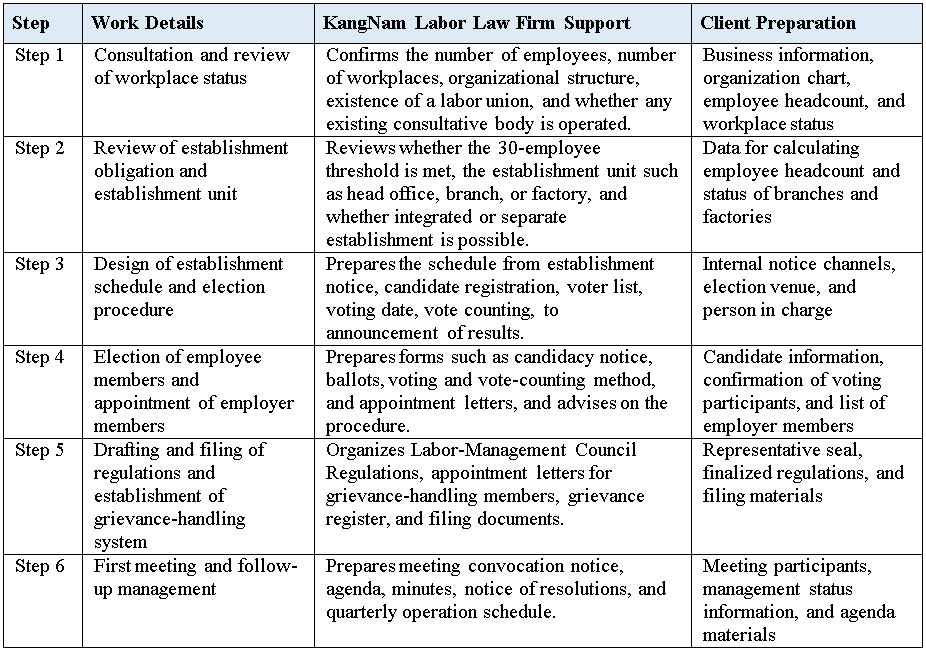
2. Preliminary Materials
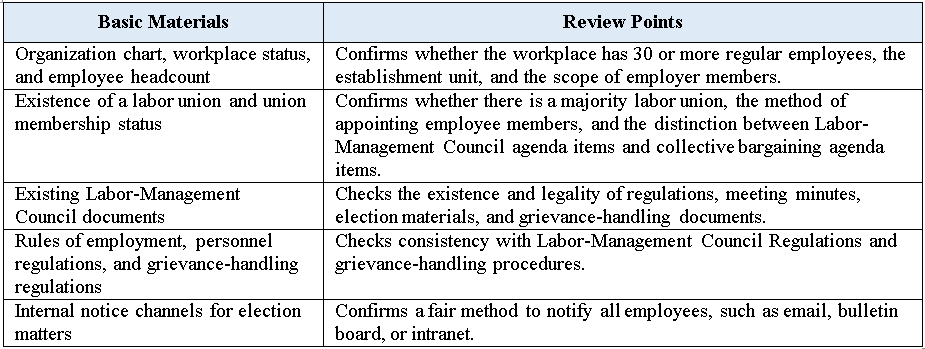
3. Detailed Support by Major Procedure
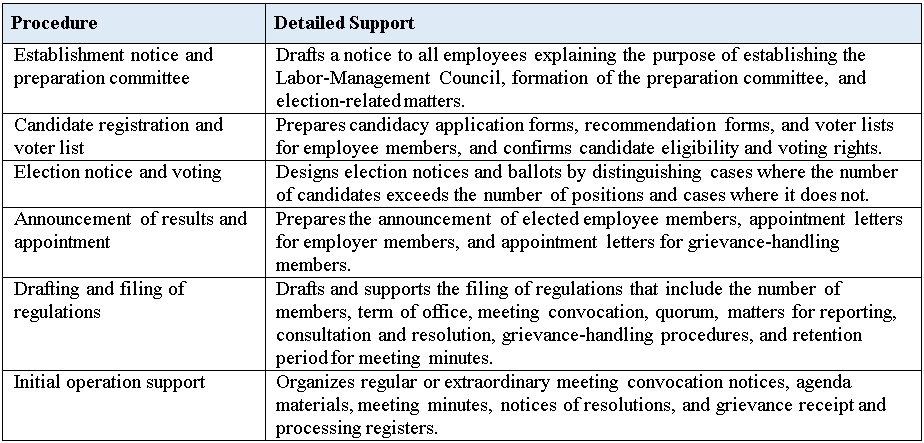
Key management point: Employee members of the Labor-Management Council must be elected according to the free will of employees, and the employer must not intervene in or influence the election. In addition, employee members of a Labor-Management Council are, in principle, not the same as the employee representative under the Labor Standards Act. Therefore, for matters requiring an employee representative - such as written agreements on flexible working systems, substitution of holidays, disadvantageous amendments to rules of employment, or consultation for redundancy dismissal - the requirements for representativeness must be reviewed separately..
III. Client Benefits
A Labor-Management Council is not a system that ends once it is established. It is a statutory system that must be continuously managed through regular meetings, preparation and preservation of meeting minutes, implementation of resolutions, grievance handling, filing and amendment management of regulations, and ongoing operation. By entrusting this service to KangNam Labor Law Firm, the company can establish lawful procedures and practical documents from the establishment stage and secure explainable records for labor inspections or internal disputes.
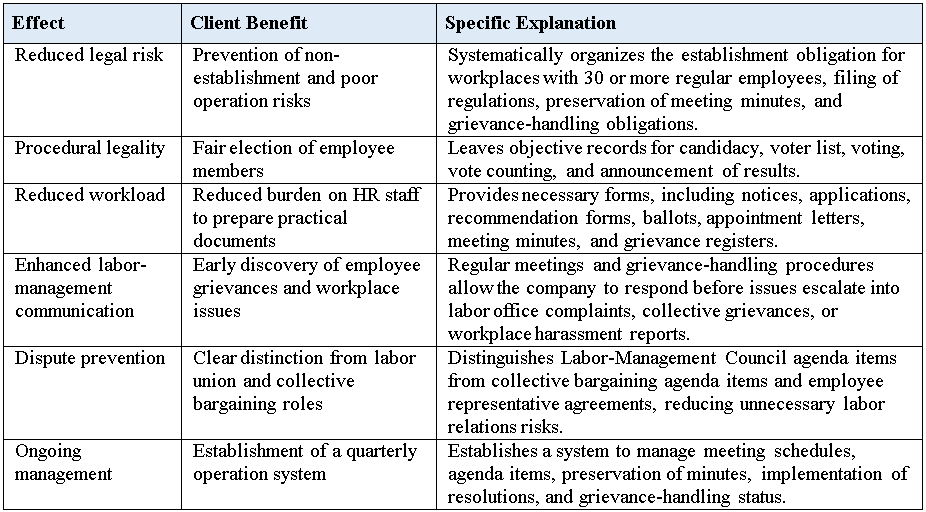
Why Choose KangNam Labor Law Firm
ㆍWe can provide comprehensive risk management by reviewing related systems together, including Labor-Management Council establishment and operation, labor inspection response, rules of employment, employee representatives, and collective bargaining.
ㆍWe propose a Labor-Management Council system that can actually operate according to each company’s size, workplace structure, foreign-invested company status, existence of a labor union, and employee composition.
ㆍWe do not merely provide standard forms, but practically support the entire process from establishment notice, election, appointment, filing of regulations, grievance handling, and the first meeting.
ㆍWe clearly distinguish between employee members of the Labor-Management Council and the employee representative under the Labor Standards Act, preventing additional risks in flexible working systems, holiday substitution, and amendments to rules of employment.
ㆍWe can provide Korean-English labor-management documentation that is explainable to foreign-invested companies and multinational companies.
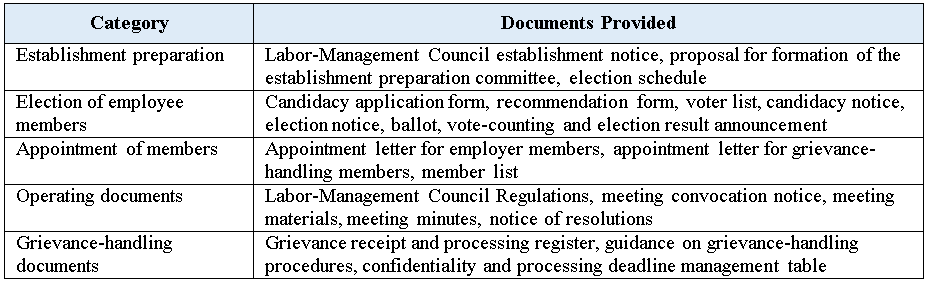
Main Deliverables
Consultation Notes
The obligation to establish a Labor-Management Council and the method of operation may vary depending on the number of regular employees, the number of workplaces, authority to determine working conditions, existence of a labor union, whether an existing consultative body is operated, and the company’s organizational structure. For an accurate establishment procedure, it is necessary to first review the workplace status and relevant supporting documents through prior consultation.
※ This material has been prepared for general informational and promotional purposes. Each individual workplace should confirm the applicable requirements through separate consultation..
FAQ
Q8
Can an employee member of a labor-management council elected by employee-member electors be regarded as a workers’ representative under the Labor Standards Act?
Under the Labor Standards Act, a “workers’ representative” means the labor union where a labor union organized by a majority of the workers exists at the relevant business or workplace, or a person representing a majority of the workers where no such labor union exists (Article 24(3)).
Although it is difficult to provide a definitive answer because the specific facts and circumstances cannot be ascertained solely from the information provided in your inquiry:
The Labor Standards Act does not expressly prescribe how a workers’ representative must be selected where there is no labor union organized by a majority of the workers. Nevertheless, the representative should be selected through a process that reflects the will of a majority of the workers, after the workers have been fully informed of the nature and scope of the authority to be exercised by the representative.
Accordingly, at a business or workplace where there is no labor union organized by a majority of the workers, employee members of a labor-management council elected pursuant to the Act on the Promotion of Employees’ Participation and Cooperation may exercise the authority of a workers’ representative if the workers have been informed that all or part of the authority of a workers’ representative under the Labor Standards Act will be conferred upon those employee members during their term of office, and if a majority of the workers have participated in the election.
Where employee members of a labor-management council are elected through electoral delegates, the workers should be informed, at the time the electoral delegates are elected, that all or part of the authority of a workers’ representative under the Labor Standards Act will be conferred upon the employee members subsequently elected through those delegates. In addition, a majority of the workers should participate in the election of the electoral delegates.
(Labor Standards Policy Division-1140, April 7, 2023)
Although it is difficult to provide a definitive answer because the specific facts and circumstances cannot be ascertained solely from the information provided in your inquiry:
The Labor Standards Act does not expressly prescribe how a workers’ representative must be selected where there is no labor union organized by a majority of the workers. Nevertheless, the representative should be selected through a process that reflects the will of a majority of the workers, after the workers have been fully informed of the nature and scope of the authority to be exercised by the representative.
Accordingly, at a business or workplace where there is no labor union organized by a majority of the workers, employee members of a labor-management council elected pursuant to the Act on the Promotion of Employees’ Participation and Cooperation may exercise the authority of a workers’ representative if the workers have been informed that all or part of the authority of a workers’ representative under the Labor Standards Act will be conferred upon those employee members during their term of office, and if a majority of the workers have participated in the election.
Where employee members of a labor-management council are elected through electoral delegates, the workers should be informed, at the time the electoral delegates are elected, that all or part of the authority of a workers’ representative under the Labor Standards Act will be conferred upon the employee members subsequently elected through those delegates. In addition, a majority of the workers should participate in the election of the electoral delegates.
(Labor Standards Policy Division-1140, April 7, 2023)
Q7
If a collective agreement and a labor-management council resolution conflict, which takes precedence?
In principle, a collective bargaining agreement is likely to take precedence over a labor-management council resolution.
A collective agreement is a binding instrument concluded through collective bargaining between a labor union and the employer regarding working conditions such as wages, working hours, holidays, leave, disciplinary procedures, and union activities. Therefore, if a labor-management council resolution conflicts with an existing collective agreement or is less favorable to employees, its validity may be questioned.
The labor-management council is a system designed for cooperation and participation, mainly addressing matters such as company operations, productivity improvement, welfare, training, and workplace environment. It must not be used as a substitute for collective bargaining or as a means to bypass union negotiations.
Accordingly, if a resolution concerns cooperative matters, it may be validly implemented through the council. However, if it relates to core working conditions or conflicts with a collective agreement, its relationship with employment contracts, rules of employment, and collective agreements must be carefully reviewed. Using the council to bypass union bargaining may also raise unfair labor practice issues.
A collective agreement is a binding instrument concluded through collective bargaining between a labor union and the employer regarding working conditions such as wages, working hours, holidays, leave, disciplinary procedures, and union activities. Therefore, if a labor-management council resolution conflicts with an existing collective agreement or is less favorable to employees, its validity may be questioned.
The labor-management council is a system designed for cooperation and participation, mainly addressing matters such as company operations, productivity improvement, welfare, training, and workplace environment. It must not be used as a substitute for collective bargaining or as a means to bypass union negotiations.
Accordingly, if a resolution concerns cooperative matters, it may be validly implemented through the council. However, if it relates to core working conditions or conflicts with a collective agreement, its relationship with employment contracts, rules of employment, and collective agreements must be carefully reviewed. Using the council to bypass union bargaining may also raise unfair labor practice issues.
Q6
To what extent can labor-management council operations be outsourced?
Depending on the company’s situation, support may be provided from diagnosing whether establishment is required to building a full operational system.
This may include reviewing the number of regular employees and establishment units, drafting council regulations, preparing election notices and candidate registration forms, organizing voting and counting materials, forming employer representatives, setting agendas, preparing meeting materials and minutes, operating grievance handling committees, managing regular meeting schedules, and preparing documents for labor inspections.
Since a labor-management council requires not only documentation but also lawful and continuous operation, it is important to establish a system tailored to the company’s HR structure.
This may include reviewing the number of regular employees and establishment units, drafting council regulations, preparing election notices and candidate registration forms, organizing voting and counting materials, forming employer representatives, setting agendas, preparing meeting materials and minutes, operating grievance handling committees, managing regular meeting schedules, and preparing documents for labor inspections.
Since a labor-management council requires not only documentation but also lawful and continuous operation, it is important to establish a system tailored to the company’s HR structure.
Q5
Is it enough to simply prepare meeting minutes?
No. Preparing meeting minutes in a purely formal manner is not sufficient. A labor-management council must actually convene meetings, discuss agenda items, and manage resolutions and follow-up actions when necessary.
Minutes should include specific details such as date, time, location, participants, agenda, discussion details, resolutions, and implementation plans. During labor inspections, authorities may review not only minutes but also documents related to employee representative elections, council regulations, meeting notices, attendance records, and grievance handling logs.
Minutes should include specific details such as date, time, location, participants, agenda, discussion details, resolutions, and implementation plans. During labor inspections, authorities may review not only minutes but also documents related to employee representative elections, council regulations, meeting notices, attendance records, and grievance handling logs.
Q4
How often must labor-management council meetings be held?
Labor-management council meetings must generally be held on a regular basis, typically once every three months. When holding meetings, the agenda, date, and location should be notified in advance. After the meeting, minutes must be prepared and retained.
Minutes should include participants, date and time, agenda items, discussion content, resolutions, and follow-up actions. It is important not merely to prepare formal minutes, but to ensure that actual consultation took place and that both employer explanations and employee representative opinions are recorded.
Minutes should include participants, date and time, agenda items, discussion content, resolutions, and follow-up actions. It is important not merely to prepare formal minutes, but to ensure that actual consultation took place and that both employer explanations and employee representative opinions are recorded.
Q3
Can employee representatives be designated by the company?
As a principle, employee representatives must be elected directly by employees through democratic procedures such as secret and direct voting.
The employer cannot unilaterally appoint specific employees or select representatives through a merely formal recommendation process, as this may raise issues regarding procedural validity. Since employee representatives act on behalf of all employees in the council, it is advisable to clearly document procedures such as election notices, candidate registration, voting, vote counting, and announcement of elected members.
Where a labor union represents a majority of employees, that union may appoint employee representatives.
The employer cannot unilaterally appoint specific employees or select representatives through a merely formal recommendation process, as this may raise issues regarding procedural validity. Since employee representatives act on behalf of all employees in the council, it is advisable to clearly document procedures such as election notices, candidate registration, voting, vote counting, and announcement of elected members.
Where a labor union represents a majority of employees, that union may appoint employee representatives.
Q2
If there is a labor union, is a labor-management council still necessary?
No. Even if a labor union exists, workplaces employing 30 or more regular workers are still separately required to establish a labor-management council.
A labor union primarily performs collective bargaining functions regarding wages, working hours, and other working conditions through collective agreements. In contrast, a labor-management council is a consultative body that deals with matters such as productivity improvement, employee grievance handling, vocational training, welfare enhancement, and improvement of working environments. Therefore, since the labor union and the labor-management council serve different purposes and functions, they must operate separately, and the labor-management council must not be used as a substitute for a labor union.
Resolutions of the labor-management council refer to matters agreed upon or resolved by employee members and employer members within the council. The employer is required to faithfully implement duly adopted resolutions; however, such resolutions do not have the same legal effect as a collective bargaining agreement. For example, matters related to employee training, skill development, and welfare promotion may be discussed and resolved within the labor-management council. Accordingly, it is permissible for the employer and employee representatives to deliberate and resolve issues such as the content, target group, and implementation methods of training programs.
However, if the content is directly related to fundamental changes in working conditions such as wages, working hours, personnel evaluation, promotion, or disciplinary measures, a resolution of the labor-management council alone may not be sufficient. In such cases, the relationship with employment contracts, rules of employment, collective bargaining agreements, or employee consent procedures must be separately examined.
A labor union primarily performs collective bargaining functions regarding wages, working hours, and other working conditions through collective agreements. In contrast, a labor-management council is a consultative body that deals with matters such as productivity improvement, employee grievance handling, vocational training, welfare enhancement, and improvement of working environments. Therefore, since the labor union and the labor-management council serve different purposes and functions, they must operate separately, and the labor-management council must not be used as a substitute for a labor union.
Resolutions of the labor-management council refer to matters agreed upon or resolved by employee members and employer members within the council. The employer is required to faithfully implement duly adopted resolutions; however, such resolutions do not have the same legal effect as a collective bargaining agreement. For example, matters related to employee training, skill development, and welfare promotion may be discussed and resolved within the labor-management council. Accordingly, it is permissible for the employer and employee representatives to deliberate and resolve issues such as the content, target group, and implementation methods of training programs.
However, if the content is directly related to fundamental changes in working conditions such as wages, working hours, personnel evaluation, promotion, or disciplinary measures, a resolution of the labor-management council alone may not be sufficient. In such cases, the relationship with employment contracts, rules of employment, collective bargaining agreements, or employee consent procedures must be separately examined.
Q1
Which companies are required to establish a labor-management council?
Any business or workplace that regularly employs 30 or more workers must establish a labor-management council.“Regularly employed workers” is assessed based on the usual number of workers, not temporary fluctuations. It includes not only full-time employees but also fixed-term and part-time workers depending on the actual employment relationship. However, the establishment unit is generally the workplace rather than the entire company, so factors such as organizational structure, independence of HR management, and the authority over working conditions must also be considered.
Key Representative Cases