

Rules of Employment Labor Consulting & Legal Representation
Consultation Request
Comprehensive support for initial establishment, full amendment, unfavorable amendment procedures, and filing with the Labor Office
The Rules of Employment Drafting and Amendment Service is a professional labor-management service that helps workplaces with 10 or more employees comply with their obligation to prepare and report rules of employment, and ensures that statutory amendments and changes in the company's HR system are lawfully reflected in its internal rules. Because rules of employment serve as the standard for working conditions across the workplace, including wages, working hours, leave, discipline, dismissal, workplace harassment, sexual harassment, and maternity protection, both the contents of the rules and the amendment procedures are important.
I. What Service
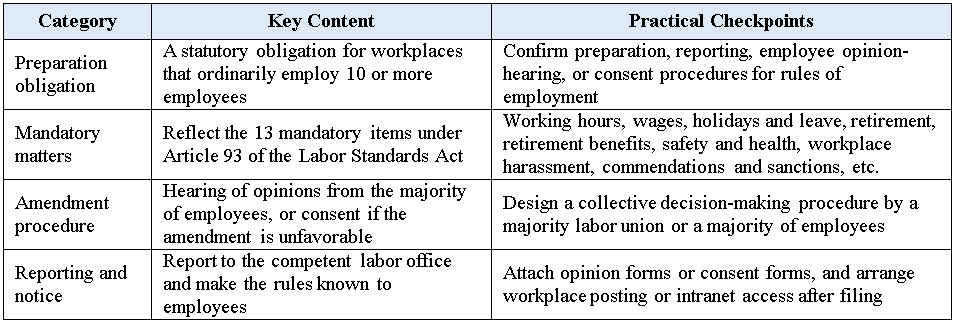
Rules of employment are internal workplace norms that prescribe employees' service discipline and working conditions applicable to the entire workplace. Rules commonly referred to as “company rules” or “HR regulations” may constitute rules of employment under Korean labor law. An employer who ordinarily employs 10 or more employees must prepare rules of employment and report them to the Minister of Employment and Labor, and the same reporting obligation applies when the rules are amended.
1. Key Elements in Drafting and Amending Rules of Employment
2. Main Service Areas
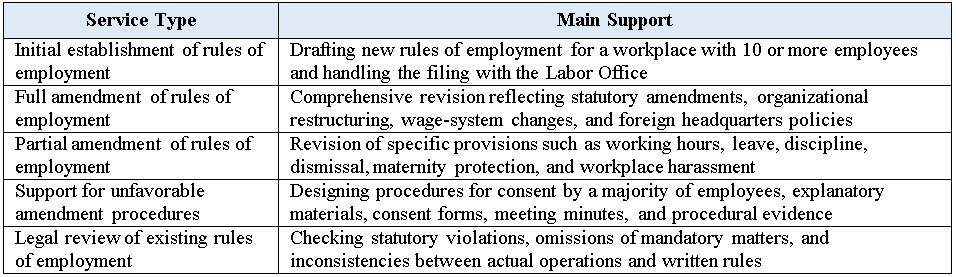
3. Scope of Service
ㆍReview related materials such as current rules of employment, employment contracts, wage regulations, HR regulations, disciplinary rules, and collective agreements.
ㆍCheck whether the mandatory matters under Article 93 of the Labor Standards Act and the latest labor-related statutes are properly reflected.
ㆍDraft rules of employment suited to the workplace, revise provisions, and review whether amendments are unfavorable to employees.
ㆍSupport preparation of employee opinion forms, consent forms, explanatory materials, and filing documents for the Labor Office.
ㆍGuide Labor Office filing, posting and notice methods, future amendment needs, and follow-up management.
II. How to Deliver
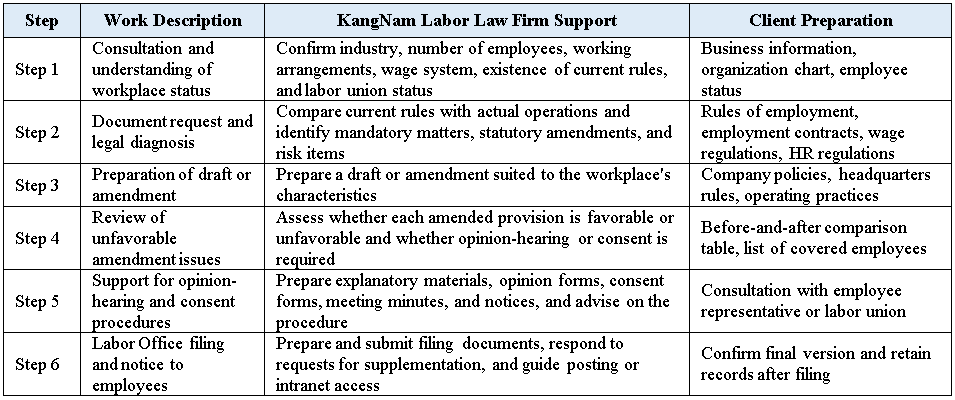
Drafting and amending rules of employment is not simply a matter of filling in a standard template. The contents of the rules must be consistent with the company's actual HR operations, employment contracts, wage system, working arrangements, disciplinary and dismissal procedures, leave system, and maternity protection system. In particular, if an unfavorable amendment is handled through an improper procedure, the amendment itself may become invalid. Therefore, whether the amendment is unfavorable must be accurately assessed in advance.
1. Common Process
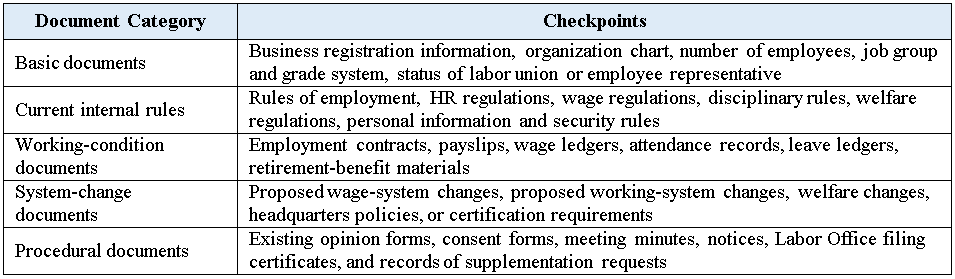
2. Documents to Prepare in Advance
3. Design of Opinion-Hearing and Consent Procedures
ㆍFor initial preparation or amendments that are not unfavorable to employees, an opinion-hearing procedure is conducted through the majority labor union or the majority of employees.
ㆍFor amendments unfavorable to employees, collective consent must be obtained from the majority labor union or the majority of employees.
ㆍThe explanation method, meeting procedure, and collection of consent forms should be designed so that the employer does not appear to have improperly intervened or coerced employees.
ㆍA before-and-after comparison table and explanatory materials should be provided so that employees can express their opinions or consent after sufficiently understanding the amendments.
Key management point: If the procedure for unfavorable amendments is not properly followed, the amended rules of employment may be invalid. In particular, amendments that are favorable to some employees but unfavorable to others, deletion of existing provisions, or establishment of new sanction provisions require legal review in advance..
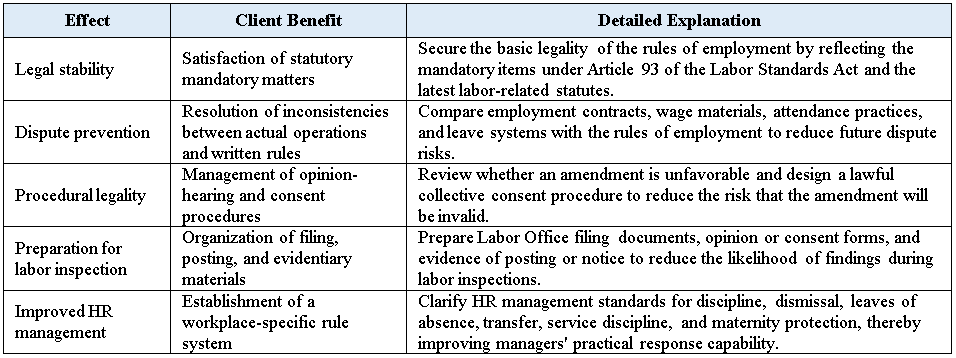
III. Client Benefits
Rules of employment are not merely internal documents; they are important standards in almost every labor dispute, including wages, working hours, leave, discipline, and dismissal. Rules that are poorly drafted or outdated may become evidence unfavorable to the company, and an improper unfavorable-amendment procedure may invalidate the amendment itself and create unexpected disputes.
Why You Should Entrust This Service to KangNam Labor Law Firm
ㆍWe reflect practical experience from various labor cases, including labor inspections, wage arrears, dismissal and discipline, workplace harassment and sexual harassment, and maternity protection, in the provisions of the rules of employment.
ㆍWe do not simply apply standard rules of employment. We prepare customized rules that reflect the company's industry, size, job groups, working arrangements, wage system, and headquarters policies.
ㆍWe review procedural issues in advance, including whether the amendment is unfavorable, whether consent from the majority labor union or majority of employees is required, and whether there is a risk of employer intervention.
ㆍFor foreign-invested and multinational companies, we can review Korean and English rules and prepare bilingual materials for HR and labor issues.
ㆍWe provide practical support through Labor Office filing, responses to supplementation requests, posting and notice methods, and future amendment schedules.
Examples of Service Deliverables
ㆍNewly drafted rules of employment or amended rules of employment
ㆍBefore-and-after comparison table and unfavorable-amendment review table
ㆍEmployee opinion form, consent form, explanatory materials, and meeting-minutes template
ㆍLabor Office filing documents and supporting attachments for submission
ㆍPosting and notice guidance and future amendment management checklist
※ This material has been prepared for general informational and promotional purposes. For each individual workplace, the requirements should be confirmed through separate consultation depending on the industry, number of ordinary employees, scope of application of the rules of employment, existence of a labor union, whether the amendment is favorable or unfavorable to employees, and the method of conducting employee consent procedures.
FAQ
Q10
What are the consequences of violating the obligation to prepare, change, or report rules of employment?
If an employer fails to comply with the statutory procedures regarding the preparation, amendment, or reporting of rules of employment, both administrative sanctions and legal disputes regarding validity may arise. In addition, labor authorities may issue corrective orders during labor inspections.
1) Administrative sanctions
Workplaces employing 10 or more workers on a regular basis must prepare rules of employment and report them to the competent labor office. Any amendments must also be reported. Failure to prepare, report, or amend properly may result in an administrative fine of up to KRW 5 million under the Labor Standards Act.
2) Validity issues
When changing rules of employment, employers must follow procedures such as hearing opinions or obtaining consent from a majority labor union or a majority of employees, depending on whether the change is disadvantageous. If these procedures are not properly followed, the legality of the change itself may be challenged.
In particular, for disadvantageous changes, consent from a majority labor union or a majority of employees is required, and failure to obtain such consent makes the change highly likely to be invalid. For advantageous changes, only opinion hearing is required; therefore, failure to conduct opinion hearing does not automatically invalidate the change but may still result in corrective orders or administrative guidance from labor authorities.
1) Administrative sanctions
Workplaces employing 10 or more workers on a regular basis must prepare rules of employment and report them to the competent labor office. Any amendments must also be reported. Failure to prepare, report, or amend properly may result in an administrative fine of up to KRW 5 million under the Labor Standards Act.
2) Validity issues
When changing rules of employment, employers must follow procedures such as hearing opinions or obtaining consent from a majority labor union or a majority of employees, depending on whether the change is disadvantageous. If these procedures are not properly followed, the legality of the change itself may be challenged.
In particular, for disadvantageous changes, consent from a majority labor union or a majority of employees is required, and failure to obtain such consent makes the change highly likely to be invalid. For advantageous changes, only opinion hearing is required; therefore, failure to conduct opinion hearing does not automatically invalidate the change but may still result in corrective orders or administrative guidance from labor authorities.
Q9
What role does the “social reasonableness” doctrine currently play when changing rules of employment disadvantageously for employees?
Under earlier case law, even if rules of employment were changed disadvantageously to employees, such changes could be exceptionally valid if they were deemed to have “social reasonableness.” In other words, courts considered factors such as the employer’s managerial necessity, the reasonableness of the change, the degree of disadvantage to employees, whether other working conditions were improved, and procedural circumstances in a comprehensive manner.
However, the Supreme Court en banc decision in 2023 changed this position. Under the current legal framework, in principle, when rules of employment are changed disadvantageously, Article 94(1) of the Labor Standards Act requires the consent of a majority labor union or, in its absence, the collective consent of a majority of employees.
Accordingly, it is no longer sufficient for an employer to argue that the change is “reasonable” or “socially acceptable.” A disadvantageous change to rules of employment that has not undergone collective consent is, in principle, difficult to recognize as valid.
That said, if employees unreasonably refuse consent despite the employer having made sufficient efforts to explain and persuade, issues regarding abuse of collective consent rights may arise in exceptional cases. Ultimately, after the 2023 decision, “social reasonableness” no longer serves as an independent basis to replace collective consent. The fundamental principle is employee collective consent.
However, the Supreme Court en banc decision in 2023 changed this position. Under the current legal framework, in principle, when rules of employment are changed disadvantageously, Article 94(1) of the Labor Standards Act requires the consent of a majority labor union or, in its absence, the collective consent of a majority of employees.
Accordingly, it is no longer sufficient for an employer to argue that the change is “reasonable” or “socially acceptable.” A disadvantageous change to rules of employment that has not undergone collective consent is, in principle, difficult to recognize as valid.
That said, if employees unreasonably refuse consent despite the employer having made sufficient efforts to explain and persuade, issues regarding abuse of collective consent rights may arise in exceptional cases. Ultimately, after the 2023 decision, “social reasonableness” no longer serves as an independent basis to replace collective consent. The fundamental principle is employee collective consent.
Q8
What is the most important point when changing rules of employment?
The first step is to determine whether the change is disadvantageous, and then follow the appropriate procedure for consultation or consent. It is also necessary to ensure consistency with other internal rules such as employment contracts, collective agreements, and wage regulations. After the change, employees must be properly notified.
Q7
Is a change to rules of employment invalid if it is not reported?
Failure to report is an administrative issue, but validity is generally determined based on whether proper consultation or consent procedures were followed and whether the content complies with mandatory law. However, failure to report may still disadvantage the employer in labor inspections or disputes.
Q6
What documents are required when reporting changes to rules of employment?
Generally, the full text of the rules of employment, a comparison table before and after amendment, and documentation of consultation with a majority labor union or majority of employees are required. In the case of disadvantageous changes, documentation of collective consent must also be attached. The Ministry of Employment and Labor guidance also lists these documents as required materials.
In practice, the safest approach for obtaining employee input?when no majority union exists?is to directly collect opinions from a majority of employees. This may be done through written consent, email, electronic approval systems, or electronic voting. What is essential is that the employer can objectively prove that the opinion of a majority of employees was actually obtained. Therefore, the process and results should be documented and retained in preparation for labor inspections or disputes.
In practice, the safest approach for obtaining employee input?when no majority union exists?is to directly collect opinions from a majority of employees. This may be done through written consent, email, electronic approval systems, or electronic voting. What is essential is that the employer can objectively prove that the opinion of a majority of employees was actually obtained. Therefore, the process and results should be documented and retained in preparation for labor inspections or disputes.
Q5
How is it determined whether a change in rules of employment is disadvantageous?
It is determined by whether working conditions become worse than before, such as wage reductions, abolition of allowances, reduction of leave, stricter disciplinary standards, or strengthened working time or workplace discipline rules. If provisions are mixed?some favorable and some unfavorable?each item must be assessed separately.
Q4
In the case of unfavorable changes for employees, is it sufficient to obtain only an opinion instead of consent?
No. For disadvantageous changes, not only opinion hearing but the consent of a majority labor union or a majority of employees is required. This consent must be collective and explicit, meaning employees must have a meaningful opportunity to express agreement through meetings, voting, or similar collective decision-making procedures. Without such consent, the change may be invalid.
Q3
When rules of employment are changed in a way favorable to employees, can the opinion of employee representatives from a labor-management council replace the opinion of a majority of employees?
In principle, it is reasonable to conclude that it cannot replace it.
Article 94(1) of the Labor Standards Act provides that when an employer changes rules of employment in a way favorable to employees, the employer must obtain the opinion of a majority labor union if one exists, or otherwise the opinion of a majority of employees. This is because rules of employment directly affect working conditions such as wages, working hours, leave, and workplace discipline.
Where a majority labor union exists, it has statutory representative authority and may submit its opinion. However, where no majority labor union exists, the law explicitly requires the opinion of a majority of employees. Therefore, the opinion must be collected in a manner that reflects the collective will of a majority of employees.
In contrast, a labor-management council is an institution established under the Act on the Promotion of Workers’ Participation and Cooperation to discuss matters such as productivity improvement, grievance handling, training, and welfare. Employee members of the council do not have the same legal status as a majority labor union or a majority of employees under Article 94(1). Therefore, an opinion submitted by labor-management council employee representatives alone does not necessarily satisfy the statutory requirement.
Article 94(1) of the Labor Standards Act provides that when an employer changes rules of employment in a way favorable to employees, the employer must obtain the opinion of a majority labor union if one exists, or otherwise the opinion of a majority of employees. This is because rules of employment directly affect working conditions such as wages, working hours, leave, and workplace discipline.
Where a majority labor union exists, it has statutory representative authority and may submit its opinion. However, where no majority labor union exists, the law explicitly requires the opinion of a majority of employees. Therefore, the opinion must be collected in a manner that reflects the collective will of a majority of employees.
In contrast, a labor-management council is an institution established under the Act on the Promotion of Workers’ Participation and Cooperation to discuss matters such as productivity improvement, grievance handling, training, and welfare. Employee members of the council do not have the same legal status as a majority labor union or a majority of employees under Article 94(1). Therefore, an opinion submitted by labor-management council employee representatives alone does not necessarily satisfy the statutory requirement.
Q2
What must be included in rules of employment?
They must include matters concerning working conditions and workplace discipline, such as working hours, rest periods, holidays, leave, wages, retirement, dismissal, disciplinary rules, occupational safety and health, maternity protection, and prevention of workplace harassment. The rules must reflect both actual workplace practices and statutory requirements.
Q1
If a workplace with 5 to fewer than 10 employees establishes rules of employment, what obligations does the employer have?
The obligation to prepare and report rules of employment generally applies to employers who regularly employ 10 or more workers.Workplaces with 5 to fewer than 10 employees are not legally required to prepare or report rules of employment under the Labor Standards Act. Therefore, such workplaces are not subject to a mandatory duty to prepare rules of employment or report them to the Ministry of Employment and Labor. However, they may voluntarily establish rules of employment, and once established, such rules may function as internal standards for working conditions and workplace discipline.
Even in such cases, the content of the rules must comply with mandatory provisions of law. Accordingly, matters such as wages, working hours, rest periods, holidays and leave, disciplinary actions, dismissal, and service discipline must conform to legal standards. In particular, since key provisions of the Labor Standards Act?such as restrictions on dismissal, overtime/night/holiday wage premiums, and annual paid leave?apply to workplaces with 5 or more employees, these must be reflected in the rules if they are established.
If the rules are later changed in a way that is disadvantageous to employees, it is not sufficient for the employer to unilaterally revise them; obtaining employee consent is the safer approach. In particular, where the rules of employment have effectively been incorporated into individual employment conditions in practice, disadvantageous changes such as wage reductions, reduction of leave, or stricter disciplinary standards may require individual or collective employee consent.
In conclusion, workplaces with 5 to fewer than 10 employees are not legally required to prepare or report rules of employment, but if they do so voluntarily, the content must comply with law, and employee consent should be obtained for disadvantageous changes.
Even in such cases, the content of the rules must comply with mandatory provisions of law. Accordingly, matters such as wages, working hours, rest periods, holidays and leave, disciplinary actions, dismissal, and service discipline must conform to legal standards. In particular, since key provisions of the Labor Standards Act?such as restrictions on dismissal, overtime/night/holiday wage premiums, and annual paid leave?apply to workplaces with 5 or more employees, these must be reflected in the rules if they are established.
If the rules are later changed in a way that is disadvantageous to employees, it is not sufficient for the employer to unilaterally revise them; obtaining employee consent is the safer approach. In particular, where the rules of employment have effectively been incorporated into individual employment conditions in practice, disadvantageous changes such as wage reductions, reduction of leave, or stricter disciplinary standards may require individual or collective employee consent.
In conclusion, workplaces with 5 to fewer than 10 employees are not legally required to prepare or report rules of employment, but if they do so voluntarily, the content must comply with law, and employee consent should be obtained for disadvantageous changes.