

Workplace Sexual Harassment Investigation Labor Consulting & Legal Representation
Consultation Request
Support from receipt of a complaint to objective investigation, investigation report, victim protection measures, and follow-up response
The Workplace Sexual Harassment Investigation Service is a professional HR and labor management service in which a certified labor attorney objectively verifies the facts of a case and provides an investigation report and proposed follow-up measures when an employer receives a workplace sexual harassment complaint or becomes aware of such an incident. Because the investigation process itself may lead to secondary harm in sexual harassment cases, it is important to manage victim protection, the respondent's right of defense, confidentiality, prevention of adverse treatment, and response to complaints filed with the labor office in an integrated manner
I. What Service
A workplace sexual harassment investigation is a fact-finding and legal assessment process to determine whether the reported sexual words or conduct constitute workplace sexual harassment under the Equal Employment Opportunity and Work-Family Balance Assistance Act. When an employer receives a complaint or becomes aware of the occurrence of sexual harassment, the employer must conduct an investigation to verify the facts without delay. During the investigation, the procedure must be handled carefully so that the victimized employee, etc. does not experience sexual humiliation or secondary harm.
1. Key Criteria for Determining Workplace Sexual Harassment
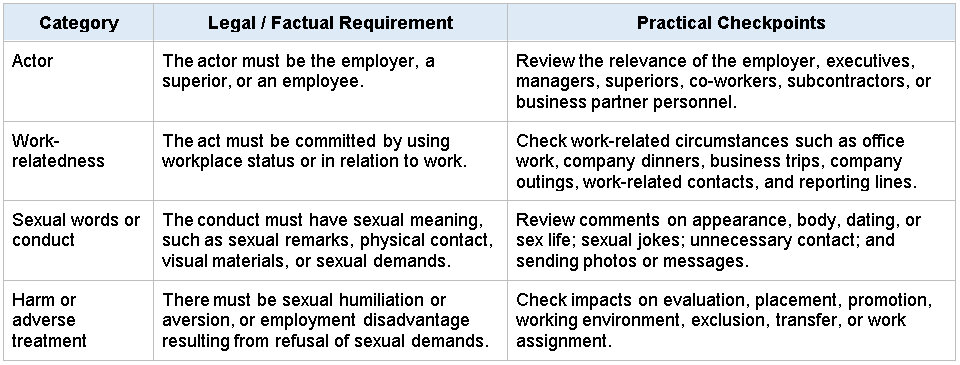
2. Main Acts Subject to Investigation
ㆍSexual comments about appearance, body, dating, or sex life; obscene remarks; sexual jokes; sexual metaphors or evaluations.
ㆍUnnecessary physical contact, holding hands, touching shoulders or waist, hugging, or requests for massage or caressing.
ㆍForcing someone to pour drinks at a company dinner, forcing someone to sit nearby, requesting private meetings, or requesting or persuading someone to engage in a sexual relationship.
ㆍSending photos, videos, messages, or links containing sexual content, or posting or sharing obscene materials.
ㆍGiving disadvantages in evaluation, placement, promotion, compensation, or working environment because the employee refused a sexual demand.
ㆍFailure by the company to take appropriate protective measures in response to sexual harassment by a third party, such as a customer or business partner employee.
3. Scope of Service
ㆍReview of the complaint and initial evidence, organization of key issues, and preparation of an investigation plan.
ㆍInterviews with the victimized employee(s), the respondent, and witnesses, and preparation of statements.
ㆍReview of evidence such as messenger records, emails, recordings, CCTV footage, company dinner materials, work materials, and HR records.
ㆍLegal assessment of whether sexual harassment is recognized and preparation of an investigation result report.
ㆍSupport for victim protection measures, disciplinary or personnel measures against the actor, recurrence prevention training, and response to labor office complaints.
II. How to Deliver
A sexual harassment investigation requires promptness, objectivity, and confidentiality at the same time. In particular, if the manner of questioning, investigation location, scope of access to materials, or management of investigation participants is inappropriate, the company may face secondary-harm liability or adverse-treatment issues regardless of whether sexual harassment is ultimately recognized. KangNam Labor Law Firm designs and documents the entire investigation process so that it can be explained afterward.
1. General Procedure
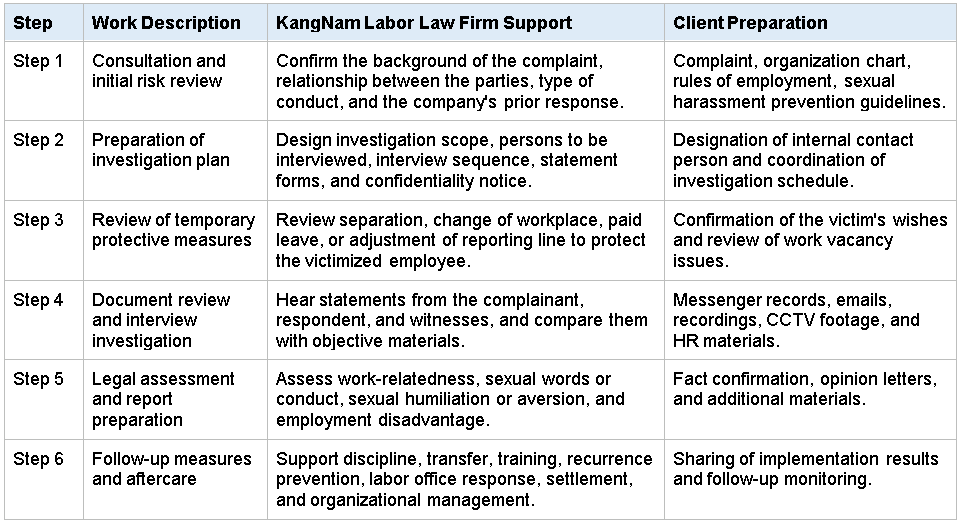
2. Materials to Prepare Before Investigation
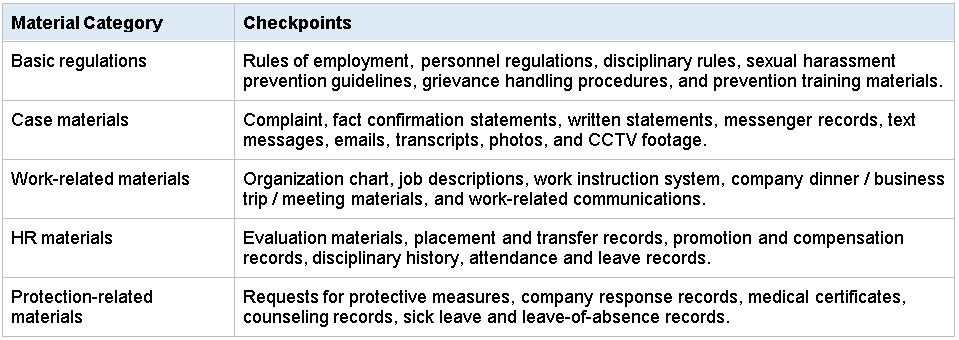
3. Support by Position
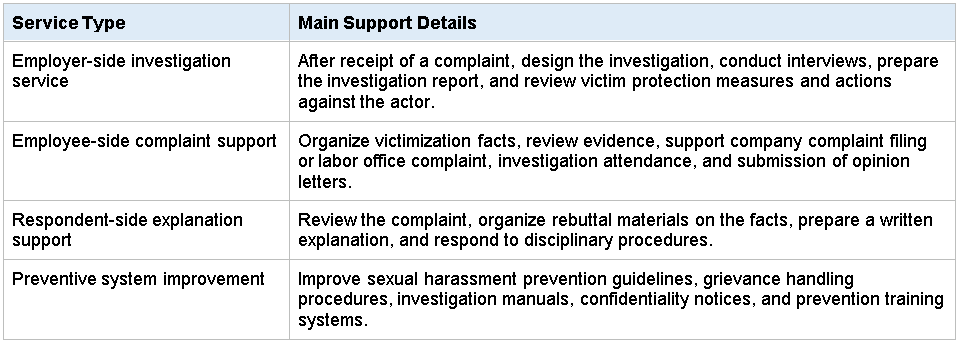
Key management point: In sexual harassment cases, the manner of questioning itself may become an issue of secondary harm. Unnecessary questions about private life should be avoided, and only facts relevant to the case should be confirmed. In addition, the victim's wishes must be confirmed so that protective measures are not evaluated as adverse personnel measures against the victim.
4. Detailed Support by Major Investigation Area
KangNam Labor Law Firm does not treat sexual harassment cases as simple internal grievance handling or emotional mediation. We conduct them as fact-finding procedures based on legal assessment standards. We balance victim protection with the respondent's right of defense, and organize objective grounds so that the investigation result can be explained in labor office complaints, disciplinary procedures, and subsequent disputes.
(1) ) Investigation Design and Procedure Management
ㆍClearly organize the complaint receipt date, investigation start date, persons subject to investigation, investigation scope, and investigation deadline.
ㆍDetermine the interview sequence for the victimized employee(s), the respondent, and witnesses, and review possible conflicts of interest.
ㆍInform all investigation participants of confidentiality, prohibition of secondary harm, prohibition of false statements, and prohibition of retaliation.
(2) Fact-finding and Evidence Review
ㆍOrganize the content of the sexual words or conduct, timing and location, surrounding circumstances, witnesses, and subsequent reactions by date and type.
ㆍReview the consistency, specificity, mutual consistency, and compatibility of statements with objective materials.
ㆍReview digital and documentary evidence, including KakaoTalk messages, emails, text messages, recordings, CCTV footage, company dinner materials, work materials, and HR materials.
(3) Legal Assessment and Report Preparation
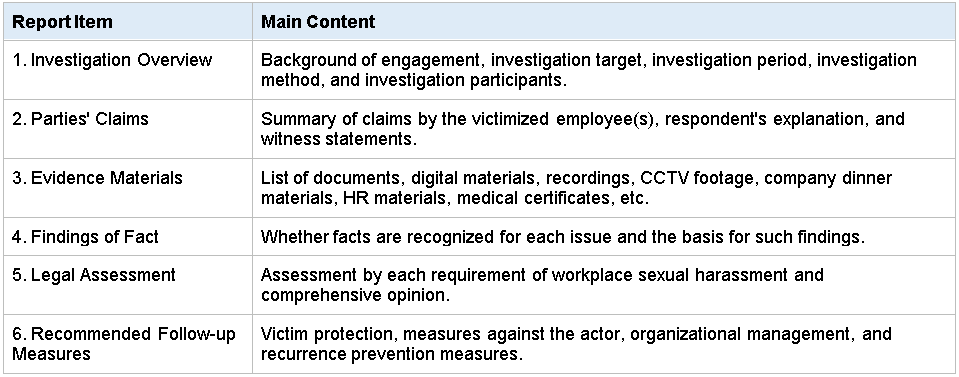
ㆍAssess, item by item, whether the act involved use of workplace status or work-relatedness, whether it constitutes sexual words or conduct, whether sexual humiliation or aversion occurred, and whether employment disadvantage occurred.
ㆍConsider the victim's subjective circumstances while also reviewing how a reasonable person in the victim's position would view the situation under socially accepted norms.
ㆍInclude the investigation process, confirmed facts, issue-by-issue assessment, whether sexual harassment is recognized, and recommended follow-up measures in the investigation report.
(4) Protection Measures, Disciplinary Measures, and Recurrence Prevention
ㆍDuring the investigation, review separation from the actor, change of workplace, paid leave, or adjustment of reporting line to the extent not contrary to the wishes of the victimized employee(s).
ㆍIf sexual harassment is confirmed, review necessary measures such as discipline against the actor, change of workplace, training, apology, and recurrence prevention pledge.
ㆍEven if sexual harassment is difficult to recognize, propose aftercare measures such as organizational conflict management, prevention of secondary harm, communication improvement, and manager training.
(5) Basic Structure of the Investigation Report
Consultation Notes
The outcome of a workplace sexual harassment case may vary depending on the content of the sexual words or conduct, work-relatedness, circumstances at the time, degree of evidence secured, and whether the company took proper measures. For an accurate investigation, the complaint details, evidence, rules of employment, sexual harassment prevention guidelines, and prior measures should be reviewed in advance.
III. Client Benefits
Workplace sexual harassment cases can expand into secondary disputes due to delays in starting the investigation, biased investigation, insufficient victim protection measures, breach of confidentiality, or inappropriate disciplinary measures. By entrusting the matter to KangNam Labor Law Firm, the client can secure procedural legitimacy and objectivity from the early stage and derive a solution acceptable to both the company and employees.
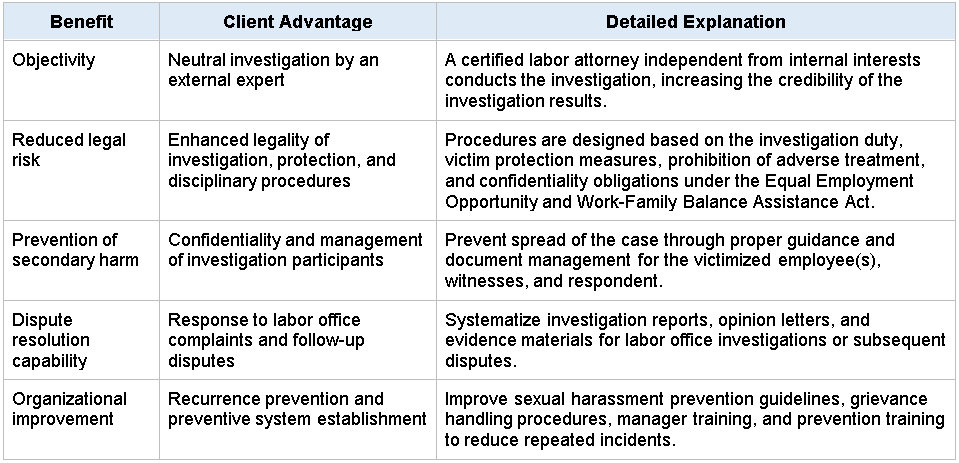
Why Entrust the Matter to KangNam Labor Law Firm
ㆍWe have practical experience handling related matters comprehensively, including workplace sexual harassment, workplace harassment, discipline, labor office complaints, and industrial accidents.
ㆍWe provide consistent support from complaint receipt to investigation planning, interviews, investigation report, and follow-up measures.
ㆍWe provide documents that can be used immediately in practice, including an investigation report summary, full report, and evidence list.
ㆍWe can provide Korean- and English-based consultation and document organization for HR and labor issues involving foreign-invested companies and multinational corporations.
ㆍWe do not hastily conclude whether sexual harassment is recognized; rather, we explain the facts and risks based on objective materials and the credibility of statements.
Examples of Service Deliverables
ㆍInvestigation plan and interview questionnaire for each investigation target.
ㆍConfidentiality notice and investigation participant confirmation form.
ㆍInterview records for the victimized employee(s), respondent, and witnesses.
ㆍWorkplace sexual harassment investigation result report and summary.
ㆍVictim protection measures, measures against the actor, and recurrence prevention training plan.
※ This material has been prepared for general information and promotional purposes. For individual cases, the requirements must be confirmed through separate consultation according to the facts, evidence, rules of employment, sexual harassment prevention guidelines, and current status of the investigation procedure..
FAQ
Q9
What is the relationship between workplace harassment and sexual harassment?
Workplace sexual harassment refers to sexual behavior that causes sexual humiliation or discomfort, or disadvantage in employment because of refusal of sexual demands. Workplace harassment refers more broadly to the abuse of superior position or workplace relationships to cause physical or mental harm or worsen the working environment.Therefore, sexual remarks, physical contact, appearance-based comments, sexual jokes, or coercion into private meetings are primarily assessed as sexual harassment. However, if such behavior is followed by exclusion, retaliation, or repeated humiliation or pressure, it may also constitute workplace harassment.In practice, companies should not treat these issues as mutually exclusive. The same facts should be reviewed for sexual harassment, workplace harassment, and secondary victimization or retaliatory treatment simultaneously. In particular, any adverse personnel action or ostracism following a sexual harassment complaint may lead to separate legal liability.
Q8
How should sexual harassment investigation records be managed?
Documents such as complaint forms, statements, investigation reports, evidence materials, and corrective actions must be treated as confidential. Access should be strictly limited to authorized personnel, and the information must not be used for any purpose other than the investigation or disclosed externally.
Q7
If sexual harassment is not confirmed, are no further actions needed?
Not necessarily. Even if sexual harassment is not clearly established, if inappropriate behavior, workplace conflict, or communication issues are identified, the company may still need to implement preventive training, organizational culture improvements, or workplace adjustments.
Q6
What actions must be taken if sexual harassment is confirmed?
The company must take appropriate measures against the perpetrator, such as disciplinary action, reassignment, mandatory training, or separation from the victim. The level of action should be determined based on the severity of the case, repetition, intent, and degree of harm.
Q5
What protective measures should be taken for the victim during the investigation?
If necessary, measures such as workplace reassignment, paid leave, remote work, separation of duties, or restrictions on contact may be implemented. However, such measures must not disadvantage the victim.
Q4
Must the accused be given an opportunity to respond?
Yes. For a fair investigation, the accused must be informed of the key allegations and given an opportunity to respond. However, the victim’s personal information and unnecessary details must not be disclosed.
Q3
What is the most important principle during the investigation?
The most important principles are confidentiality, fairness, promptness, and prevention of secondary harm. The identities of the victim and reporter must not be disclosed unnecessarily, and the investigator must maintain a neutral and objective stance.
Q2
If the victim does not want an investigation, can the company skip it?
In principle, the company has a duty to investigate the facts. However, the victim’s wishes, risk of secondary harm, and the seriousness of the case must be carefully considered when determining the scope and method of the investigation.
Q1
Must a company investigate when a workplace sexual harassment report is filed?
Yes. When a company receives a report of workplace sexual harassment or becomes aware of such an incident, it must promptly conduct a fact-finding investigation. Even if the matter appears to be a minor complaint or misunderstanding, the basic facts must first be verified.
Key Representative Cases