

Workplace Harassment Investigation Labor Consulting & Legal Representation
Consultation Request
Support from receipt of a complaint to objective investigation, investigation report, protective measures for the victim, and follow-up response
The Workplace Harassment Investigation Service is a professional HR and labor management service in which a certified labor attorney objectively investigates the facts of a workplace harassment complaint, or a case recognized by the company, and provides an investigation report and follow-up action plan based on legal standards. The service goes beyond simple internal interviews and provides integrated support for protection of the affected employee, guarantee of the respondent’s right of defense, prevention of secondary harm, confidentiality, and response to the labor office.
I. What Service Is Provided | What Service
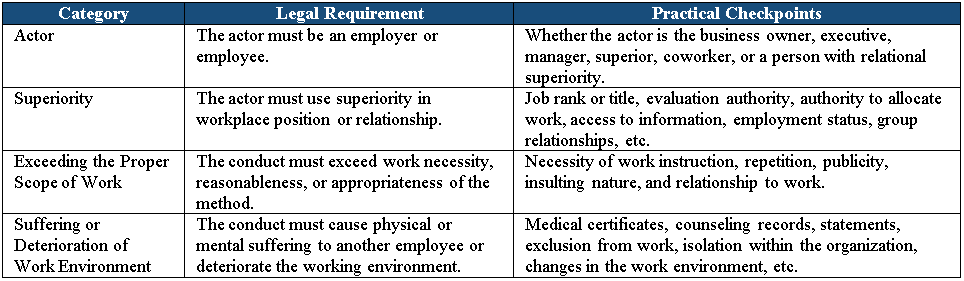
A workplace harassment investigation is a fact-finding and legal assessment procedure to determine whether the reported conduct constitutes workplace harassment under the Labor Standards Act. When an employer receives a complaint or becomes aware of workplace harassment, it must promptly conduct an objective investigation of the parties concerned. During the investigation, the employer must also consider protective measures for the affected employee, confidentiality, disciplinary or other measures against the actor after the investigation, and measures to prevent recurrence.
1. Key Legal Elements of Workplace Harassment
2. Major Conduct Subject to Investigation
ㆍRepeated verbal abuse, swearing, insults, threats, public humiliation, and derogatory comments about personality or character.
ㆍExcessive work assignments beyond business necessity, impossible work instructions, and instructions to perform private errands.
ㆍExclusion from work without justifiable reason, exclusion from meetings or information sharing, group ostracism, and pressure to resign.
ㆍDisadvantageous treatment or secondary harm after a complaint, such as transfer, unfavorable evaluation, exclusion from duties, or ostracism.
ㆍConduct that is not merely an emotional dispute but is comprehensively recognized as involving superiority, exceeding the proper scope of work, and causing suffering or deterioration of the work environment.
3. Scope of Representation
ㆍReview of the complaint and initial materials, identification of key issues, and establishment of an investigation plan.
ㆍInterviews with the complainant, affected employee(s), respondent, and witnesses, and organization of written statements.
ㆍReview of evidence such as emails, messenger records, recordings, CCTV footage, personnel records, attendance records, and work-related materials.
ㆍLegal assessment of whether the conduct constitutes workplace harassment and preparation of an investigation report.
ㆍSupport for protective measures for the affected employee, measures against the actor, recurrence-prevention training, and response to labor office complaints.
II. How the Service Is Delivered | How to Deliver
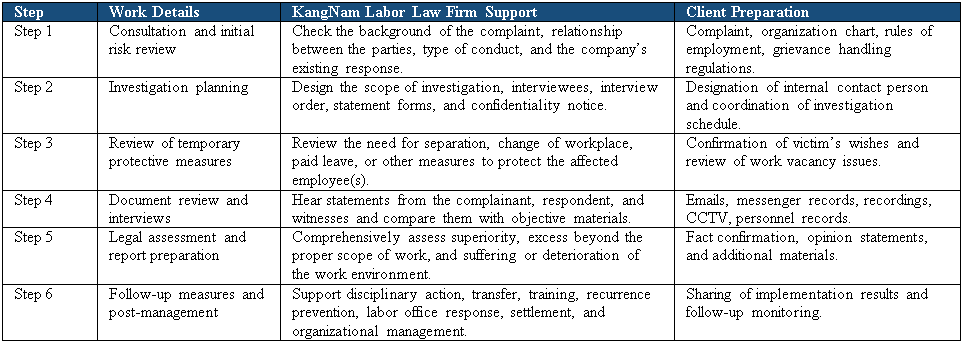
In workplace harassment investigations, both speed and fairness are important. When a complaint is received, the company must start the investigation without delay, while also protecting the victim, guaranteeing the respondent’s right of defense, maintaining confidentiality, and securing objective evidence. KangNam Labor Law Firm designs the investigation process step by step and documents the process and results so that they can be explained later in a labor office complaint or dispute.
1. Common Procedure
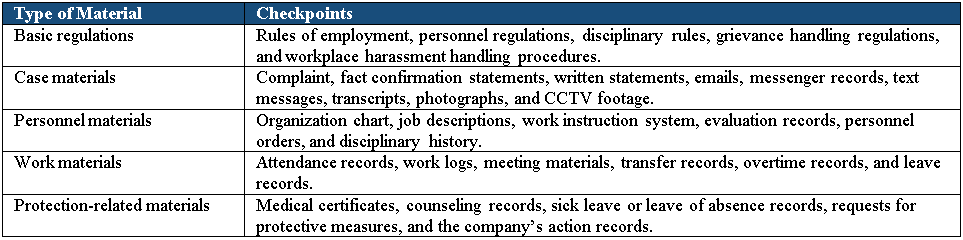
2. Preliminary Materials for Investigation
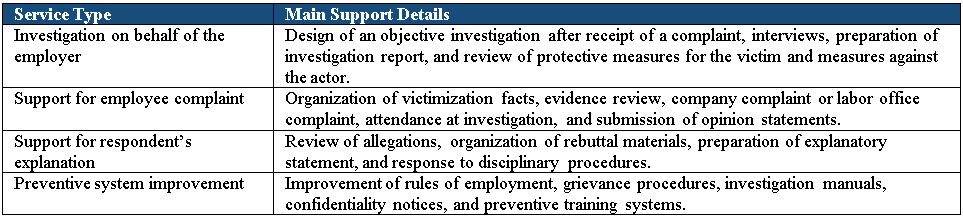
3. Support by Party Position
Key management point: If the investigation procedure is insufficient or protective measures for the victim are inadequate, the company may face procedural liability regardless of whether harassment is ultimately recognized. Therefore, it is important to document the investigation plan, interview records, evidence list, grounds for judgment, and follow-up measures.
4. Detailed Support by Investigation Area | Detailed Support
KangNam Labor Law Firm does not treat workplace harassment cases as simple complaint handling or emotional mediation. We conduct them as fact-finding procedures based on legal standards. In particular, we balance protection of the complainant with the respondent’s right of defense to enhance the reliability of the investigation results.
(1) ) Investigation Design and Procedure Management
ㆍClearly organize the complaint receipt date, investigation commencement date, investigation subjects, scope of investigation, and investigation deadline.
ㆍDetermine the order of interviews with the complainant, affected employee(s), respondent, and witnesses, and review potential conflicts of interest.
ㆍInform investigation participants of confidentiality, prohibition of secondary harm, prohibition of false statements, and prohibition of retaliation.
(2) Fact-Finding and Evidence Review
ㆍOrganize the complaint by date, place, and type of conduct, and match each act with evidence and witnesses.
ㆍReview the consistency, specificity, mutual consistency, and conformity of statements with objective materials.
ㆍReview digital and documentary evidence such as KakaoTalk messages, emails, text messages, recordings, CCTV footage, work materials, and personnel records.
(3) Legal Assessment and Report Preparation
ㆍAssess by item whether there was superiority in workplace position or relationship, conduct exceeding the proper scope of work, and physical or mental suffering or deterioration of the working environment.
ㆍWhere work instruction authority conflicts with personality rights, comprehensively assess work necessity, reasonableness, repetition, publicity, insulting nature, and the victim’s response.
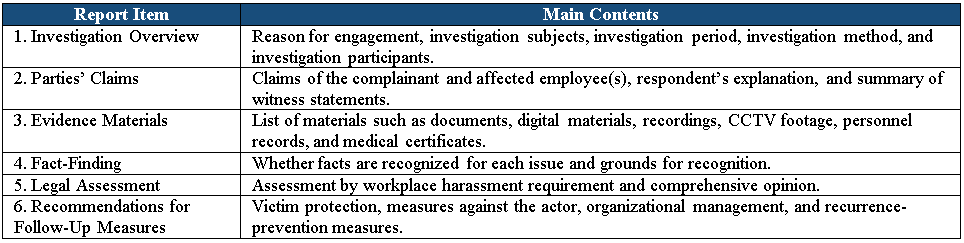
ㆍThe investigation report includes the investigation process, confirmed facts, assessment of each issue, whether harassment is recognized, and recommendations for follow-up measures.
(4) Support for Protective Measures, Disciplinary Measures, and Recurrence Prevention
ㆍDuring the investigation, review separation measures, change of workplace, paid leave, or work adjustment within the scope that does not go against the wishes of the affected employee(s).
ㆍIf harassment is confirmed, review necessary measures against the actor, such as disciplinary action, change of workplace, training, apology, and recurrence-prevention pledge.
ㆍEven when harassment is difficult to recognize, propose follow-up management measures such as organizational conflict management, communication improvement, and manager training.
(5)) Basic Structure of the Investigation Report
Consultation Notes
Workplace harassment cases are difficult to assess based only on the statements of the parties, and the result may vary depending on the context of the case and the extent to which evidence has been accumulated. For an accurate investigation, the content of the complaint, evidence materials, rules of employment, organization chart, and records of existing measures should be reviewed in advance
III. Client Benefits
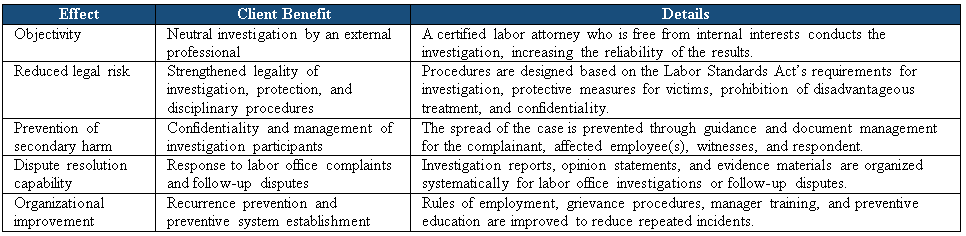
Workplace harassment cases may escalate into secondary disputes due to delayed commencement of investigation, biased investigation, insufficient protective measures for the victim, breach of confidentiality, or inappropriate disciplinary measures. By retaining KangNam Labor Law Firm, clients can secure procedural fairness and objectivity from the early stage and derive a solution that both the company and employees can accept.
Why Choose KangNam Labor Law Firm
ㆍWe have practical experience handling related matters comprehensively, including workplace harassment, sexual harassment, disciplinary action, labor office complaints, and industrial accidents.
ㆍWe provide consistent support from complaint receipt to investigation planning, interviews, investigation report, and follow-up measures.
ㆍWe provide documents that can be used immediately in practice, including a summary report, full report, and list of evidence materials.
ㆍWe can provide Korean- and English-based consultation and documentation for HR and labor issues involving foreign-invested companies and multinational companies.
ㆍWe do not hastily conclude whether harassment is recognized, but explain the facts and risks based on objective materials and the credibility of statements.
Examples of Service Deliverables
ㆍInvestigation plan and questionnaires for each investigation subject.
ㆍConfidentiality notice and investigation participant confirmation form.
ㆍInterview records for the complainant, respondent, and witnesses.
ㆍWorkplace harassment investigation report and summary report.
ㆍVictim protection plan, measures against the actor, and recurrence-prevention training plan.
※ This material has been prepared for general information and promotional purposes. For each individual case, the requirements should be confirmed through separate consultation depending on the facts, evidence, rules of employment, and status of the investigation procedure.
FAQ
Q8
What records should a company keep after an investigation?
The company must document the entire process from report receipt to case closure, in preparation for labor inspections, civil disputes, disciplinary challenges, or secondary victimization claims.
Key records include:
Category Documents
Report receipt Complaint forms, emails, consultation records, date of receipt
Protective measures Interview notes, protection request forms, action records
Investigation process Investigation plan, interview schedule, attendance notices, statements
Evidence Messages, emails, recordings, CCTV, work records
Findings Investigation report, fact determination sheets, legal analysis
Follow-up actions Disciplinary records, transfer orders, training records, prevention measures
Closure Final notice, appeal review materials, document logs
Confidentiality is critical. Investigation details must be restricted to prevent secondary harm or defamation issues, and access should be limited to necessary personnel only.
Key records include:
Category Documents
Report receipt Complaint forms, emails, consultation records, date of receipt
Protective measures Interview notes, protection request forms, action records
Investigation process Investigation plan, interview schedule, attendance notices, statements
Evidence Messages, emails, recordings, CCTV, work records
Findings Investigation report, fact determination sheets, legal analysis
Follow-up actions Disciplinary records, transfer orders, training records, prevention measures
Closure Final notice, appeal review materials, document logs
Confidentiality is critical. Investigation details must be restricted to prevent secondary harm or defamation issues, and access should be limited to necessary personnel only.
Q7
What happens if the complainant or victim suffers retaliation?
The company must not treat employees unfavorably because they reported or were victims of workplace harassment. The Labor Standards Act prohibits adverse treatment against reporters and victims, and violations may result in criminal liability.Adverse treatment includes dismissal, reassignment, performance disadvantages, denial of promotion, work exclusion, tolerance of ostracism, contract non-renewal, or wage disadvantages. Therefore, any personnel action after a report must be carefully reviewed to ensure it is based on objective reasons unrelated to the complaint and does not harm the victim’s rights.
Q6
What actions must be taken if workplace harassment is confirmed?
If workplace harassment is confirmed, the company must take measures to protect the victim and address the perpetrator.For the victim, measures may include reassignment, workplace transfer, paid leave, counseling support, and restriction of contact with the perpetrator.For the perpetrator, disciplinary actions such as warnings, training, reassignment, suspension of duties, or formal disciplinary measures may be taken depending on severity. In serious cases involving verbal abuse, humiliation, retaliation, or repeated misconduct, stronger disciplinary actions such as suspension, pay reduction, or dismissal may be considered. The key principle is proportionality between the findings and the disciplinary action.
Q5
Must anonymous or third-party reports also be investigated?
Anonymous or third-party reports must not be ignored if the content is specific and suggests possible workplace harassment.However, since anonymous reports lack identifiable complainants, caution is required in how investigations are conducted. The company should first assess the specificity of the report, relevant individuals, timing, location, and available evidence. If necessary, the company may cautiously check the intent of the presumed victim.In third-party reports, the victim’s intent and need for protection must also be considered, and confidentiality must be strictly maintained to prevent internal information leakage.
Q4
Who should conduct the workplace harassment investigation?
?A. In principle, the investigator should be a person who has no conflict of interest in the case and who is able to maintain objectivity and neutrality. In general, members of the HR department, compliance department, audit department, or an external labor attorney may participate as investigators.
In the following cases, an investigation by an external expert may be more appropriate.
Situation Reason Why an External Investigation May Be Necessary
The alleged perpetrator is an executive or senior manager Concerns over the independence of an internal investigation
There is a lack of trust between the victim and the HR department Need to ensure fairness in the investigation
Multiple victims or multiple alleged perpetrators are involved Need to define the investigation scope and organize evidence
The case involves serious issues such as sexual harassment, verbal abuse, or retaliation Need to prevent secondary victimization
There is a high possibility of future disciplinary action or litigation Need to secure procedural legitimacy
The investigator should interview the complainant, victim, respondent, and witnesses separately, and systematically organize the statements and evidence.
In the following cases, an investigation by an external expert may be more appropriate.
Situation Reason Why an External Investigation May Be Necessary
The alleged perpetrator is an executive or senior manager Concerns over the independence of an internal investigation
There is a lack of trust between the victim and the HR department Need to ensure fairness in the investigation
Multiple victims or multiple alleged perpetrators are involved Need to define the investigation scope and organize evidence
The case involves serious issues such as sexual harassment, verbal abuse, or retaliation Need to prevent secondary victimization
There is a high possibility of future disciplinary action or litigation Need to secure procedural legitimacy
The investigator should interview the complainant, victim, respondent, and witnesses separately, and systematically organize the statements and evidence.
Q3
What protective measures must be taken for the victim during the investigation?
During the investigation period, the company must take necessary measures to protect the victim or the alleged victim. Examples include workplace reassignment, paid leave, remote work, restriction of contact, or changes in reporting lines.However, protective measures must not disadvantage the victim against their will. For example, forcing a transfer, removing duties, or imposing negative performance evaluations against the victim’s wishes may be problematic. In practice, it is advisable to confirm the victim’s preferences first and document them in meeting records or protection measure confirmations.
Q2
Must a company investigate when a workplace harassment report is filed?
Yes. When a company receives a report or becomes aware of workplace harassment, it must conduct an objective investigation without delay. Article 76-3 of the Labor Standards Act requires employers to promptly investigate the facts when a report is made or when they become aware of possible workplace harassment.Therefore, a company must not skip the investigation on the grounds that “it seems minor,” “there is no clear evidence,” or “the parties should resolve it themselves.” If there is a possibility that the conduct constitutes workplace harassment, at least a fact-finding process must be conducted. Failure to investigate or conducting only a formal investigation may lead to labor office complaints, civil liability, secondary victimization, and loss of organizational trust.
Q1
What are the requirements for workplace harassment?
Workplace harassment refers to behavior by an employer or employee that uses superiority in position or relationship at work, exceeds the appropriate scope of work, and causes physical or mental harm to another employee or worsens the working environment.Therefore, workplace harassment is generally assessed based on the following three elements:
Requirement Description
Superiority in position or relationship Job rank, age, seniority, authority, number advantage, etc.
Exceeding the appropriate scope of work No work necessity, or excessive methods even if necessary
Physical/mental harm or worsened working environment Verbal abuse, humiliation, exclusion, excessive workload, work isolation, etc.
Not all instructions or legitimate reprimands constitute harassment. However, even if there is a work-related necessity, factors such as humiliating language, repetition, public embarrassment, or personal insult may lead to a finding of workplace harassment.
Requirement Description
Superiority in position or relationship Job rank, age, seniority, authority, number advantage, etc.
Exceeding the appropriate scope of work No work necessity, or excessive methods even if necessary
Physical/mental harm or worsened working environment Verbal abuse, humiliation, exclusion, excessive workload, work isolation, etc.
Not all instructions or legitimate reprimands constitute harassment. However, even if there is a work-related necessity, factors such as humiliating language, repetition, public embarrassment, or personal insult may lead to a finding of workplace harassment.
Key Representative Cases