

Labor Inspection Labor Consulting & Legal Representation
Consultation Request
Preventive Workplace Audit and Labor-Law Compliance Diagnosis in Preparation for Labor Office Inspections
The Labor Inspection Support Service is not a service that “substitutes” for an official labor inspection by the Labor Office. It is a preventive labor-management service in which a certified labor attorney pre-inspects the workplace in the same manner as an actual labor inspector, identifies risks of legal violations, and helps the company correct them.
I. What Services Are Provided | What Service
A labor inspection is a comprehensive review of whether a workplace complies with labor laws in areas such as employment contracts, wages, working hours, leave, rules of employment, retirement benefits, workplace harassment and sexual harassment, and the labor-management council. Based on its Labor Inspection Manual and checklist, KangNam Labor Law Firm reviews the company’s actual operations and identifies matters that should be improved before an official inspection.
1. Major Service Areas
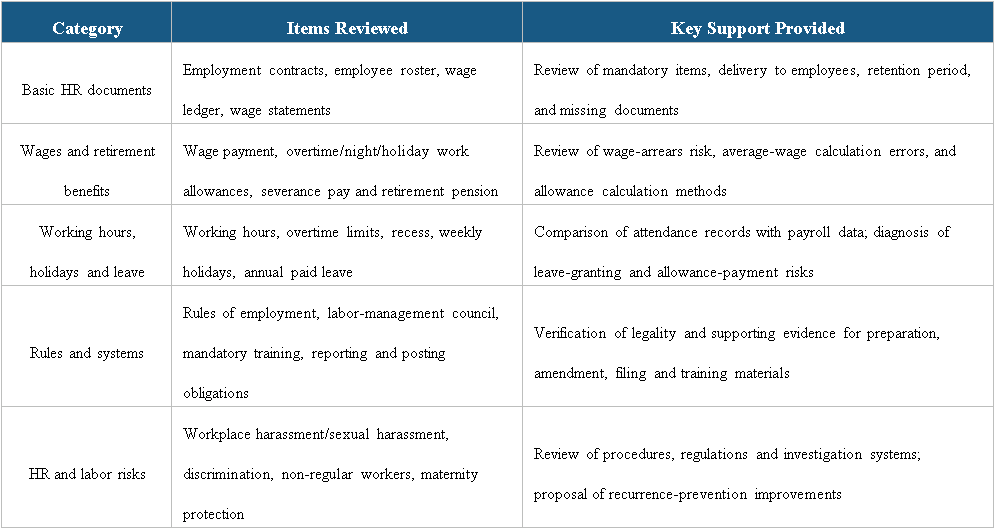
2. Scope of Services
ㆍOn-site workplace visit by a certified labor attorney and practical mock labor inspection
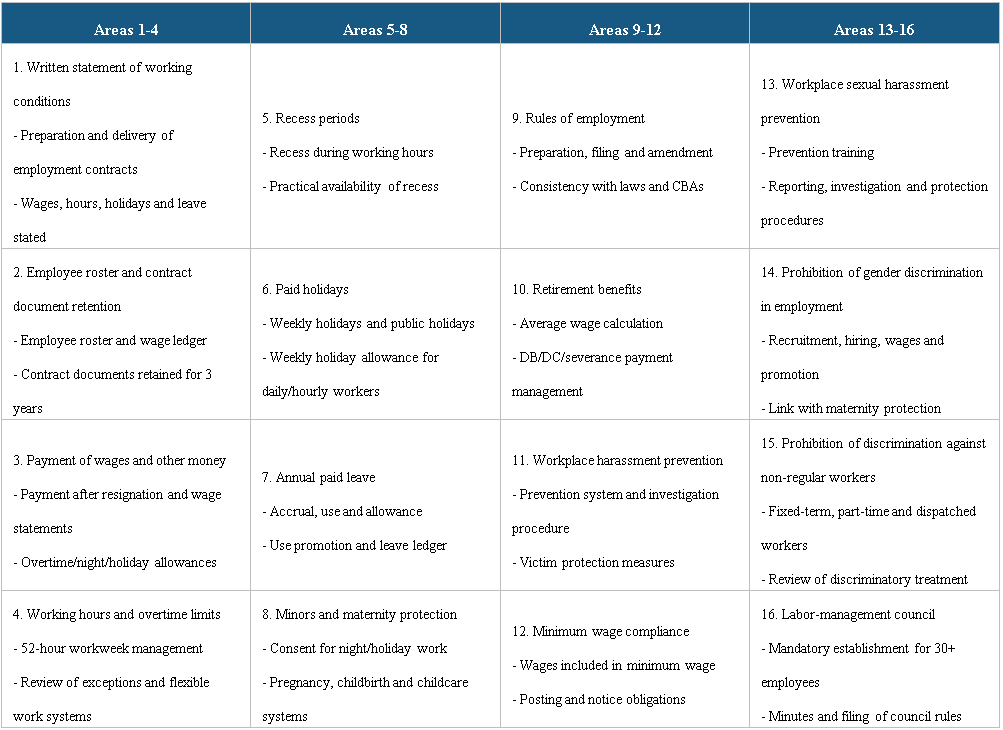
ㆍDiagnosis of compliance with labor laws in the 16 areas of the labor inspection checklist
ㆍReview of evidentiary documents such as employment contracts, wage ledgers, attendance records, rules of employment and training materials
ㆍInterviews with the employer and HR staff and, where necessary, confirmation of actual workplace operations
ㆍProvision of an inspection report summarizing possible violations, required supplements and correction priorities
ㆍSupport for form revisions, system improvement, training and follow-up management for items likely to be subject to correction orders
II. How the Service Is Delivered | How to Deliver
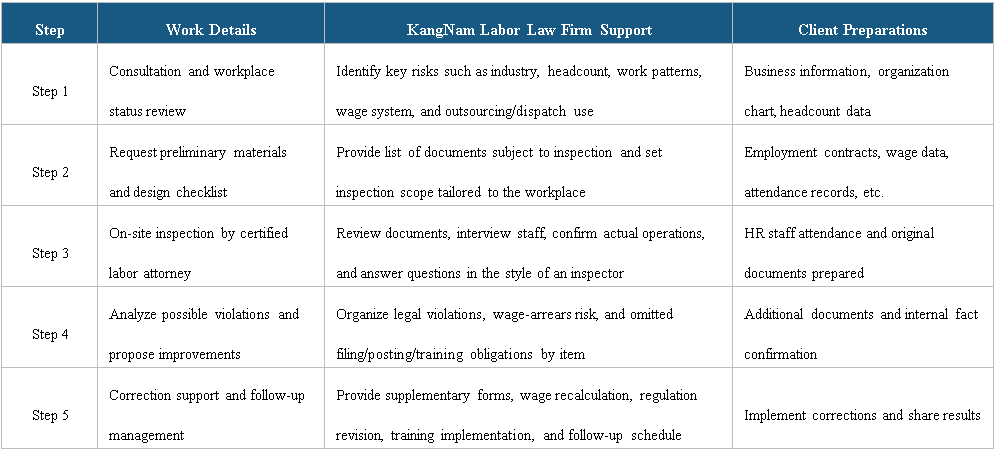
The Labor Inspection Support Service is a “preventive inspection.” A certified labor attorney visits the workplace, requests materials as an actual labor inspector would, interviews the relevant staff, and checks whether the company’s actual practices match its documents. The purpose is not merely to complete a checklist, but to identify in advance items that could become issues during a Labor Office inspection and make them correctable before the inspection.
1. General Process
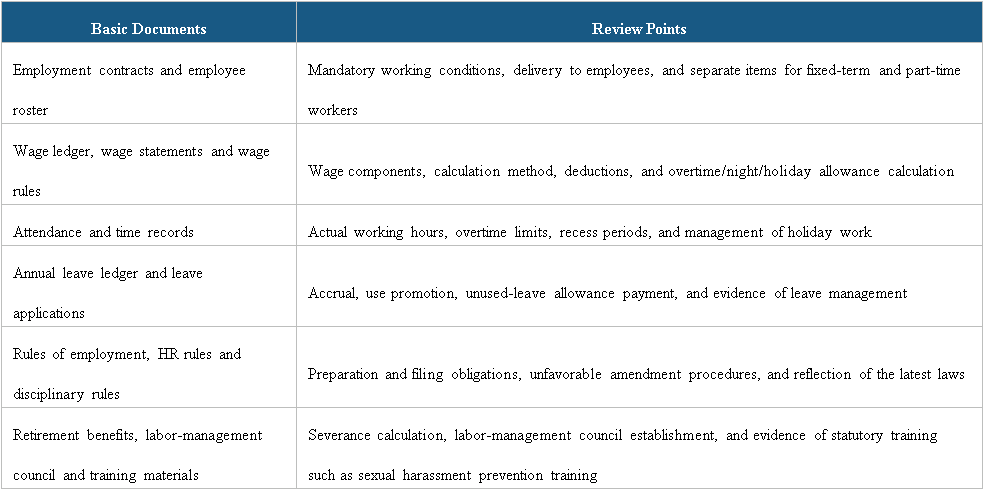
2. Preliminary Documents
3. Detailed Support by Major Inspection Area | Detailed Support
KangNam Labor Law Firm diagnoses workplace compliance with labor laws based on the 16 areas of the labor inspection checklist. In particular, matters frequently identified in actual inspections, such as missing employment contracts, errors in overtime allowance calculation, unpaid annual leave allowances, failure to file rules of employment, failure to establish a labor-management council, and failure to conduct sexual harassment prevention training, are treated as priority review items.
(1) 16 Areas of the Labor Inspection Checklist
(2) Practical On-Site Inspection Method
ㆍThe certified labor attorney sequentially reviews core documents such as employment contracts, wage data, attendance records and rules of employment in the same manner as a labor inspector’s document request.
ㆍThrough interviews with responsible staff, the attorney checks whether actual operations match the written documents and explains matters that can be supplemented immediately on site.
ㆍFor items with wage-arrears risk, the wage ledger and attendance records are compared to assess the need for recalculation and to set correction priorities.
ㆍAfter the inspection, an improvement table is provided in the format of “possible violation - required action - documents to prepare - responsible department - completion deadline,” leading to follow-up management.
Key management point: Even when an official labor inspection begins with a complaint from one employee, it may expand into wage-arrears or documentation issues affecting all employees in the same or similar position. Therefore, the preventive inspection should be conducted not as “one individual case,” but based on the workplace’s overall systems and practices.
III. What Benefits Are Provided to Clients | Client Benefits
If violations are found during a labor inspection, the matter may expand into correction orders, administrative fines, criminal penalties, additional inspections, or collective wage-arrears issues. By entrusting the matter to KangNam Labor Law Firm, clients can identify risks before an actual inspection, organize the necessary documents and procedures, and systematically improve the level of compliance with labor laws.
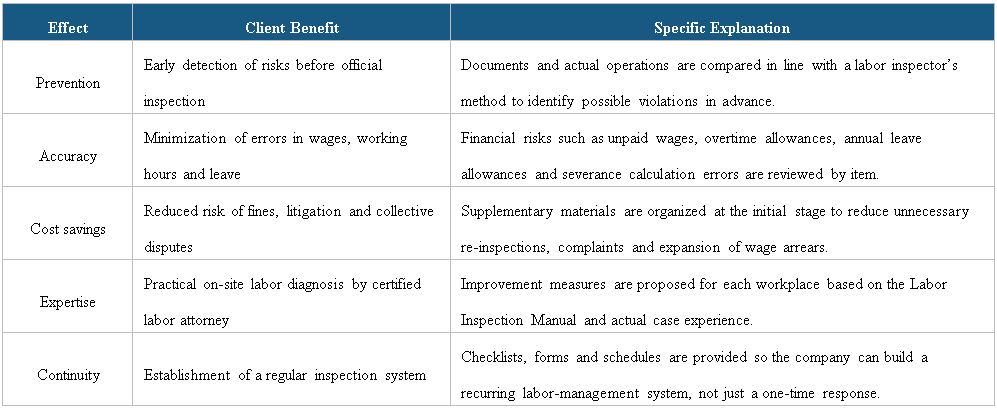
Why Entrust This Work to KangNam Labor Law Firm
ㆍWe provide a systematic preventive inspection based on our Labor Inspection Manual and labor-law compliance checklist.
ㆍWe diagnose workplace-specific risks based on practical experience in labor inspection responses, wage arrears, rules of employment, labor-management councils, workplace harassment and sexual harassment cases.
ㆍWe organize issues that may be identified during an official inspection and provide practical support in the form of correction materials, training materials and reports.
ㆍWe can provide Korean- and English-based consultations and documentation for HR and labor issues involving foreign-invested companies and multinational companies.
ㆍWe do not falsely assert that there are “no problems.” Instead, we explain risks and improvement directions based on the facts and evidence of each workplace.
Matters to Note During Consultation
Labor inspection risks may vary depending on the industry, number of regular employees, wage system, work patterns, use of outsourcing or dispatch, and operation of rules of employment and the labor-management council. For an accurate diagnosis, the workplace status and relevant evidence should first be reviewed through a preliminary consultation..
FAQ
Q9
How many years back can a labor inspection review employment records?
During a labor inspection, employment records such as payroll ledgers, employment contracts, attendance records, and annual leave records may be reviewed. The scope of the inspection varies depending on its purpose and the nature of the alleged violations. In wage-related matters, including unpaid wages and overtime pay, inspectors often request records covering the applicable statutory limitation period. Therefore, companies should maintain and organize key HR and labor documents in accordance with the legally required retention periods.
Q8
How should a company respond after receiving a labor inspection?
After a labor inspection, it is advisable for the company to accurately understand the matters pointed out by the inspector and respond in the following order.
Confirm the issues identified and the relevant laws and regulations.
Review whether the facts and the company’s records are consistent.
Distinguish between matters that should be acknowledged and matters that should be disputed.
Correct matters that can be remedied within the prescribed period.
If there are unpaid wages or benefits, review the basis for the calculation and then determine whether payment should be made.
To prevent recurrence, improve employment contracts, the wage system, working time management, and rules of employment.
If necessary, obtain a review from a labor attorney or labor consultant and submit a written opinion.
The attitude that should be avoided most in responding to a labor inspection is “simply holding out for the time being.” Clear violations should be corrected promptly, and matters that can be disputed on legal grounds should be explained calmly with supporting evidence and materials. If a company believes that there are factual errors or incorrect legal interpretations in the labor inspection results, it may submit supporting documents and explanations. The company can discuss the findings with the labor inspector in charge or request additional clarification regarding corrective orders. If an administrative sanction is imposed, the company may consider available legal remedies such as objections or administrative appeals in accordance with applicable laws. It is important to respond with objective evidence and a clear explanation of the facts rather than an emotional reaction.
Confirm the issues identified and the relevant laws and regulations.
Review whether the facts and the company’s records are consistent.
Distinguish between matters that should be acknowledged and matters that should be disputed.
Correct matters that can be remedied within the prescribed period.
If there are unpaid wages or benefits, review the basis for the calculation and then determine whether payment should be made.
To prevent recurrence, improve employment contracts, the wage system, working time management, and rules of employment.
If necessary, obtain a review from a labor attorney or labor consultant and submit a written opinion.
The attitude that should be avoided most in responding to a labor inspection is “simply holding out for the time being.” Clear violations should be corrected promptly, and matters that can be disputed on legal grounds should be explained calmly with supporting evidence and materials. If a company believes that there are factual errors or incorrect legal interpretations in the labor inspection results, it may submit supporting documents and explanations. The company can discuss the findings with the labor inspector in charge or request additional clarification regarding corrective orders. If an administrative sanction is imposed, the company may consider available legal remedies such as objections or administrative appeals in accordance with applicable laws. It is important to respond with objective evidence and a clear explanation of the facts rather than an emotional reaction.
Q7
What documents should a company prepare in advance before a labor inspection?
In order to prepare for a labor inspection, the basic materials related to the company’s human resources and labor management should be systematically organized in advance. This is because a labor inspector does not determine whether there has been a legal violation based solely on the company’s explanation, but rather confirms the facts through objective materials such as employment contracts, payroll ledgers, working time records, annual leave management materials, and rules of employment.
First, with respect to employment relationships, employment contracts, annual salary agreements, and wage change agreements should be prepared. Employment contracts are the most basic materials for confirming working conditions such as wages, working hours, holidays, leave, and job duties. If wages or working conditions have been changed, annual salary agreements or wage change agreements that confirm the changed contents should also be retained.
With respect to wages, payroll ledgers, pay statements, and bank transfer records are required. Payroll ledgers are the key materials for confirming wage payment details for each employee, and pay statements are materials used to confirm the composition of wage items and deduction details. In addition, it is important to retain bank transfer records to prove that wages were actually paid.
With respect to working hours, attendance records, overtime work application forms, and holiday work approval materials are required. Where overtime, night work, or holiday work allowances become an issue, materials capable of proving actual working hours are the most important. Therefore, the company should systematically manage attendance records, and it is desirable to operate overtime work and holiday work through prior application and approval procedures.
With respect to leave, annual leave registers, annual leave promotion documents, and records of payment for unused leave allowances should be prepared. In annual leave disputes, the main issues are whether the employee actually used annual leave, whether the company properly carried out the statutory annual leave usage promotion procedure, and whether allowances for unused annual leave were paid. Therefore, materials relating to annual leave accrual, use, promotion, and allowance payments should all be organized.
With respect to retirement, severance pay calculation statements, average wage calculation materials, and resignation letters are required. Since severance pay is calculated based on the continuous period of employment and average wages, wage materials for the three months preceding retirement and severance pay calculation details should be clearly retained. In addition, because the issue of whether the resignation was voluntary may arise, resignation letters or retirement-related agreements are also important materials.
With respect to rules of employment, rules of employment, filing confirmation documents, and documents relating to amendment procedures should be prepared. Workplaces with ten or more regular employees have an obligation to prepare and report rules of employment, and where the rules are changed unfavorably to employees, consent procedures involving the majority labor union or a majority of employees are required. Therefore, not only the rules of employment themselves but also materials capable of proving the amendment procedure, such as opinion forms, consent forms, and meeting minutes, should be retained.
With respect to the four major social insurance programs, acquisition and loss reporting materials and insurance premium payment materials are required. Social insurance reporting materials may be used to verify whether employees’ dates of hire, dates of resignation, employment types, and monthly remuneration amounts are consistent with the actual employment relationship. Insurance premium payment materials also serve as evidence of whether the company has properly fulfilled its social insurance obligations toward employees.
Lastly, with respect to workplace harassment, complaint receipt materials, investigation reports, and protective measure materials should be prepared. When a workplace harassment complaint is received, the company must promptly conduct an investigation to confirm the facts and take protective measures for the affected employee as well as appropriate measures against the perpetrator. Therefore, it is important to document the entire process, from complaint receipt through investigation, interviews, protective measures, disciplinary action, or recurrence prevention measures.
In particular, payroll ledgers, employment contracts, and working time records are the most basic materials requested during a labor inspection. If these materials do not exist, it may become difficult to prove the company’s explanation even if it is true. Therefore, companies should systematically organize and retain materials relating to employment contracts, wages, working hours, leave, retirement, rules of employment, the four major social insurance programs, and workplace harassment on a regular basis.
First, with respect to employment relationships, employment contracts, annual salary agreements, and wage change agreements should be prepared. Employment contracts are the most basic materials for confirming working conditions such as wages, working hours, holidays, leave, and job duties. If wages or working conditions have been changed, annual salary agreements or wage change agreements that confirm the changed contents should also be retained.
With respect to wages, payroll ledgers, pay statements, and bank transfer records are required. Payroll ledgers are the key materials for confirming wage payment details for each employee, and pay statements are materials used to confirm the composition of wage items and deduction details. In addition, it is important to retain bank transfer records to prove that wages were actually paid.
With respect to working hours, attendance records, overtime work application forms, and holiday work approval materials are required. Where overtime, night work, or holiday work allowances become an issue, materials capable of proving actual working hours are the most important. Therefore, the company should systematically manage attendance records, and it is desirable to operate overtime work and holiday work through prior application and approval procedures.
With respect to leave, annual leave registers, annual leave promotion documents, and records of payment for unused leave allowances should be prepared. In annual leave disputes, the main issues are whether the employee actually used annual leave, whether the company properly carried out the statutory annual leave usage promotion procedure, and whether allowances for unused annual leave were paid. Therefore, materials relating to annual leave accrual, use, promotion, and allowance payments should all be organized.
With respect to retirement, severance pay calculation statements, average wage calculation materials, and resignation letters are required. Since severance pay is calculated based on the continuous period of employment and average wages, wage materials for the three months preceding retirement and severance pay calculation details should be clearly retained. In addition, because the issue of whether the resignation was voluntary may arise, resignation letters or retirement-related agreements are also important materials.
With respect to rules of employment, rules of employment, filing confirmation documents, and documents relating to amendment procedures should be prepared. Workplaces with ten or more regular employees have an obligation to prepare and report rules of employment, and where the rules are changed unfavorably to employees, consent procedures involving the majority labor union or a majority of employees are required. Therefore, not only the rules of employment themselves but also materials capable of proving the amendment procedure, such as opinion forms, consent forms, and meeting minutes, should be retained.
With respect to the four major social insurance programs, acquisition and loss reporting materials and insurance premium payment materials are required. Social insurance reporting materials may be used to verify whether employees’ dates of hire, dates of resignation, employment types, and monthly remuneration amounts are consistent with the actual employment relationship. Insurance premium payment materials also serve as evidence of whether the company has properly fulfilled its social insurance obligations toward employees.
Lastly, with respect to workplace harassment, complaint receipt materials, investigation reports, and protective measure materials should be prepared. When a workplace harassment complaint is received, the company must promptly conduct an investigation to confirm the facts and take protective measures for the affected employee as well as appropriate measures against the perpetrator. Therefore, it is important to document the entire process, from complaint receipt through investigation, interviews, protective measures, disciplinary action, or recurrence prevention measures.
In particular, payroll ledgers, employment contracts, and working time records are the most basic materials requested during a labor inspection. If these materials do not exist, it may become difficult to prove the company’s explanation even if it is true. Therefore, companies should systematically organize and retain materials relating to employment contracts, wages, working hours, leave, retirement, rules of employment, the four major social insurance programs, and workplace harassment on a regular basis.
Q6
If violations are discovered during a labor inspection, is there immediate punishment?
Not always. Depending on the matter, the inspector may first issue a corrective order, and if the company complies within the prescribed period, the case may be administratively closed.
For example, in a wage arrears case, if the unpaid wages are confirmed, the inspector may instruct the employer to make payment, and if payment is completed, the case may be closed.
On the other hand, if the corrective order is not complied with, a criminal case may be initiated, followed by an investigation and referral to the prosecution. The Labor Portal explains that, with respect to wage arrears, if a corrective order is not complied with, a criminal case is initiated and an investigation begins, and an employer responsible for wage arrears may be subject to imprisonment for up to three years or a fine of up to 30 million won.
Therefore, from the company’s perspective, it is necessary to distinguish between matters in which the existence of a violation should be disputed and matters that should be corrected promptly. It is advantageous to resolve clear wage arrears or documentation deficiencies at an early stage.
For example, in a wage arrears case, if the unpaid wages are confirmed, the inspector may instruct the employer to make payment, and if payment is completed, the case may be closed.
On the other hand, if the corrective order is not complied with, a criminal case may be initiated, followed by an investigation and referral to the prosecution. The Labor Portal explains that, with respect to wage arrears, if a corrective order is not complied with, a criminal case is initiated and an investigation begins, and an employer responsible for wage arrears may be subject to imprisonment for up to three years or a fine of up to 30 million won.
Therefore, from the company’s perspective, it is necessary to distinguish between matters in which the existence of a violation should be disputed and matters that should be corrected promptly. It is advantageous to resolve clear wage arrears or documentation deficiencies at an early stage.
Q5
If a comprehensive wage system is being operated, is it unnecessary to pay overtime pay separately?
A. That is not the case. The existence of a comprehensive wage system does not mean that all obligations to pay overtime, night work, and holiday work allowances disappear.
For a comprehensive wage system to be valid, at least the following requirements must be satisfied.
1) The comprehensive wage agreement must be clearly stated in the employment contract or wage agreement.
2) It must be possible to distinguish between the base salary and fixed allowances.
3) It must be clear how many hours of overtime, night work, and holiday work allowances are included in the fixed allowance.
4) If actual overtime work is greater than the agreed hours, additional payment must be made for the excess portion.
5) Problems may arise if a comprehensive wage system is abused for ordinary office workers whose working hours can be calculated.
Therefore, in a labor inspection, a simple explanation such as “Our company operates a comprehensive wage system” is not sufficient. Actual working time records, wage statements, employment contracts, and payroll calculation methods must be consistent with one another.
For a comprehensive wage system to be valid, at least the following requirements must be satisfied.
1) The comprehensive wage agreement must be clearly stated in the employment contract or wage agreement.
2) It must be possible to distinguish between the base salary and fixed allowances.
3) It must be clear how many hours of overtime, night work, and holiday work allowances are included in the fixed allowance.
4) If actual overtime work is greater than the agreed hours, additional payment must be made for the excess portion.
5) Problems may arise if a comprehensive wage system is abused for ordinary office workers whose working hours can be calculated.
Therefore, in a labor inspection, a simple explanation such as “Our company operates a comprehensive wage system” is not sufficient. Actual working time records, wage statements, employment contracts, and payroll calculation methods must be consistent with one another.
Q4
If there is no employment contract, is there automatically a punishment?
As a principle, an employment contract must be prepared in writing and delivered to the employee. If there is no employment contract, or if it was prepared but not delivered to the employee, it may constitute a violation of the law.
In particular, the following matters must be clearly stated:
Wages
Prescribed working hours
Holidays
Annual paid leave
Place of work and job duties
Components of wages, method of calculation, and method of payment
Failure to prepare or deliver an employment contract does not end as a simple deficiency in documentation. Later, in disputes concerning wage arrears, overtime pay, severance pay, or working hours, the company may be placed at a disadvantage. Therefore, it is safer to prepare an employment contract at the time of hiring and, if there are changes, to keep an amended contract or a separate agreement.
In particular, the following matters must be clearly stated:
Wages
Prescribed working hours
Holidays
Annual paid leave
Place of work and job duties
Components of wages, method of calculation, and method of payment
Failure to prepare or deliver an employment contract does not end as a simple deficiency in documentation. Later, in disputes concerning wage arrears, overtime pay, severance pay, or working hours, the company may be placed at a disadvantage. Therefore, it is safer to prepare an employment contract at the time of hiring and, if there are changes, to keep an amended contract or a separate agreement.
Q3
What items most frequently become issues during a labor inspection?
In practice, the items that most frequently become issues during labor inspections or labor audits include employment contracts, payroll ledgers, overtime/night/holiday work allowances, minimum wage, annual leave, severance pay, rules of employment, and workplace harassment.
First, with respect to employment contracts, it is common for issues to arise where an employment contract was not prepared, or where it was prepared but not delivered to the employee. In addition, omission of mandatory items such as wages, prescribed working hours, holidays, and leave may also be pointed out as legal violations.
In the case of payroll ledgers, there are many cases where mandatory items are omitted or where the contents recorded in the payroll ledger do not match the actual wage payment details. Payroll ledgers are key evidentiary materials in various disputes involving wage arrears, overtime pay, and severance pay calculations, and therefore must be prepared and retained accurately.
With respect to overtime, night work, and holiday work allowances, issues frequently arise where a comprehensive wage system is operated improperly, or where additional allowances are not paid even though employees worked beyond the hours included in a fixed overtime allowance. Even where a comprehensive wage system is operated, if the actual overtime hours exceed the agreed scope, allowances for the excess portion must be paid separately.
With respect to the minimum wage, issues arise where meal allowances or bonuses are incorrectly included in the scope of wages counted toward the minimum wage, or where the requirements for reduced application during a probationary period are incorrectly determined. Whether the minimum wage has been violated is not determined simply by the total monthly salary amount; rather, it must be reviewed by distinguishing wages included in the minimum wage calculation from wages excluded from it.
Regarding annual leave, issues arise where compensation for unused annual leave is not paid, or where it is incorrectly determined that there is no obligation to pay annual leave compensation even though the annual leave usage promotion procedure was not properly carried out. Since annual leave usage promotion must be conducted strictly according to the timing and method prescribed by law, it is important to keep the relevant documents accurately.
With respect to severance pay, errors frequently occur in calculating average wages, determining the continuous period of employment, or judging whether bonuses and various allowances should be included. Since severance pay is calculated based on the average wage for the three months preceding retirement, the nature of wage items and payment details must be managed accurately.
In the case of rules of employment, problems arise where a workplace with ten or more regular employees fails to prepare or report its rules of employment. In addition, where rules of employment are changed unfavorably to employees without obtaining the consent of the majority labor union or a majority of employees, the validity of the change may also become an issue.
Lastly, with respect to workplace harassment, major violation cases include situations where an investigation was not conducted even though a report was received, where protective measures for the victim were not taken, or where disadvantageous treatment was given to the reporter or victim. When a workplace harassment incident occurs, the company must, without delay, conduct an objective investigation, take protective measures for the victim, and take appropriate measures against the perpetrator.
In particular, the Labor Standards Act establishes the principles of payment of wages in currency, direct payment, full payment, and regular payment. Accordingly, wage arrears are a representative subject of labor inspections. Therefore, companies need to systematically manage employment contracts, payroll ledgers, attendance records, annual leave management materials, and severance pay calculation materials on a regular basis in preparation for labor inspections or labor audits.
First, with respect to employment contracts, it is common for issues to arise where an employment contract was not prepared, or where it was prepared but not delivered to the employee. In addition, omission of mandatory items such as wages, prescribed working hours, holidays, and leave may also be pointed out as legal violations.
In the case of payroll ledgers, there are many cases where mandatory items are omitted or where the contents recorded in the payroll ledger do not match the actual wage payment details. Payroll ledgers are key evidentiary materials in various disputes involving wage arrears, overtime pay, and severance pay calculations, and therefore must be prepared and retained accurately.
With respect to overtime, night work, and holiday work allowances, issues frequently arise where a comprehensive wage system is operated improperly, or where additional allowances are not paid even though employees worked beyond the hours included in a fixed overtime allowance. Even where a comprehensive wage system is operated, if the actual overtime hours exceed the agreed scope, allowances for the excess portion must be paid separately.
With respect to the minimum wage, issues arise where meal allowances or bonuses are incorrectly included in the scope of wages counted toward the minimum wage, or where the requirements for reduced application during a probationary period are incorrectly determined. Whether the minimum wage has been violated is not determined simply by the total monthly salary amount; rather, it must be reviewed by distinguishing wages included in the minimum wage calculation from wages excluded from it.
Regarding annual leave, issues arise where compensation for unused annual leave is not paid, or where it is incorrectly determined that there is no obligation to pay annual leave compensation even though the annual leave usage promotion procedure was not properly carried out. Since annual leave usage promotion must be conducted strictly according to the timing and method prescribed by law, it is important to keep the relevant documents accurately.
With respect to severance pay, errors frequently occur in calculating average wages, determining the continuous period of employment, or judging whether bonuses and various allowances should be included. Since severance pay is calculated based on the average wage for the three months preceding retirement, the nature of wage items and payment details must be managed accurately.
In the case of rules of employment, problems arise where a workplace with ten or more regular employees fails to prepare or report its rules of employment. In addition, where rules of employment are changed unfavorably to employees without obtaining the consent of the majority labor union or a majority of employees, the validity of the change may also become an issue.
Lastly, with respect to workplace harassment, major violation cases include situations where an investigation was not conducted even though a report was received, where protective measures for the victim were not taken, or where disadvantageous treatment was given to the reporter or victim. When a workplace harassment incident occurs, the company must, without delay, conduct an objective investigation, take protective measures for the victim, and take appropriate measures against the perpetrator.
In particular, the Labor Standards Act establishes the principles of payment of wages in currency, direct payment, full payment, and regular payment. Accordingly, wage arrears are a representative subject of labor inspections. Therefore, companies need to systematically manage employment contracts, payroll ledgers, attendance records, annual leave management materials, and severance pay calculation materials on a regular basis in preparation for labor inspections or labor audits.
Q2
Must we respond if a labor inspector visits?
In principle, yes. A labor inspector may enter the workplace, request books and documents, and hear statements from employers and employees in order to confirm whether labor-related laws and regulations have been violated.
After confirming the inspector’s identity, the company should clearly confirm the scope of the requested materials and the submission deadline, and cooperate faithfully. However, if it is difficult to submit all materials immediately or if the materials contain personal information or trade secrets, the company may explain the reason and coordinate the method of submission, scope of submission, and submission deadline.
The important point is that the company should not respond by unconditionally refusing or concealing materials. Depending on the circumstances, this may increase the inspector’s suspicion and lead to additional investigations or criminal proceedings.
After confirming the inspector’s identity, the company should clearly confirm the scope of the requested materials and the submission deadline, and cooperate faithfully. However, if it is difficult to submit all materials immediately or if the materials contain personal information or trade secrets, the company may explain the reason and coordinate the method of submission, scope of submission, and submission deadline.
The important point is that the company should not respond by unconditionally refusing or concealing materials. Depending on the circumstances, this may increase the inspector’s suspicion and lead to additional investigations or criminal proceedings.
Q1
In what cases does a labor inspection come out?
A labor inspection is a public procedure in which a labor inspector of the Ministry of Employment and Labor investigates whether a workplace has violated labor-related laws and regulations.
A labor inspection may be conducted through a regular inspection, ad hoc inspection, special inspection, or as a result of an employee’s complaint or report. In this process, if violations such as wage arrears, failure to prepare an employment contract, non-payment of overtime pay, minimum wage violations, failure to report rules of employment, or failure to conduct a workplace harassment investigation are confirmed, the company may receive a corrective order, and depending on the matter, it may lead to administrative fines or criminal punishment.
Labor inspections can be broadly divided into regular inspections, ad hoc inspections, special inspections, and investigations of reported cases.
Regular inspections are conducted by selecting industries, sizes, and vulnerable areas according to the Ministry of Employment and Labor’s annual inspection plan. Ad hoc inspections may be conducted when it is determined that there is a possibility of legal violations at a specific workplace. Special inspections may be carried out when serious problems occur, such as significant legal violations, social controversy, repeated wage arrears, industrial accidents, or workplace harassment. The most common case is when a former or current employee files a complaint alleging wage arrears, non-payment of overtime pay, failure to prepare an employment contract, workplace harassment, unfair dismissal, or similar issues, and the labor inspector’s investigation begins as a result. In the case of a wage arrears complaint, the processing period is, in principle, 25 days excluding Saturdays and public holidays, and if the wage arrears are confirmed, the inspector explains that he or she will instruct the employer to make payment.
A labor inspection may be conducted through a regular inspection, ad hoc inspection, special inspection, or as a result of an employee’s complaint or report. In this process, if violations such as wage arrears, failure to prepare an employment contract, non-payment of overtime pay, minimum wage violations, failure to report rules of employment, or failure to conduct a workplace harassment investigation are confirmed, the company may receive a corrective order, and depending on the matter, it may lead to administrative fines or criminal punishment.
Labor inspections can be broadly divided into regular inspections, ad hoc inspections, special inspections, and investigations of reported cases.
Regular inspections are conducted by selecting industries, sizes, and vulnerable areas according to the Ministry of Employment and Labor’s annual inspection plan. Ad hoc inspections may be conducted when it is determined that there is a possibility of legal violations at a specific workplace. Special inspections may be carried out when serious problems occur, such as significant legal violations, social controversy, repeated wage arrears, industrial accidents, or workplace harassment. The most common case is when a former or current employee files a complaint alleging wage arrears, non-payment of overtime pay, failure to prepare an employment contract, workplace harassment, unfair dismissal, or similar issues, and the labor inspector’s investigation begins as a result. In the case of a wage arrears complaint, the processing period is, in principle, 25 days excluding Saturdays and public holidays, and if the wage arrears are confirmed, the inspector explains that he or she will instruct the employer to make payment.