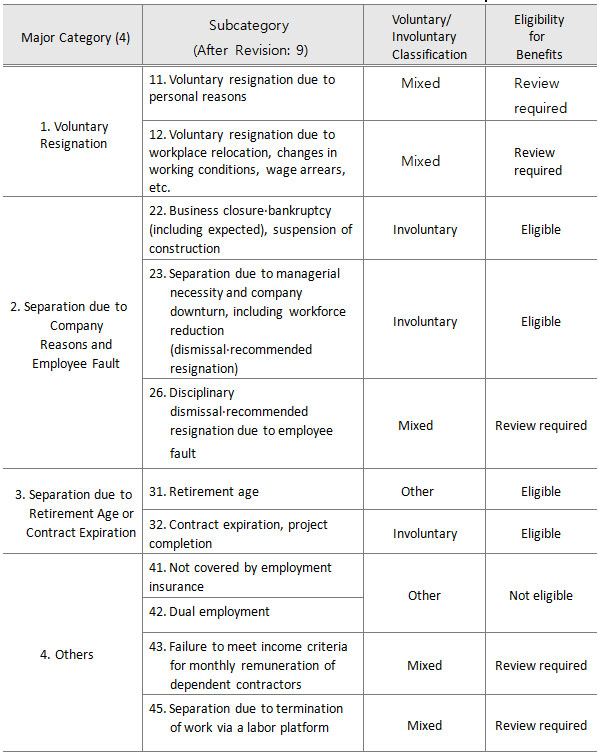
Classification of Reasons for Job Separation (Major / Subcategories)
1. Voluntary Resignation
11. Voluntary Resignation Due to Personal Reasons
① Cases where the employee leaves to move to another job
? Cases where the employee leaves to move to another job due to personal reasons such as low wages, lack of future prospects, or mismatch with aptitude, skills, or knowledge
② Cases where the employee leaves to start their own business or engage in a family business
③ Cases where the employee leaves due to marriage, childbirth, or childcare
☞ However, if resignation due to marriage, pregnancy, or childbirth is customary in the workplace, classify under ??23??
④ Cases where the employee relocates residence to live with family (spouse or dependent relatives)
? Cases where relocation is due to a family member’s workplace transfer or reassignment
? Cases where relocation is to reunite with previously separated family members
⑤ Cases where the employee leaves for children’s education
⑥ Cases where there is no workplace relocation or reassignment, but commuting becomes difficult due to personal reasons (e.g., relocation of residence)
☞ However, if commuting becomes difficult due to workplace relocation, reassignment, or long-distance transfer by the company, classify under ??12-③ or 12-⑤??
⑦ Cases where the employee leaves due to illness or injury of themselves, cohabiting family members, or relatives, making it difficult to perform duties
? Cases where the employee’s own illness or injury makes it difficult to perform assigned duties
? Cases where the employee leaves to care for injured or ill family members or relatives
⑧ Cases where the employee leaves voluntarily due to difficulty in performing duties caused by advanced age, etc.
⑨ Cases where the employee leaves voluntarily due to work-related fault, lack of ability, or decline in physical strength
? Cases where health deterioration (not necessarily a visible illness or injury) makes it difficult to perform duties
☞ However, if the employee leaves due to maladjustment caused by an unreasonable reassignment, classify under ??12-⑤??
⑩ Cases where the employee leaves for academic study or exam preparation
⑪ Cases where the employee leaves to fulfill military service obligations (eligible for benefits)
⑫ Cases where the employee leaves simply to take a rest
⑬ Cases where the employee voluntarily takes early retirement or honorary retirement (not eligible for benefits)
? Cases where resignation occurs under routine or customary retirement announcements without unavoidable necessity for workforce reduction or specific downsizing plans
⑭ Cases where the employee refuses employment succession to a newly established corporation after the closure of a business or department
⑮ Cases where the employee leaves due to unreasonable discrimination in the workplace based on religion, gender, disability, or union activities
? Cases where the employee leaves due to sexual harassment, sexual violence, or other sexual misconduct against their will
? Cases where the employee leaves due to workplace harassment under Article 76-2 of the Labor Standards Act
? Cases where the employee leaves due to exposure to risk of serious industrial accidents, where the employer failed to comply with corrective orders under Article 2(2) of the Occupational Safety and Health Act
? Cases where the employer’s business becomes illegal due to enactment or revision of laws, or begins producing or selling goods/services prohibited by law
? Other personal reasons not listed above (specify in detail)
________________________________________
12. Voluntary Resignation Due to Workplace Relocation, Changes in Working (Contract) Conditions, or Wage Arrears
① Cases where the employee leaves because business suspension or leave of absence due to company circumstances continues
② Cases where the employee leaves due to continuous non-payment or delayed payment of wages, etc.
③ Cases where commuting becomes difficult due to relocation of the workplace (place of work/service provision)
④ Cases where there is no workplace relocation, but the employee is reassigned by the employer to a location where commuting is not feasible
⑤ Cases where the employee is unable to adapt to work due to an unreasonable job reassignment by the employer that is not socially acceptable
⑥ Cases where the wages or working conditions (contract conditions) presented by the employer at the time of hiring (contract conclusion) are significantly lowered
⑦ Cases where, within the 12 months prior to resignation, wages were below the minimum wage for at least 2 months, or violations of overtime work limits under Article 53 of the Labor Standards Act continued
________________________________________
2. Separation Due to Company Reasons and Insured Person’s Fault
22. Business Closure·Bankruptcy (Including Expected), Suspension of Construction
① Cases where the bankruptcy or closure of the business is confirmed and realized, leading to separation
? Cases where the business enters legal insolvency procedures such as application for commencement of bankruptcy or liquidation
? Cases where insolvency is virtually certain, such as when dishonored bills occur and transactions with financial institutions are suspended
② Cases where the business becomes impossible due to natural disasters, etc., leading to separation
? Cases where continuation of the business becomes impossible due to natural disasters or other unavoidable circumstances
(e.g., the business site is completely destroyed by fire)
③ Cases where the business is suspended and there is no prospect of resumption, leading to separation
? Cases where business activities or construction related to the workplace are effectively halted or suspended with no prospect of resumption
________________________________________
23. Separation Due to Managerial Necessity or Company Downturn, Including Workforce Reduction
(including dismissal, recommended resignation, and contract termination)
① Cases where the employee is separated due to dismissal resulting from workforce reduction based on managerial necessity
? Dismissals carried out by establishing criteria for workforce reduction due to managerial needs such as corporate restructuring or prevention of business deterioration
② Cases where the employee is separated because employment succession is excluded during the process of business transfer, acquisition, or merger, regardless of the employee’s intention
③ Cases where the employee is separated upon accepting the employer’s recommendation to resign due to an inevitable workforce reduction based on managerial necessity, or under an employment adjustment plan or anticipated large-scale downsizing
? Cases where, as a preliminary step to collective dismissal, there is a specific workforce reduction plan and expected future personnel disadvantages, and the employee accepts the employer’s recommendation to resign
☞ However, if the separation occurs due to routine or customary early retirement or voluntary retirement announcements without unavoidable necessity for workforce reduction, classify under ??11-⑬??
? Cases where the employee accepts the employer’s recommendation to resign in anticipation of large-scale layoffs
④ Cases where the employee is transferred to a newly established corporation due to the abolition of a business or department
? Includes employment succession, outsourcing, transfers within affiliated companies or subsidiaries, and transfers from an individual business to a corporate entity
⑤ Cases where the employee is separated upon accepting the employer’s recommendation to resign due to organizational abolition or downsizing from restructuring, industry conversion, or changes in certain business operations or work types
⑥ Cases where the employee is separated due to business deterioration such as a decrease in orders or workload
⑦ Cases where the employee leaves a workplace where resignation is customary in situations such as marriage, pregnancy, childbirth, or military enlistment
⑧ Cases of dismissal without fault of the employee
(including cases where artists or service providers have no fault, but the contract is terminated at the employer’s request)
? Cases where the employer dismisses the employee despite no serious work-related fault, lack of ability, or unavoidable workforce reduction due to managerial necessity
? Cases where contracts of artists or service providers are terminated at the employer’s request without any attributable fault (such as criminal violations related to duties, causing significant business disruption or financial damage, or intentional income reduction)
________________________________________
26. Separation or Contract Termination Due to Fault of the Insured Person
① Cases where a worker is dismissed through disciplinary procedures due to serious work-related misconduct that constitutes grounds for disciplinary dismissal under employment rules or collective agreements
(including cases where contracts of artists or service providers are terminated due to their fault)
? Includes cases where, in the absence of provisions regarding dismissal procedures in employment rules or collective agreements, the dismissal is carried out in accordance with the procedures under the Labor Standards Act
- ① Cases where the individual is sentenced to imprisonment or a heavier penalty for violating the Criminal Act or laws related to their duties
② Cases where the individual causes significant disruption to the business or inflicts financial damage
(including cases corresponding to [Annex Table 1-2] under Article 101(1) of the Enforcement Rules of the Employment Insurance Act)
③ Cases where an artist or service provider intentionally reduces income (performance decline), resulting in contract termination or cancellation
☞ However, if there is no fault on the part of the artist or service provider but the contract is terminated at the request of the employer, classify under ??23-⑧??
② Cases where a worker qualifies for disciplinary dismissal due to serious work-related misconduct but voluntarily resigns upon the employer’s recommendation
③ Cases where the worker’s fault (including inadequate work performance) does not rise to the level of disciplinary dismissal, but the employer recommends resignation, leading to separation
________________________________________
3. Separation Due to Retirement Age or Contract Expiration
31. Retirement Age
① Cases where the employee retires upon reaching the retirement age as stipulated in employment rules or a collective agreement
________________________________________
32. Contract Expiration, Project Completion
① Cases where an employment contract, a culture and arts service contract, or a service provision contract expires
? Cases where a contract with a fixed term ends upon expiration of its duration
? However, in the case of a “worker,” if there are circumstances where a contract of at least one month has been repeatedly renewed such that it can be regarded as having no fixed term, the reason for separation shall be classified based on the actual reason at the time of the final contract termination
※ Even if a worker has repeatedly renewed the contract, if the total contract period exceeds two years, the worker shall be deemed an indefinite-term employee under the Act on the Protection, etc. of Fixed-Term and Part-Time Employees
② Cases where a contract expires upon fulfillment of a specified condition
? Cases where a worker enters into a contract with Company A, with the contract period defined as lasting until the termination of a service contract between Company A and Company B, and the employment contract ends upon termination of that service contract
? Cases where, at the time of concluding a culture and arts service contract or a service provision contract, the contract clearly specifies conditions for termination, and the contract ends upon fulfillment of those conditions
☞ However, even if the contract ends due to fulfillment of the specified condition, if such fulfillment results from the fault of the artist or service provider, classify under ??26-①?? (not eligible for benefits)
③ Cases where a construction contract expires
? Cases where a construction contract with a fixed term ends upon expiration of the contract period
(including cases where the project period is shortened and separation occurs earlier than expected)
________________________________________
4. Others
41. Not Covered by Employment Insurance
① Cases where the insured status is lost because the individual becomes subject to exclusion from coverage or optional coverage under employment insurance
? Cases where eligibility is lost because the individual falls under exclusion from coverage pursuant to Article 10 of the Employment Insurance Act
? Cases where eligibility is lost because the individual is no longer considered a “worker” under the Labor Standards Act
※ Example: A person who was employed as a worker is appointed as an executive or representative director of a corporation
Cases where nationality or residence status changes, resulting in a shift from mandatory coverage to optional coverage
② Cases where insured status is lost due to termination of the insurance relationship of the workplace
? Cases where approval for termination of the insurance relationship is granted for an insured person who was employed in an optionally covered workplace with approval for optional enrollment (including deemed enrollment)
③ Cases where insured status is lost due to approval of an application for withdrawal from optional enrollment
? Cases where approval is granted for withdrawal from employment insurance for an insured person who had been enrolled in a (mandatory) covered workplace with approval for optional enrollment
※ Example: Fixed-term or special-position public officials, or foreign workers approved for optional coverage, apply for withdrawal while still employed without separation
④ Cases where insured status is lost due to the individual’s death
________________________________________
42. Dual Employment
① Cases where a worker loses insured status after acquiring insured status as a worker at another workplace
________________________________________
43. Failure to Meet the Income Threshold Based on Monthly Remuneration of a Service Provider
① Cases where insured status is lost because the monthly remuneration falls below the income threshold for Employment Insurance coverage pursuant to Article 104-11(2)1 of the Enforcement Decree of the Employment Insurance Act
? Cases where, although there is no separation, insured status is lost because the monthly remuneration decreases below the income threshold required for Employment Insurance coverage
________________________________________
45. Separation Due to Termination of Service Provision via a Labor Platform
① Cases where a service provider using a labor platform loses insured status due to the termination of service provision
※ Limited to unavoidable cases where the labor platform operator is unable to ascertain the reason for the service provider’s separation
1.Employees Eligible for Unemployment Benefits
Employment benefits are paid to unemployed persons who satisfy the following two criteria: employees who had to leave a job involuntarily for reasons such as dismissal for managerial reasons, expiration of contract period, etc. after having worked at least 180 days during the last 18month period, and unemployed people who are actively seeking to become reemployed. However, unemployment benefits shall not be given in cases where an employee has left his/her job to start another job or become self-employed or in cases where the employee is separated from employment following the advice of the employer or dismissed due to reasons attributable to him/herself.
※ Cases dismissed due to critical reasons attributable to employee
1. The employee is sentenced to imprisonment (without being assigned prison labor or more severe punishment) for violating the Criminal Act or laws relating to employment;
2. The employee has, on purpose, caused a considerable hindrance to the business or inflicted any damage to property due to embezzlement, disclosure of corporate secrets, damage to property, etc.; and
3. The employee has been absent from work for a long time without due notice or justifiable reasons.
* If an employee to whom any of the above items apply resigns voluntarily at the employer's advice, he/she shall not be eligible to receive unemployment benefits.
Unemployment benefits are paid to an unemployed person when he/she reports unemployment and is recognized as an eligible recipient, and when he/she begins seeking reemployment. Therefore, this beneficiary process requires the recognition of unemployment status and evidence to prove the applicant is actively seeking reemployment for a unit period of three to four weeks. Therefore, in principle, a reemployed employee is not eligible for unemployment benefits. If an eligible recipient is employed in a job that is deemed certain to keep him/her employed for at least six months, or if an eligible recipient is deemed certain to run his/her own business for six months or more, then the reemployed person can get a certain portion (1/3 ~ 2/3) of the benefit still left as an early reemployment incentive.
In cases where an employee resigns from a company voluntarily by submitting a resignation letter or changing occupation, becoming self-employed, or going back to school, unemployment benefits shall, in principle, not be given. However, the employee can receive unemployment benefits under the following special circumstances:
※ Reasons for unemployment benefit acceptable for eligible beneficiary
(Employment Insurance Decree Regulation (Article 101(1)–Table 2, 2022.6.30.)
1. If any of the following happens within a period of two months or more within one year prior to the date of unemployment:
(1) The actual working conditions are lower than the working conditions presented at the time of hiring or the working conditions generally applied after hiring;
(2) The payment of wages is delayed;
(3) If the wage paid for prescribed work falls below the minimum wage under the Minimum Wage Act;
(4) If the restrictions on extended work in Article 53 of the Labor Standards Act are violated;
(5) Due to workplace closures, less than 70 percent of average wage is paid.
2. If the employee received unreasonable discrimination on the grounds of religion, sex, physical disability, union activities, etc. at the workplace;
3. If the employee was unwillingly subjected to sexual harassment, sexual assault, or other sexual bullying in the workplace;
3-2. In case of workplace harassment pursuant to Article 76-2 of the 「Labor Standards Act」
4. The business is certain to go bankrupt or close, or large-scale layoffs are planned;
5. If the employee is advised to terminate employment by the employer due to any of the following conditions, or if he or she leaves the job due to the recruitment of early retirement applicants pursuant to an employment adjustment plan caused by the inevitability of staff reductions:
(1) Transfer, acquisition, merger of business;
(2) Partial business abolition or business conversion;
(3) Abolition and reduction of organization by reorganization;
(4) Changes in work patterns due to the introduction of new technologies and technological innovations;
(5) Deterioration of management, congestion of human resources or other similar reasons.
6. If the employee experiences difficulties in commuting due to any of the following reasons (at least three hours are required to get to the workplace and back by ordinary means of transportation):
(1) Relocation of business;
(2) Transfer to another business location;
(3) Transfer of residence for the purpose of cohabiting with a spouse or relatives in need of support;
(4) Other unavoidable reasons for the difficulty.
7. Due to the circumstances of the company, the employee could not take vacation or temporary leave and terminated employment during the period of more than 30 days of supporting his or her parents or cohabitating relatives for sickness or injury;
8. The employee works at a workplace where, despite a “serious accident” occurring in accordance with Article 2, Item 2 of the Occupational Safety and Health Act, and a correction order received from the Minister of Employment and Labor, the company has taken no corrective actions within the given period and employees are exposed to the same danger;
9. Termination of the employee’s employment is objectively recognized based on the opinion of a doctor or the employer, etc., due to an insured worker being unable to perform given task(s) due to a lack of physical strength, physical or mental disability, illness, injury, loss of sight, hearing or tactile sense (job transfers and temporary leaves are also allowed if they are due to company circumstances);
10. The insured worker is unable to continue work due to pregnancy, childbirth, childcare of a child under the age of 8 or up to second grade in elementary school (including an adopted child), or the employer cannot allow vacation or temporary leave for the employee to fulfill his obligatory service under the Military Service Act;
11. If the details of the business of the employer become illegal due to enactment or amendment of laws and ordinances or produces or sells goods or services not illegal at the time of employment, but now prohibited by laws or regulations;
12. The employee reaches retirement age or the employee’s contract expires;
13. In addition, it is objectively recognized that other workers in the workplace under the circumstances of the insured person may have resigned.
2.Amount of Unemployment Benefit (As of 2022)
The unemployment benefit is 60% of the average wage prior to separation within the range of 120 to 270 days in accordance with the age and insured period as of separation time.
⇨ Maximum amount: 66,000 won per day
⇨ Minimum amount: daily contractual working hours x 80% of daily minimum wage; However, if the lowest amount calculated (based upon 80% of the minimum wage) is less than 60,120 won, the amount is 60,120 won.
⇨ Number of days unemployment benefits can be received
※ Reasons for extension of payment period (maximum extension is 4 years):
1) Injury or illness of the recipient (excluding injuries or illnesses for which injury and disease benefits are being paid);
2) Injury or illness of the recipient's spouse or lineal ascendants or descendants;
3) Mandatory military service under the Military Service Act;
4) Detention or execution of sentence on criminal charges; and
5) Pregnancy, childbirth, and childcare (limited to within 3 years after the birth of a child).
3.Payment Procedure of Unemployment Benefit
To receive unemployment benefits, immediately upon termination of employment, the unemployed person shall visit the Employment Support Center in his/her location with identification documents, such as a residence card or driver's license, and report unemployment. The report of unemployment shall include an application for work and an application for the recognition of eligibility for benefit. The head of the Employment Security Office shall then notify the applicant of its decision within 14 days.
① Recognition of unemployment
Recognition of unemployment means that the head of an Employment Security Office recognizes that the applicant has become unemployed and is actively seeking reemployment during a certain recognition period of unemployment, and is eligible for unemployment benefits. An eligible recipient shall present him/herself on the date of recognition of unemployment designated by the head of the Employment Security Office over the course of one to four weeks from the date the unemployment was reported, and shall report the efforts he/she has made to become reemployed, and the head of the Employment Security Office shall recognize his/her unemployment based upon the details of the report. Eligible recipients cannot receive unemployment benefits if they were not recognized as being unemployed because of a failure to report to the Employment Security Office on the day(s) required.
② Actively seeking to become reemployed
Eligible recipients shall actively seek to become reemployed (i.e., get another job) in accordance with the reemployment action plan completed on the first day of unemployment so that they can be recognized as being unemployed. Here, "actively seeking to become reemployed" means the unemployed person has taken action such as submitting job applications or participating in job interviews, and/or made efforts to become self-employed. Job-seeking activities also include submission of job applications by mail, fax or email, participation in job interviews with recruiters at a job fair, or attending occupation guidance programs conducted by the Employment Security Office.
4. Illegal Receiving of Unemployment Benefit
Unemployment benefits are payable when an applicant is recognized as an unemployed person by the head of an Employment Security Office and actively seeks to become reemployed during the recognition period of unemployment. It is illegal to receive unemployment benefits through false or fraudulent methods.
※ The most common cases of illegally receiving benefits involve a person not reporting reemployment during the recognition period of unemployment or reporting it using fraudulent information, or making a false report regarding his/her wages while employed or the reason(s) for termination.
If it is found that a person has received unemployment benefits through illegal methods, he/she shall refund the benefit received and, as a penalty, pay an additional, identical amount equivalent to the illegally received benefit. Further, his/her unemployment benefits will stop and the person concerned could face criminal prosecution. If a company manager was involved in perpetuating the illegality, the employer shall also share joint responsibility with the person.
① A small illegal benefit can be forgiven only once.
② Criminal punishment can be pursued when a person violates the law twice, where two people or more collaborate and receive benefits illegally, and in cases where a person rejects the requests to repay the illegally received benefits despite repeated demands from the Employment Security Office.
③ In cases where illegal benefits were paid due to a falsified description on the company's confirmation of severance, an additional fine (2~3 million won) will be levied against the company.