

Performance Recovery
상담 신청
Performance Recovery Program (Low Performer Management Service: Low Performer Management and Performance Improvement Program; PIP)
Today's Executive Challenge
- Organizations that neglect low performers ultimately lose key talent as well.
- Many managers say that managing low performers is one of their most difficult responsibilities.
- Low-performance issues are often left unattended because managers want to avoid uncomfortable conversations, feel burdened by legal risks, and worry about employee pushback.
- However, when low performers are neglected for a long period, the problem does not remain limited to the individual.
- It lowers the morale of sincere and diligent employees, weakens the organization's overall performance culture, and accelerates the loss of key talent.
- Excellent organizations are not those that simply remove low performers as quickly as possible.
- They are organizations that present clear expectations, provide sufficient feedback and improvement opportunities, and support growth through an objective process.
- KangNam Labor Law Firm's Performance Recovery Program is not merely a low performer management program.
- It integrates Performance Improvement, organizational Fairness, and labor-law Compliance into one process, helping organizations build a sustainable performance culture.
- Organizations that neglect low performers ultimately lose key talent as well.
- Many managers say that managing low performers is one of their most difficult responsibilities.
- Low-performance issues are often left unattended because managers want to avoid uncomfortable conversations, feel burdened by legal risks, and worry about employee pushback.
- However, when low performers are neglected for a long period, the problem does not remain limited to the individual.
- It lowers the morale of sincere and diligent employees, weakens the organization's overall performance culture, and accelerates the loss of key talent.
- Excellent organizations are not those that simply remove low performers as quickly as possible.
- They are organizations that present clear expectations, provide sufficient feedback and improvement opportunities, and support growth through an objective process.
- KangNam Labor Law Firm's Performance Recovery Program is not merely a low performer management program.
- It integrates Performance Improvement, organizational Fairness, and labor-law Compliance into one process, helping organizations build a sustainable performance culture.
Executive Insight
- The greatest risk is failing to manage low performers.
- Most labor disputes do not begin with "dismissal."
- They begin from months or years of no management at all by the manager.
- Effective low performer management is not a technique for removing people; it is leadership for developing people.
- The greatest risk is failing to manage low performers.
- Most labor disputes do not begin with "dismissal."
- They begin from months or years of no management at all by the manager.
- Effective low performer management is not a technique for removing people; it is leadership for developing people.
I. What Service Do We Provide | What Service
- KangNam Labor Law Firm's Performance Recovery Program is not simply a service for managing low performers or supporting disciplinary procedures.
- This service is linked to the organization's performance management system and prioritizes Performance Improvement. Where necessary, it helps establish solutions that both the organization and employees can accept through reasonable and fair communication and lawful procedures.
- In particular, it applies the Performance Improvement Plan (PIP) methodology widely used by foreign-invested and global companies to Korean labor law and organizational culture, helping companies reduce unnecessary labor risks while raising their organizational performance level.
Common Issues Frequently Faced by Companies
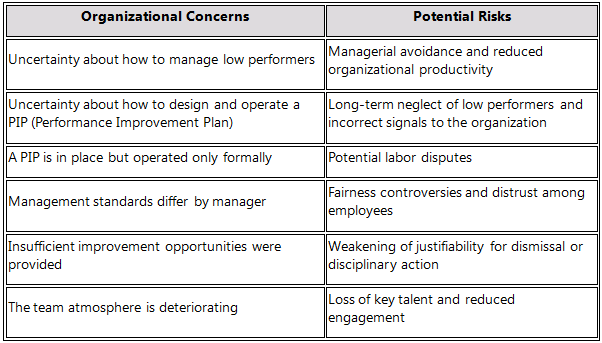
1-1. Consulting Scope
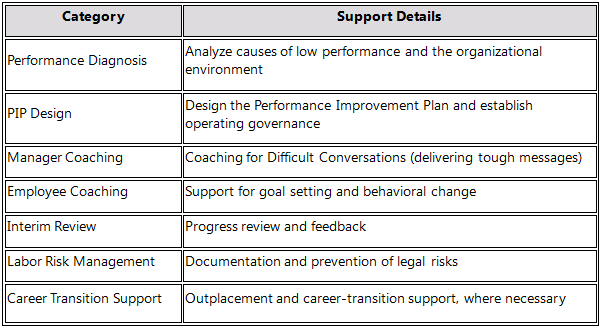
II. How Do We Deliver | How to Deliver
The core of low performer management is Fairness and Consistency.
KangNam Labor Law Firm goes beyond basic labor advisory services and designs and operates a transparent improvement process that both managers and employees can accept.
Project Process
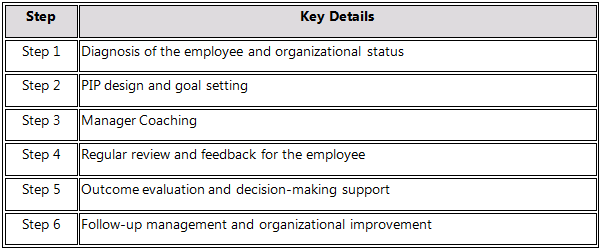
Key Management Points During Operation
ㆍDiagnose the causes of low performance from both individual and organizational perspectives.
ㆍPresent clear goals and support plans based on the premise of possible improvement.
ㆍOperate all processes based on objective records (Documented Evidence).
ㆍConduct regular feedback meetings between the manager and the employee.
ㆍSecure both procedural justifiability under labor law and organizational fairness.
ㆍWhen necessary, connect the process with Career Transition to support a positive transition for both the organization and the employee.
III. What Benefits Does the Client Receive | Client Benefits
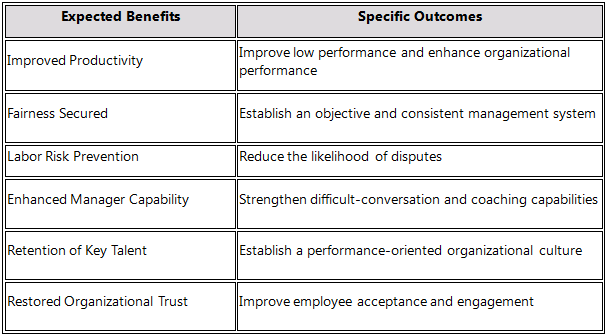
Why KangNam Labor Law Firm?
ㆍWe provide an integrated solution for Performance Improvement and labor-law risk: instead of treating a PIP as a "PIP for dismissal," we first consider a "Performance Recovery" option to restore performance, support mid- to long-term growth, and reduce labor risk.
ㆍBy combining the practical experience of Dr. Junki Han, a former CHRO of multiple Fortune Global 500 companies, with the legal expertise of a labor law firm specializing in foreign-invested companies, we provide realistic and executable solutions.
ㆍWe provide one-stop support covering manager coaching, employee growth support, Documentation, and Career Transition, thereby establishing a process that both the organization and employees can trust.
ㆍInstead of an automatic "exit" approach, we build a sustainable performance culture centered on "performance recovery and fair decision-making."
자주 묻는 질문
Q8
How does KangNam Labor Law Firm differentiate itself from general HR consulting firms or conventional labor advisory services?
A Seamless Integration of Labor Law and Human Resources
General HR consulting firms often lack strong labor and employment law capabilities, while conventional labor consultants may have limitations in designing and delivering management-oriented, globally benchmarked HR strategies.
KangNam Labor Law Firm provides a distinctive and integrated solution that combines its robust labor law expertise and dispute-prevention capabilities with the practical HR strategy experience of Dr. Junki Han, a former CHRO and senior HR executive at leading global companies, including Microsoft, eBay, and Cigna, a major U.S. financial and insurance group.
This combination enables us to provide clients with both legal risk protection and practical, business-oriented HR solutions through a single advisory platform.
A Balance Between Theory and Practice
Dr. Junki Han, Senior Advisor, holds a doctoral degree in Human Resources and Organization Management and also serves as a professor specializing in practical management education.
Through direct one-on-one counseling, business coaching, and a range of tailored strategic options, he provides practical solutions designed to improve implementation and produce tangible results in the workplace.
General HR consulting firms often lack strong labor and employment law capabilities, while conventional labor consultants may have limitations in designing and delivering management-oriented, globally benchmarked HR strategies.
KangNam Labor Law Firm provides a distinctive and integrated solution that combines its robust labor law expertise and dispute-prevention capabilities with the practical HR strategy experience of Dr. Junki Han, a former CHRO and senior HR executive at leading global companies, including Microsoft, eBay, and Cigna, a major U.S. financial and insurance group.
This combination enables us to provide clients with both legal risk protection and practical, business-oriented HR solutions through a single advisory platform.
A Balance Between Theory and Practice
Dr. Junki Han, Senior Advisor, holds a doctoral degree in Human Resources and Organization Management and also serves as a professor specializing in practical management education.
Through direct one-on-one counseling, business coaching, and a range of tailored strategic options, he provides practical solutions designed to improve implementation and produce tangible results in the workplace.
Q7
How are consulting fees determined?
Consulting fees are calculated reasonably and transparently based on the project scope, the time required, the number of participants, and the frequency and duration of the engagement.
Following the preliminary assessment meeting, we provide a customized quotation tailored to the client’s budget and specific needs, with the aim of delivering the best possible value for the investment.
Following the preliminary assessment meeting, we provide a customized quotation tailored to the client’s budget and specific needs, with the aim of delivering the best possible value for the investment.
Q6
What specifically does the “Virtual CHRO Advisory Service” provide?
This service is a hybrid, in-depth HR and organizational consulting solution that combines online and offline support with CEO business partnering and targeted coaching. It is designed for SMEs, venture companies, and foreign-invested companies that may find it difficult to maintain an independent HR department or employ a senior-level Chief Learning Officer (CLO) on a full-time basis.
At a reasonable cost, we operate as an extension of the client’s internal learning and development team by continuously planning and implementing initiatives such as annual learning master plans aligned with business strategy, core competency modeling, leadership training for team leaders and executives, and organizational culture development sessions.
For foreign-invested companies, workshops and lectures may also be delivered entirely in English by a consultant with native-level English proficiency.
At a reasonable cost, we operate as an extension of the client’s internal learning and development team by continuously planning and implementing initiatives such as annual learning master plans aligned with business strategy, core competency modeling, leadership training for team leaders and executives, and organizational culture development sessions.
For foreign-invested companies, workshops and lectures may also be delivered entirely in English by a consultant with native-level English proficiency.
Q5
What is the process for engaging the consulting service?
The consulting engagement follows a prompt and clearly structured four-step process:
1. Consultation Request
Submit the HR or labor-related issue currently facing your organization through our website or by telephone.
2. Preliminary Assessment
Participate in a one-on-one meeting with Dr. Junki Han, Senior Advisor at KangNam Labor Law Firm, to identify the organization’s specific needs and assess potential risks.
3. Customized Proposal
Receive a tailored proposal outlining the recommended curriculum, project schedule, and scope of advisory services.
4. Contract and Implementation
Following final coordination, the parties execute the consulting agreement, and the consulting or coaching project begins immediately.
1. Consultation Request
Submit the HR or labor-related issue currently facing your organization through our website or by telephone.
2. Preliminary Assessment
Participate in a one-on-one meeting with Dr. Junki Han, Senior Advisor at KangNam Labor Law Firm, to identify the organization’s specific needs and assess potential risks.
3. Customized Proposal
Receive a tailored proposal outlining the recommended curriculum, project schedule, and scope of advisory services.
4. Contract and Implementation
Following final coordination, the parties execute the consulting agreement, and the consulting or coaching project begins immediately.
Q4
Is there a specific sequence for the six services? Can each service be selected and engaged separately?
Yes. Each service may be selected and engaged separately.
Although the six services are organically interconnected, clients may choose only the programs they require, depending on their circumstances, priorities, and level of urgency. The services are therefore provided on a customized, modular basis.
For example, a company may first address an urgent issue involving a Performance Improvement Plan (PIP) or restructuring communications. Thereafter, the company may use the Virtual CHRO service to support organizational stabilization and post-project management, while gradually expanding the engagement into other necessary HR and organizational development consulting services.
Although the six services are organically interconnected, clients may choose only the programs they require, depending on their circumstances, priorities, and level of urgency. The services are therefore provided on a customized, modular basis.
For example, a company may first address an urgent issue involving a Performance Improvement Plan (PIP) or restructuring communications. Thereafter, the company may use the Virtual CHRO service to support organizational stabilization and post-project management, while gradually expanding the engagement into other necessary HR and organizational development consulting services.
Q3
How is the consulting service primarily conducted?
The consulting service is delivered through a practical, solution-oriented approach grounded in each client’s specific needs. We avoid traditional projects centered primarily on lectures or standardized reports.
Based on a thorough preliminary assessment, the engagement is conducted through a hybrid model tailored to the company’s current HR and organizational challenges. This model combines hands-on, one-on-one business coaching with the direct participation of working-level employees and leadership teams to achieve meaningful behavioral change. Depending on the client’s needs, the engagement may include interviews, workshop facilitation, individualized business coaching, and in-depth analytical reports.
Based on a thorough preliminary assessment, the engagement is conducted through a hybrid model tailored to the company’s current HR and organizational challenges. This model combines hands-on, one-on-one business coaching with the direct participation of working-level employees and leadership teams to achieve meaningful behavioral change. Depending on the client’s needs, the engagement may include interviews, workshop facilitation, individualized business coaching, and in-depth analytical reports.
Q2
Who are the primary target clients for this consulting service?
This consulting service is particularly suitable for:
Companies experiencing direct or indirect productivity issues, potential legal disputes, or conflicts among executives and employees in connection with performance evaluations and the management of underperforming employees
Companies that require discreet and orderly restructuring, as well as outplacement or career transition support for departing employees, due to deteriorating business conditions or business restructuring
Companies seeking to ensure the successful onboarding, early stabilization, and long-term performance of newly recruited or promoted executives
Small and medium-sized foreign-invested companies, SMEs, and venture companies that require high-quality organizational development solutions without establishing an independent HR department, appointing a full-time CHRO, or making a permanent executive-level hire
Companies experiencing direct or indirect productivity issues, potential legal disputes, or conflicts among executives and employees in connection with performance evaluations and the management of underperforming employees
Companies that require discreet and orderly restructuring, as well as outplacement or career transition support for departing employees, due to deteriorating business conditions or business restructuring
Companies seeking to ensure the successful onboarding, early stabilization, and long-term performance of newly recruited or promoted executives
Small and medium-sized foreign-invested companies, SMEs, and venture companies that require high-quality organizational development solutions without establishing an independent HR department, appointing a full-time CHRO, or making a permanent executive-level hire
Q1
What is the basic concept of the newly launched “Executive People Advisory Consulting” service, and what benefits can clients expect?
Basic Concept
This program combines the practical experience of a Chief Human Resources Officer (CHRO) at leading global companies with the labor and employment law expertise of KangNam Labor Law Firm. It provides senior executives and corporate decision-makers with highly customized expert services addressing critical HR and organizational development issues that they consistently recognize as important but often find difficult to manage effectively through internal resources alone.
The principal programs include performance management, underperformer management, corporate restructuring, career transition support, executive onboarding, and Virtual HRD. As a premium advisory service, the program provides one-stop solutions for managing key HR and organizational risks while developing effective growth strategies.
In addition to these programs, further customized services can be designed to address each client company’s specific needs and requested areas of support.
Expected Benefits
The service proactively prevents serious labor disputes and legal risks while strengthening leadership capabilities and stabilizing the organization. Through these measures, it supports sustainable improvements in corporate productivity and long-term organizational performance.
This program combines the practical experience of a Chief Human Resources Officer (CHRO) at leading global companies with the labor and employment law expertise of KangNam Labor Law Firm. It provides senior executives and corporate decision-makers with highly customized expert services addressing critical HR and organizational development issues that they consistently recognize as important but often find difficult to manage effectively through internal resources alone.
The principal programs include performance management, underperformer management, corporate restructuring, career transition support, executive onboarding, and Virtual HRD. As a premium advisory service, the program provides one-stop solutions for managing key HR and organizational risks while developing effective growth strategies.
In addition to these programs, further customized services can be designed to address each client company’s specific needs and requested areas of support.
Expected Benefits
The service proactively prevents serious labor disputes and legal risks while strengthening leadership capabilities and stabilizing the organization. Through these measures, it supports sustainable improvements in corporate productivity and long-term organizational performance.